

Collecting Thoughts About Long Barrows and Prehistory
The idea of building a contemporary long barrow, perhaps even here, is gaining momentum. Farmer Tim Daw has recently revived the practice at All Cannings.
This initiative offers an exciting opportunity to reconnect people with the rich heritage of these islands, provide a meaningful outlet for families during difficult times, and foster genuine cultural exchange.
With this in mind, we made a trip to Wiltshire to look at modern and ancinet monuments of stone.
The Long Barrow at All Cannings
The Long Barrow at All Cannings is a truly unique and special place. As the first new monument of its kind built in thousands of years, it offers a profound connection to the ancient past. Visitors can experience a tangible link to the Neolithic era and the people who lived and worked in this region.

The new Long Barrow at All Cannings
Stonehenge
Stonehenge, continues to captivate and intrigue visitors from around the world. Its imposing size, enigmatic purpose, and ancient age make it one of the most iconic archaeological sites in the world.

Stonehenge, and the sun
The sheer scale and complexity of Stonehenge is an account of human capacity for creativity, ingenuity, and perseverance. The massive stones, some weighing up to 25 tons, were transported from as far away as Wales. The precision with which the stones were positioned and the intricate alignments of the monument demonstrate the advanced knowledge and engineering skills of its builders.
Despite centuries of research, Stonehenge remains shrouded in mystery. Its exact purpose and the beliefs of its builders continue to be debated by scholars. This sense of mystery adds to the monument’s allure.
Avebury
Avebury Stone, is one of the largest and most enigmatic prehistoric monuments in Europe.
Again, the construction of Avebury required a monumental effort. The massive stones were transported from nearby quarries and erected with incredible precision. The intricate alignments of the stones suggest that they served a specific purpose, perhaps related to astronomical observations or religious rituals.

Avebury
Walking among the ancient stones of Avebury, one is struck by a sense of timelessness. The monument’s enduring presence connects us to the people who lived and worked here thousands of years ago. It is a reminder of the enduring power of the human spirit and our ability to leave a lasting legacy.

Standing stones at Avebury
Again, despite centuries of research, the exact purpose of Avebury remains shrouded in mystery. This sense of enigma adds to the monument’s allure and continues to draw visitors from all over the world.
Silbury Hill
Silbury Hill, is the largest artificial prehistoric hill in Europe. Its purpose and construction remain a subject of fascination and debate among archaeologists and historians.

Silbury Hill
Once again, the exact purpose of Silbury Hill is unknown. Some theories suggest that it was a burial mound, while others propose that it served as a place of ritual or astronomical observation. The hill’s massive size and symmetrical shape suggest that it was a significant undertaking for the Neolithic people who built it.
The construction of Silbury Hill, too, was a remarkable feat of engineering.
Silbury Hill is located close to Avebury Stone Circle, suggesting that these two monuments may have been part of a larger complex of ritual sites. Some archaeologists believe that Silbury Hill and Avebury were connected by a processional route, creating a sacred landscape for the Neolithic people.
West kennet long barrow
West Kennet Long Barrow is one of the best-preserved long barrows in the country and offers a glimpse into the burial practices of the Neolithic people.

West Kennet Long Barrow
The long barrow is approximately 105 meters long and 25 meters wide. It is thought to have been built around 3700 BC and is believed to have been used as a burial place for several generations.
Inside the long barrow, archaeologists discovered a number of human skeletons, as well as grave goods such as pottery, flint tools, and animal bones.
These finds provide valuable insights into the lives and beliefs of the Neolithic people who lived in this region.
Historical perspectives on the ancient stones
William Stukeley, the antiquarian, member of Corpus, Cambridge, physician and Anglican clergyman, was deeply intrigued by Stonehenge and its origins. His fascination with the monument led him to conduct extensive research and fieldwork, contributing significantly to our understanding of this ancient site.

Portrait of the English antiquarian William Stukeley
Stukeley believed that Stonehenge was built by Druids, ancient Celtic priests, and that it held clues to the lost wisdom and practices of these enigmatic people. He was also one of the first to recognize the astronomical alignments of the stones, suggesting that Stonehenge was used for celestial observations and rituals. Stukeley’s belief in Stonehenge’s connection to British identity and heritage led him to see it as a symbol of the nation’s ancient past and a source of healhy pride.
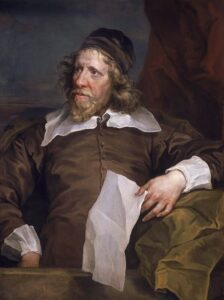
Inigo Jones, by William Hogarth, after Anthony van Dyck
Inigo Jones, a man from not too far away in Wales, and like Sir Rowland Hill a Mercer. He was a renowned architect and designer of the early 17th century, also shared Stukeley’s fascination with Stonehenge. Jones visited the site on several occasions and was particularly interested in its architectural elements. He believed that Stonehenge was a product of Roman engineering and that it demonstrated advanced knowledge of geometry and construction techniques. Jones’s admiration for Stonehenge is evident in his own architectural designs, which often incorporate elements inspired by ancient monuments.
Stukeley and Jones’s shared interest in Stonehenge highlights the enduring fascination that this enigmatic site has held for centuries. Their work has helped to preserve and promote Stonehenge’s legacy, ensuring that it remains a source of wonder and inspiration for generations to come.

Stonehenge
