


We have noticed that The King is making significant visits this week, one of which is to the diocese in which Soulton Hall can be found.
Parts of the royal itinerary resonate with ideas we have to think about at Soulton Hall because of the complex legacy of Sir Rowland Hill and the context of the 1550s when Soulton Hall was built. We are attentive to this legacy because we are guardians of a history and a legacy people care about.
This complex relationship between Rome and the English Crown, spanning the Anglo-Saxon period, the Reformation, and modern ecumenical gestures, creates a powerful narrative of continuity and healing. The King’s itinerary links two specific sites—the Basilica of St. Paul Outside the Walls and Lichfield Cathedral—through the unifying thread of early Christian history and the search for religious harmony.
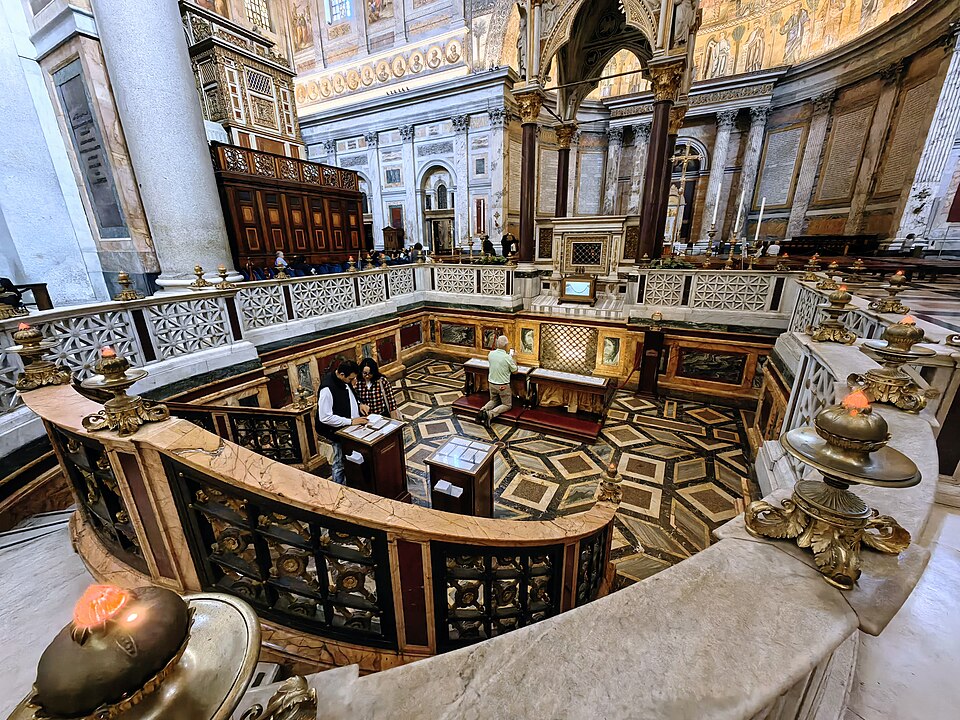
Basilica of Saint Paul Outside the Walls (Creative Commons)
The Basilica of St. Paul Outside the Walls is a monument to the undivided church. Its significance to the English monarchy stretches back to the Anglo-Saxon period, with kings like Offa of Mercia and Æthelwulf of Wessex contributing to its upkeep.
This historic link acknowledges the time of the Undivided Church, before the Great Schism and the Reformation.
The patronage by these early monarchs cemented St. Paul’s Basilica associtation with the English. The recent recognition of the current British sovereign as a “Royal Confrater” of the associated Abbey is a profound modern gesture, symbolizing the enduring and healing nature of this ancient bond, transcending the centuries of division.
The significance of the Royal visit to St. Paul’s is immediately echoed in the King’s subsequent presence at Lichfield Cathedral.
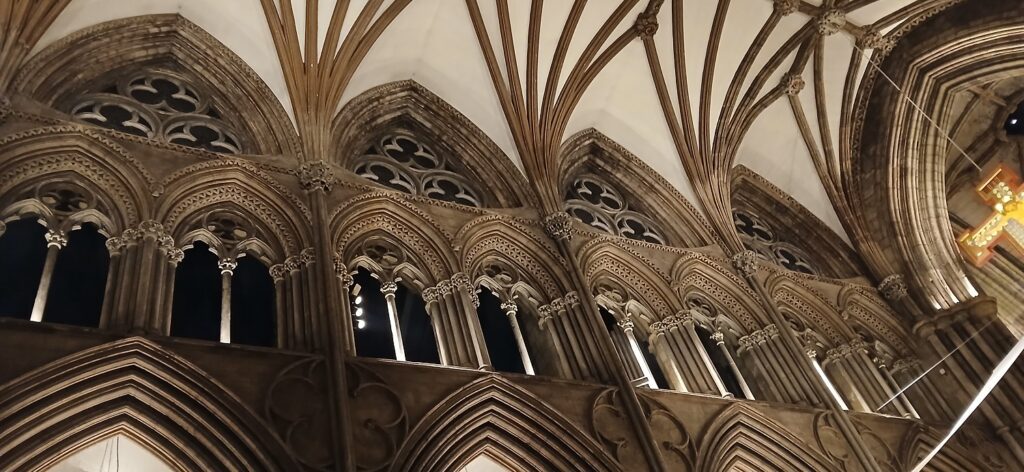
The triforium at Lichfield
Lichfield is the historic seat of St. Chad (d. 672 AD), an Anglo-Saxon monk and Bishop of Mercia—a Saint of the undivided Church.
The reinstatement of a Shrine to St. Chad at the cathedral is a remarkable ecumenical gesture. A relic of St. Chad, preserved by the Catholic Church since the Reformation, was recently returned to the Anglican Cathedral.

Image of St Chad, in the chapel of Shrewsbury School.
This shared respect and witness is a powerful sign of reconciliation and a joint commitment by the Anglican Diocese of Lichfield and the Roman Catholic Archdiocese of Birmingham to healing historic fractures, specifically by focusing on a figure revered by both traditions.
This interweaving of Anglo-Saxon heritage, Continental links, and the quest for religious harmony is directly reflected in the life and work of Sir Rowland Hill (d. 1561), the builder of Soulton Hall.
Hill’s career, straddling the tumultuous period of the Reformation, can be viewed as a focused and strategic pursuit of harmony.
As a key figure in the English Reformation, he played a foundational role in the publication of the Geneva Bible. Crucially, he was also a preservationist and humanist who provided protection for people and for the Mercers’ christ, an act of historical and communal safeguard.
His architecture and interests show a deep engagement with Anglo-Saxon history and ancient wisdom—a kind of Anglo-Saxon revival. This focus on the distant English past, including the era of St. Chad, sought to find roots for the Church that pre-dated the later division that the Reformation challenged.
As a major figure in Shropshire and the West Midlands, Hill would have been profoundly aware of Lichfield’s importance.
Furthermore, he travelled to the continent where he picked up ideas for how to build Soulton Hall and engaged with classical ideas and mathematics as a social allegory for harmony. By looking at the story of the Early Church 100o years before his own time, Hill was promoting a theological vision that, at its heart, aligns with the original ecumenical ideal—a return to fellowship and shared roots—that St. Paul’s Basilica represents through its ancient, pre-schism patronage.
In essence, the two holy sites—St. Paul’s and St. Chad’s—represent the start and the healing of the English Church’s relationship with Rome, while Sir Rowland Hill represents the critical, strategic pivot during the Reformation that sought to achieve that same sense of harmony by rooting the English Church in a powerful combination of scriptural truth and ancient Anglo-Saxon heritage.
