

The Shattering of the Medieval Commonwealth – And Its Repair
It was a pleasure ito visit a fellow Historic Houses Association (HHA) member: the magnificent Lord Leycester Hospital in Warwick, a building whose history intersects with that of Soulton Hall. This exploration focuses on the structure’s pre-foundation life and the wider context of the Reformation, embodied by the contemporary figure Sir Rowland Hill (d. 1561), and the Hospital’s later civic significance.
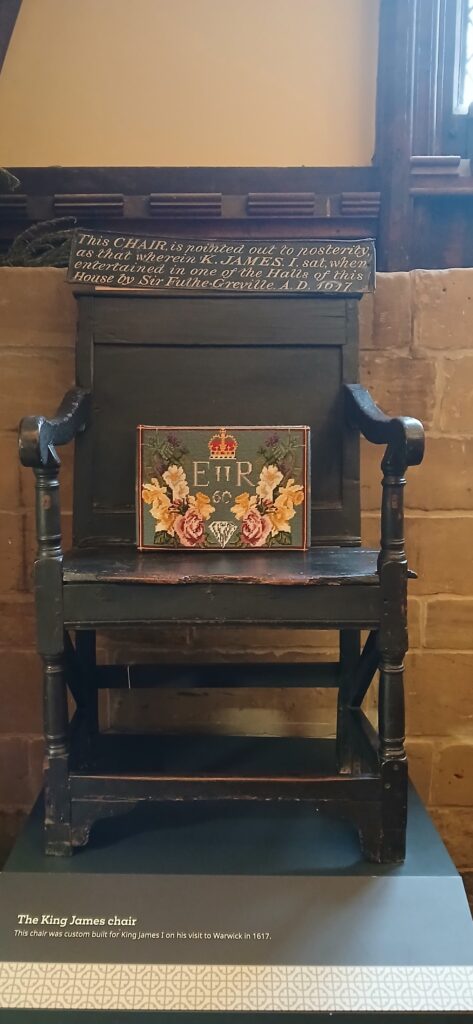
Throne for King James I (and VI) built for the purpos for Sir Fulke Grevil – The Lord Leycester Hospital – this chair is similar to the Sir Rowland Hill Chair
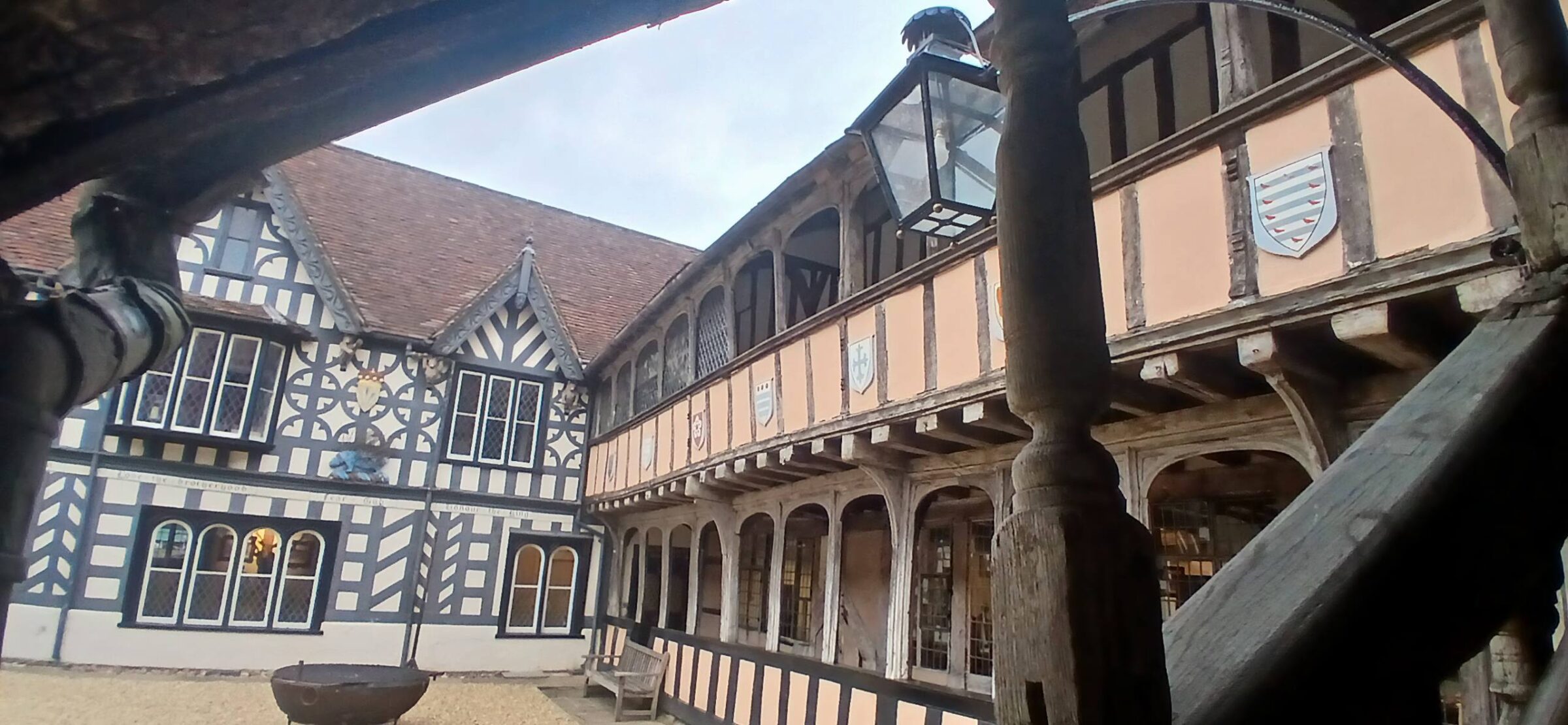
The buildings that now form the Lord Leycester Hospital were a premier example of medieval corporate architecture, not originally an almshouse, but the functional centre of Warwick’s civic life. The site’s history began with the Chapel of St James the Great (c. 1126), constructed over the town’s West Gate. By the late 14th century, the site was granted to the local guilds, who eventually merged to form the United Guilds of Warwick. Throughout the 15th century, these guilds constructed the timber-framed complex seen today, including the impressive Guildhall (c. 1450). These buildings served as the administrative, social, and charitable hub, forming the pre-Reformation ‘Commonwealth.‘
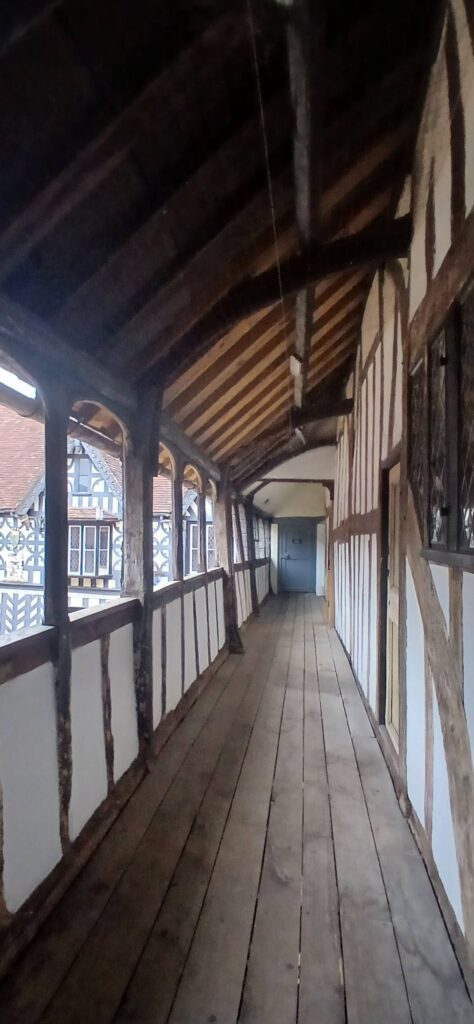
Walkway at The Lord Leycester Hospital
This medieval structure of welfare was shattered in 1546 when the English Reformation led to the dissolution of the religious guilds under Henry VIII. The Guilds’ assets were seized and their centuries-old charitable function was immediately removed. Though the wealth was expected to be transferred to the Crown, in the event the buildings themselves were transferred to the Burgesses (Corporation) of Warwick, where they served as a civic centre and school, lacking the old codified social purpose.
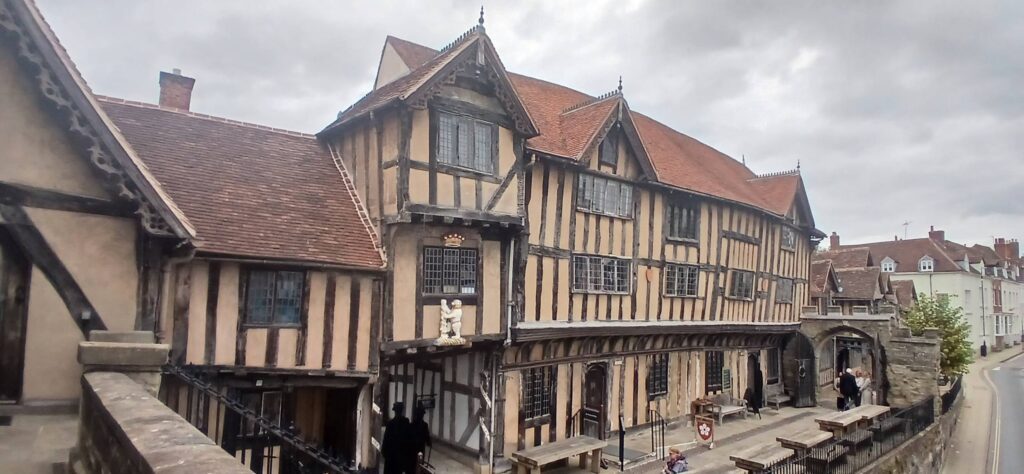
View from the Chapel of The Lord Leycester Hospital
The life of Sir Rowland Hill (d. 1561), builder of Soulton Hall and first Protestant Lord Mayor of London, exemplifies the solution sought for this crisis. He is the inspiration for Shakespeare’s noble, patriarch, “Old Sir Rowland,” in As You Like It, embodying the spirit of the Renaissance hero. Hill was an architect of the “renewal of the Commonwealth,” recognizing the vacuum left by the dissolved institutions. Hill was a prominent London Alderman and a close colleague of the Tudor elite. Crucially, Hill was a major political player whose London house facilitated a decisive political moment where John Dudley, then Earl of Warwick, and his allies of the Privy Council met in 1549 to plan the deposition of Protector Somerset, confirming Dudley’s dominance. Hill’s provision of the venue was instrumental in this fundamental shift of power. He became a driving force behind new, civic models of welfare, exemplified by his pivotal role in establishing the London Hospitals (such as Bridewell and St. Barts/St. Thomas’s), demonstrating how organized, non-monastic charity could function under the new Protestant state. His efforts provided the practical and philosophical foundation for subsequent Elizabethan foundations.
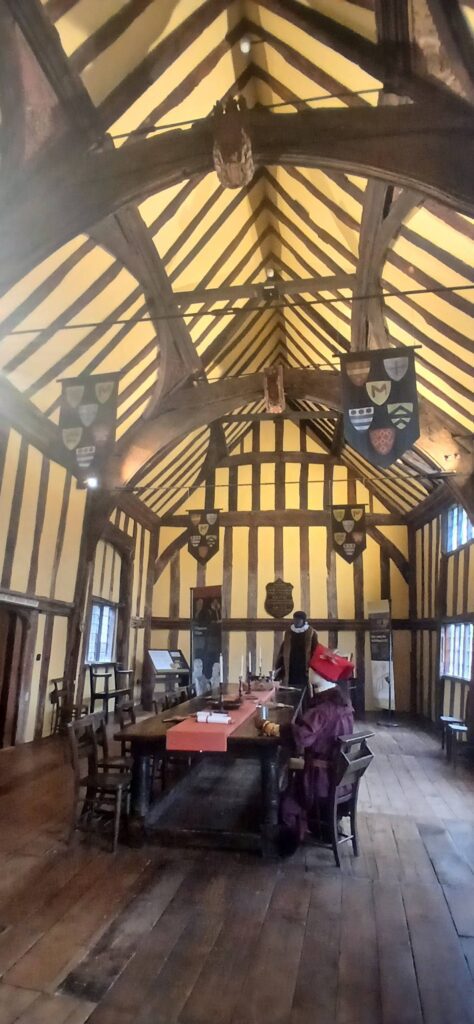
Upper Hall in View from the Chapel of The Lord Leycester Hospital
The ultimate fate of the Warwick Guildhall perfectly embodies this renewed commitment to the Commonwealth, specifically through the work of a man whose family was so closely linked to Hill. The Lord Leycester Hospital was founded by Robert Dudley, 1st Earl of Leicester (d. 1588), Queen Elizabeth I’s great favourite. Robert Dudley was the son of John Dudley, Duke of Northumberland (executed 1553), the man who had benefited directly from Hill’s support to seize control of the government. In 1571, Robert Dudley acquired the Guildhall buildings and formally established the Lord Leycester Hospital. The term ‘Hospital’ is used in its ancient sense—an almshouse providing sanctuary.
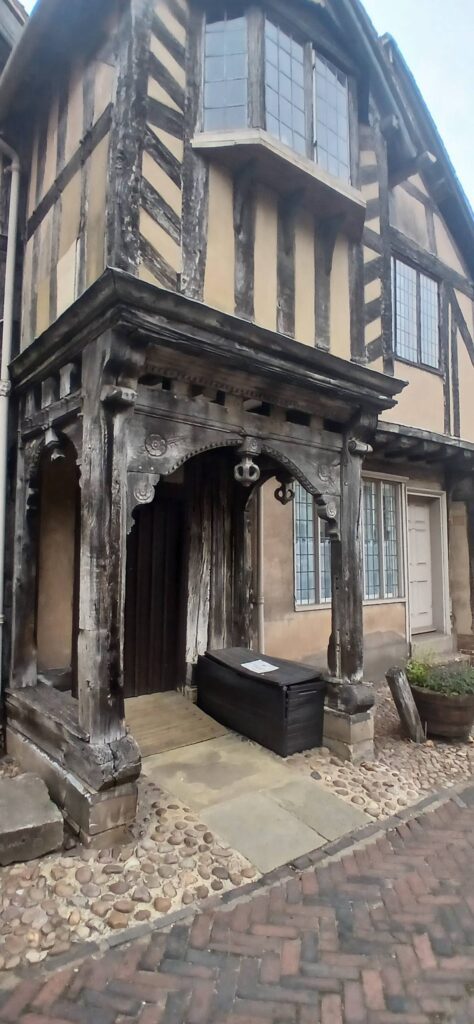
Doorway at The Lord Leycester Hospital
The foundation was for a Master and twelve Brethren, specifically disabled former soldiers who had served the Crown, offering them a dignified retirement funded by the endowment. Dudley’s act was a powerful move to restore the social fabric. By repurposing the physical structure of the dissolved guilds, he created a stable, permanent institution based on the principles of civic responsibility and codified good works. This represented the successful establishment of a renewed Commonwealth and its social obligations in the post-Reformation era.
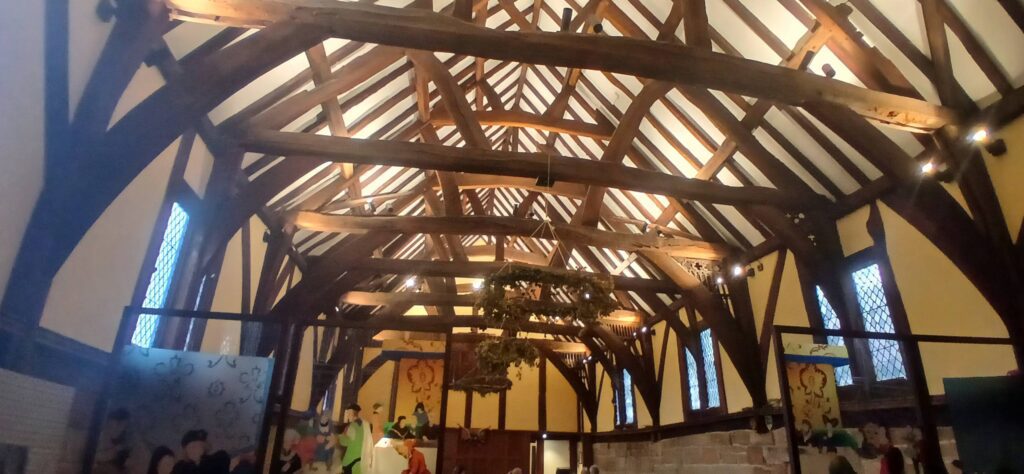
The hall – now a cafe – at The Lord Leycester
Decades after its foundation, the Hospital played a crucial role in royal entertainment. In 1617, King James I (and VI of Scotland) visited Warwick. Due to renovations at Warwick Castle, the royal banquet had to move to the Hospital’s magnificent Great Hall. This three-day party was lavishly furnished, including a specially commissioned banqueting chair for the King, which still resides there today. The expenses incurred by the town to host James I were so ruinous that the debt from the banquet took the Corporation an astonishing 10 years to pay off. This event highlights the complex financial burden and civic duty that came with royal patronage during the period.
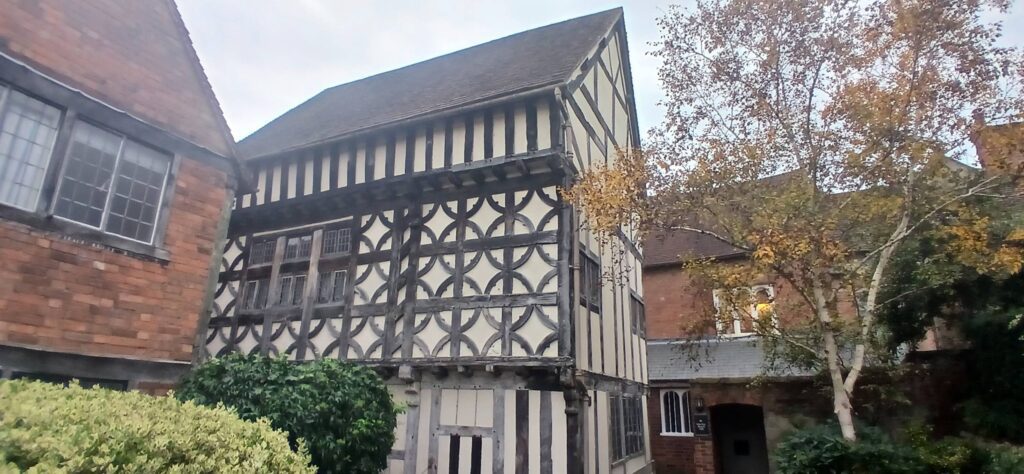
Clever timber framing at The Lord Leycester
Today, the Lord Leycester Hospital remains a living institution, its original charitable function intact.
It is a powerful site that resonates with the broader efforts of the Tudor and Stuart eras, in which figures like Sir Rowland Hill, the Renaissance hero, were indispensable.
