


From Swiss Sanctuary to American Revolution: A Theopolitical Journey
As our friends in America mark July 4th, Independence Day today, our thoughts might naturally turn to fireworks, barbecues, and celebrations of freedom across the Atlantic.

Tybee Island, Georgia July 4 fireworks. (Creative Commons)
But beyond all the fanfare, this day commemorates some pretty big ideals:
- equality,
- unalienable rights,
- the consent of the governed, and
- the right to resist tyranny.
These have surprisingly deep and complex roots, stretching back centuries to a quiet corner of Europe, and to a book that once sat in many an English and American home.
Here at Soulton Hall, where history truly comes alive, we are always required to investigate the intricate tapestry of the past.
So, today, let us actually pull a very specific thread from the American Revolution right back to the intellectual ferment of the mid-1500s. We are talking about Geneva, Switzerland, and then, crucially, its connection right back to England, to our part of Shropshire in particular, and the profound influence of the 1560 Geneva Bible.
First, let us imagine England in the mid-1550s.
Queen Mary I, “Bloody Mary,” was on the throne, relentlessly pursuing the restoration of Catholicism.

“Old” Sir Rowland recovered from a period of disfavor enough to sit as a judge in treason proceedings… but all the while, he was working on publishing that would have horrified Mary I.
Many English Protestants, facing awful persecution, actually fled abroad for their lives. These were the famous Marian Exiles (though it is clear that others were hidden somewhere here in England too, even very close by perhaps…).
We know very well that Geneva was the principal English Protestant stronghold on the continent, under the rigorous influence of John Calvin.
Geneva was not merely just some kind of somewhat safe haven; it was a living, breathing laboratory for truly radical ideas.

Renaissance Geneva
The exiles there were absolutely intent on building a society grounded in biblical principles, not just religiously but politically and socially. This environment was midwife to some really profound concepts that would later underpin revolutionary thought:
- Covenant Theology: This was the idea that God enters into mutual agreements, implying reciprocal obligations. This was actually extended to politics, suggesting a covenant between rulers and the ruled, where both had clear duties.
- The Right to Resist Tyranny: Perhaps this was the most revolutionary concept of all. Going completely against the prevailing doctrine of the divine right of kings, some Reformed thinkers argued that if a ruler violated God’s law or their covenant with the people, resistance – even outright rebellion – was not just allowed, but a sacred duty.
- Representative Governance: While not a democracy as we know it today, Geneva’s system of elected councils offered a complete contrast to absolute monarchy, emphasizing shared governance and accountability.
Into this charged atmosphere came the Geneva Bible.
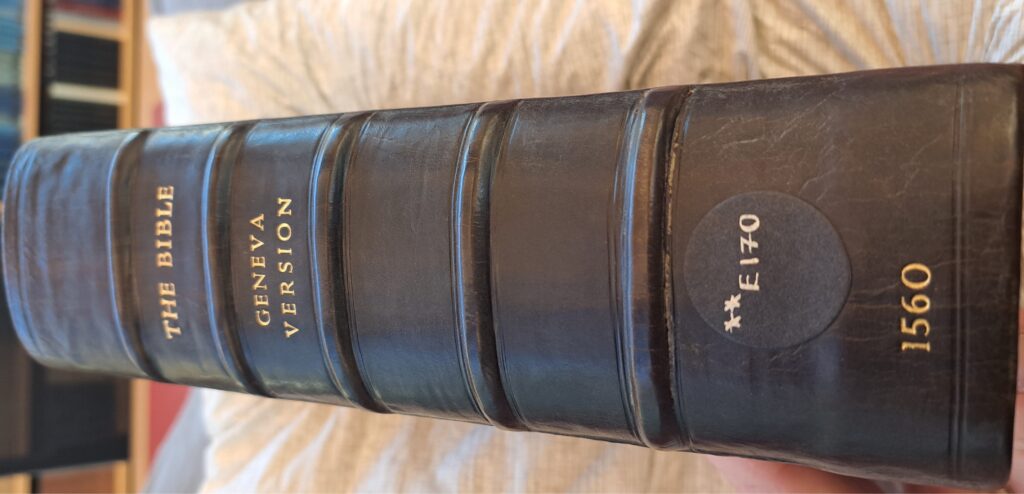
1560 Geneva Bible in Lambeth Palace Collection
Published in its complete form in 1560, it became the Bible of choice for generations of English Protestants – including, and this is key, the Pilgrims who sailed on the Mayflower and countless other early American settlers.
What made it so revolutionary, and so influential for American independence?
- Accessibility: It was genuinely easy to read, with clear Roman type, those brand-new verse divisions (a real novelty at the time!), and a compact, affordable format. This truly democratized access to scripture, encouraging individual interpretation.
- Radical Marginal Notes: This was its true, subtle power. The extensive commentary in the margins, penned from a strong Reformed perspective, certainly did not shy away from political commentary. It often labelled oppressive rulers as “tyrants” and explicitly supported the right to resist those who acted against divine law or the welfare of the people. This provided a powerful theological justification for challenging temporal authority. Consider, for example, the narrative of Moses in Exodus. Pharaoh’s decree was to kill all Hebrew male infants. But Moses’s mother, understanding that the will of the divine was for her son to live, put him into the basket, demonstrating an act of profound faith and resistance to Pharaoh’s cruel command. The Geneva Bible’s interpretive notes would have reinforced this: in a tension between the will of God and the will of a temporal ruler, one must follow one’s values and the divine. This very principle empowered readers to perceive their own struggles against oppressive authority as a righteous, divinely sanctioned act.This very principle empowered readers to perceive their own struggles against oppressive authority as a righteous, divinely sanctioned act. This profound connection between biblical narrative and political ideal found further expression: it is noteworthy that Benjamin Franklin, a prominent Founding Father, designed a proposed Great Seal for the nascent country that explicitly mirrored the flight of the Israelites, with the divine showing itself to part the Red Sea, enabling escape from the furious pursuit of Pharaoh.

Franklin’s Design foteh Grea Seal of the Unites States
This imagery was prominently featured on the frontispiece of the Geneva Bible itself, serving as a powerful visual testament to the Bible’s inherent conversation with the tides of ideas concerning liberation from tyranny and the exercise of divine providence in human affairs. Indeed, the Geneva Bible would have been regarded by many of the Founding Fathers as a constitutional text itself, foundational to how society should be governed in accordance with higher laws.

Thomas Jefferson’s design description for the Great Seal. Courtesy Library of Congress.
- Influence on Language and Thought: Its vigorous language shaped the minds and tongues of figures from William Shakespeare to John Milton, and its anti-authoritarian message became deeply embedded in the colonial mindset.
And here is where it links back directly to us: that 1560 edition of the Geneva Bible was published in ways that are definitively linked to our own Old Sir Rowland here at Soulton Hall. Historiography holds him as oe of its a key figures, indeed as the publisher. Without his support, it is just inconceivable that it would have been able to get across the continent, shipped into England, and become part of the new Elizabethan religious settlement, eventually becoming the Bible quoted by Shakespeare himself.
And other linked books are important in this intellectual journey too: The “Laws of Geneva” themselves refer to the wider system of governance and societal principles established in Geneva. These were not just religious edicts, but a kind of blueprint for a self-governing community, heavily emphasizing civic virtue and widespread education – vital for any informed citizenry, really.
So, when the American colonists gathered in Philadelphia in 1776 to declare their independence, the ideals they articulated were not born out of thin air:
- The assertion that rights are “unalienable” and derived from a “Creator” directly echoes the Geneva Bible’s emphasis on God’s law as supreme over kings.
- The concept of government deriving its “just powers from the consent of the governed” directly parallels the Genevan idea of a covenant between ruler and ruled, contrasting sharply with absolute monarchy.
- And the profound right to “alter or to abolish” a tyrannical government found its theological bedrock in those very resistance theories forged in Geneva’s crucible decades prior.
So, as the rockets glare and the fireworks burst this July 4th, let us remember that the American pursuit of “Life, Liberty and the pursuit of Happiness” is not solely an 18th-century invention.
It is a narrative drawing deep sustenance from the intellectual ferment of Renaissance emergence in England in the mid-1500s, nurtured by texts like the Geneva Bible – with its surprising and very local connection – and ultimately brought to life by those who truly believed the kind of freedom that was being explored 200 years before.
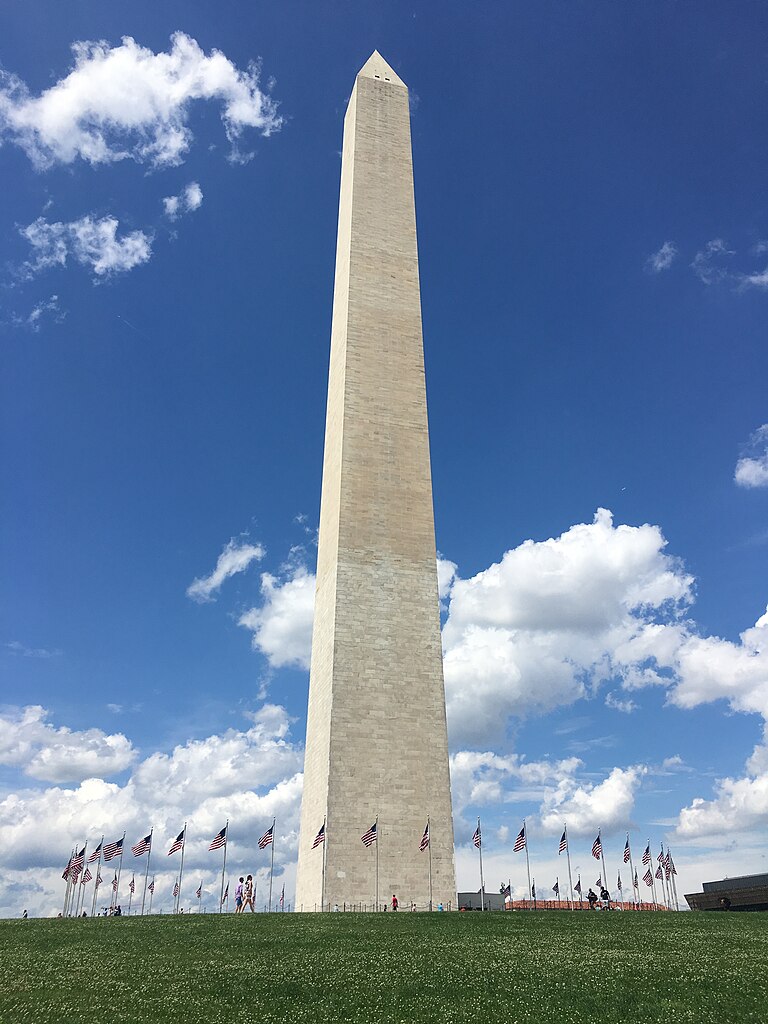
Washington Monument Washington DC
