

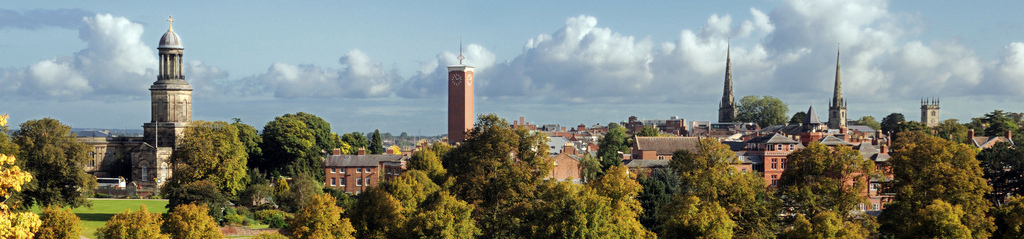
A visit to the wonderful town of Shrewsbury today provides reason enough to look over it’s history, which is an important contex for Soulton’s own story.Â
This blog looks at the town’s foundations up to the English Civil War. It is a story of enduring cultural continuity.Â
********
Beautiful #ancient #shrewsbury today. pic.twitter.com/Cu2AXZ4h3B
— Soulton Hall (@SoultonHall) January 25, 2021
Shrewsbury has a history as forecful and as enduring as River Severn that flows through its heart. This blog post considers into the town’s fascinating past, from its prehistoric roots to its early modern prominence.
Prehistoric Footprints
Shrewsbury’s history stretches far beyond the written record, but archaeological discoveries paint a picture of human activity in the area dating back thousands of years. For instance, in 2017, excavations near the medieval Church of the Holy Fathers in Sutton Farm unearthed evidence of a Neolithic religious site. This remarkable find suggests Shrewsbury boasts Britain’s oldest place of known continious worship, pre-dating 2,000 BC. Further proof of early settlement comes from the discovery of an Iron Age double ring ditch at Meole Brace.
Roman and Post-Roman Crossroads
During Roman times, Shrewsbury thrived as a roadside settlement along a major military road, though it was overshadowed by its neighbour at Viroconium (Roman Britain’s fourth largest city). The road to Chester from that once great city ran through Soulton at this time.
After the Roman withdrawl, Viroconium withered as the poet put it:
The gale, it plies the saplings double,
And thick on Severn snow the leaves.‘Twould blow like this through holt and hanger
When Uricon the city stood:
…Then, ’twas before my time, the Roman
At yonder heaving hill would stare:…
Then ’twas the Roman, now ’tis I.
– ‘A Shropshire Lad’, A. E. Houseman.
After the Roman withdrawal, the town’s strategic location ensured its continued importance.
Pengwern and Saxon settlement
Shrewsbury’s formal foundation is certainly Saxon (if not earlier), and there is a tradition that the town was “founded in the 5th century, on occasion of the decay of the Roman Uriconium”. The 14th/15th century Historia Divae Monacellae, holds that Brochwel Ysgithrog, the 6th-century king of Powis, had a palace at Shrewsbury in the 500s CE that became the site of the foundation of St Chad, This is understanding shared by the 12th century Welsh cleric Caradoc, of Llancarvan who is recorded as saying:
‘Brochwel Yscithroc… dwelt in a towne then called Pengwerne Powys, and now Salope, whose dwelling house was in the verie same place where the College of Saint Chad now standeth’.
– The historie of Cambria, now called Wales… translated into English by H. Lhoyd Gentleman: corrected, augmented, and continued out of records and best approoued authors, by Dauid Powel Doctor in diuinitie”.
Considering these accounts is worthwhile, for they suggest, if accepted, that Shrewsbury was developing civic and scholastic institutions even before the fall of Roman Uriconium. This raises the possibility of institutional and cultural continuity between the Roman life and institutions which continued unbroken to the Reformation when they were reconstituted (work in which Sir Rowland Hill was involved in).
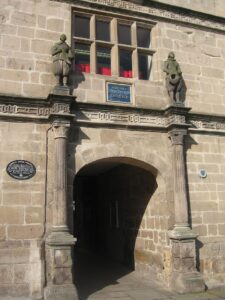
The entrance to the Old Shrewsbury School buildings – an institution renewing Saxon educational traditions. Sir Rowland Hill helped establish it to replace the collegiate teaching lost during the Reformation.
Some claim Shrewsbury was once Pengwern, the capital of the Kingdom of Powys (a polis established by the 440s). By the late 8th century, Offa, the Mercian king, is credited with fortifying Shrewsbury and possibly establishing the town’s first church dedicated to St Chad. This period also saw the town becoming a mint, minting coins for the royal government.
In the 10th century, Alfred the Great’s daughter Æthelflæd, the ‘Lady of the Mercians,’ further bolstered Shrewsbury’s defenses, recognizing its pivotal role in the face of Viking raids. The town also became the new home for the relics of St Alkmund.
The arrival of the Normans in 1066 marked a significant shift. Roger de Montgomery, gifted the town by William the Conqueror, upgraded the Castle (Archaeological excavations have revealed Saxon fortifications) and founded Shrewsbury Abbey. The town’s position on the edge of a densely wooded area added another layer to its strategic importance.
Shrewsbury witnessed its share of power struggles. Rebellions, royal visits, and the housing of relics like those of St Winifred became part of the town’s narrative. The early 12th century saw the town changing hands in rebelions, and witnessed the establishment of hospitals dedicated to St Giles and St John the Baptist.
The town and Shropshire more widely played a crucial role in the conquest of Wales by Edward I, indeed In 1283,Edwards summoned a parliament in Shrewsbury to judicially process Dafydd ap Gruffydd, last of the native Princes of Wales.
In 1394 the “Great Fire of Shrewsbury” in ravaged the town, followed by a 1398 Parliament of Richard II’s meeting, it is thought, within the Abbey.
Just a few years later, in 1403, the Battle of Shrewsbury was fought a few miles north of the town – an event William Shakespeare would set the last two acts of his history play, Henry IV, Part 1, around.
First established in the 1457 by Henry VI, and reestablished during the 1470s by Edward IV, the Council of Wales and the Marches had headquarters in Shrewsbury as well as at the Castle at Ludlow. The presence of this entity in the town was important for the influence of the area, because the court of the heir to the throne was focused on this territory. Moreover, according to historian John Davies, at its peak in the mid-16th Century, this Council:
“represented a remarkable experiment in regional government. It administered the law cheaply and rapidly; it dealt with up to twenty cases a day and George Owen stated that the ‘oppressed poor’ flocked to it.”
The 15th century also witnessed the birth of Richard of Shrewsbury, one of the Princes in the Tower tragedy. Henry Tudor, on his way to the Battle of Bosworth Field, was briefly denied entry into Shrewsbury before being allowed access. After he took the throne, this first Tudor monarch, along with his wife and son Prince Arthur, enjoyed a celebratory visit to Shrewsbury for the Feast of St. George in 1490, and the town warmly welcomed him again in 1496.
Henry maintained excellent relations with Shrewsbury, frequently returning for visits where the Bailiffs would host grand feasts in their honor. The national identity built around chivalric ideals remained strong into 16th century, when Sir Henry Sidney marked St. George’s Day in the style of Windsor at Shrewsbury in 1581: a procession led from the Council House to a St. George’s Chapel-inspired choir at St. Chad’s Church, followed by a celebratory feast.
Shrewsbury suffered a major outbreak of sweating sickness in 1551. Dr. John Caius, summoned by the town council, treated the sick. Upon returning to London, he wrote ‘A Boke or Counseill’ (1552), the leading source on the disease (now believed to be influenza), dedicated to the council president.
During the English Civil War, Shrewsbury remained a Royalist stronghold. It served as a temporary base for Charles I and Prince Rupert, who established his headquarters in the town. The town eventually fell to Parliament forces, marking a turning point in the conflict.
