

Soulton Shakespeare and the Symbolism of Salvation in As You Like It
Shakespeare’s As You Like It often sweeps us away to the idyllic Forest of Arden, where love blossoms and we miss the other forces at work in the drama.
But for Oliver, Orlando’s villainous elder brother, his journey into this pastoral setting is far from a leisurely escape. The dramatic turning point of his transformation – his perilous encounter with a snake and a lioness – is a scene so potent it has captivated audiences and artists for centuries.
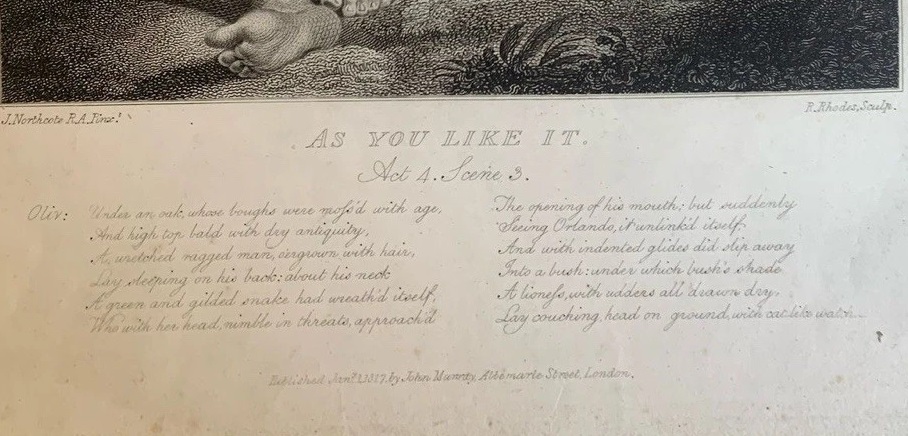
Indeed, the enduring power of this moment is beautifully captured in historical artworks, such as the engraving of As You Like It by R. Rhodes, after James Northcote RA, published in 1815 by John Murray, am item found in the Soulton Hall collection, which has a number of As You Like It items on account of this place’s deep connections to the play.
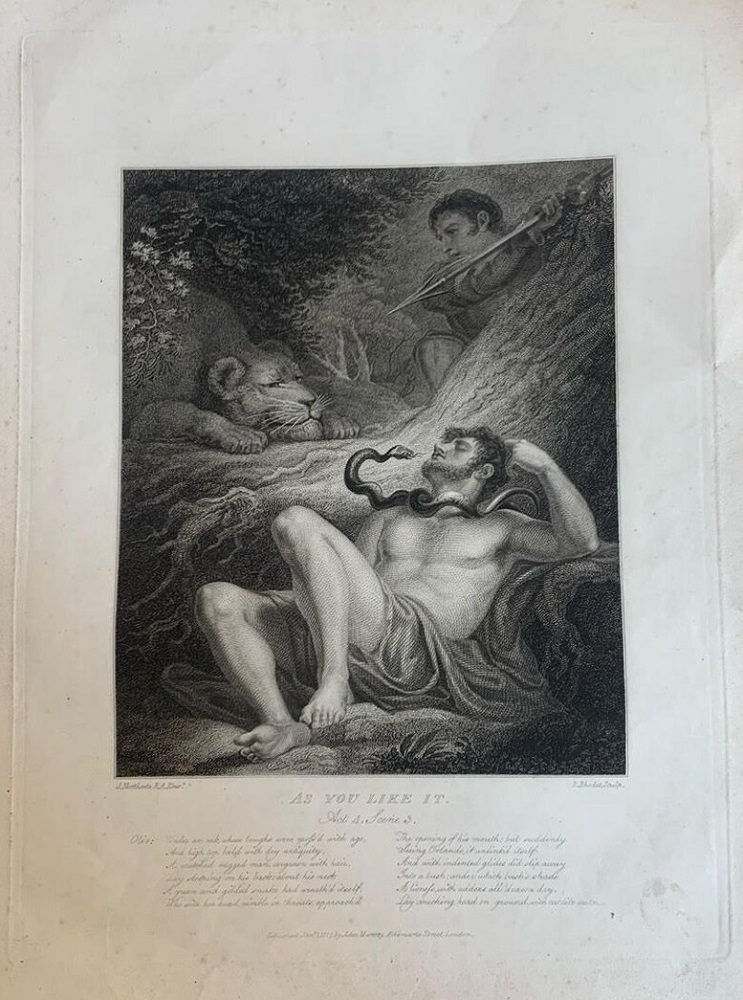
Engraving of Oliver under atack from a lion and a snake with Orlando about to save him AS YOU LIKE IT by R. Rhodes, after James Northcote RA, published in 1815 by John Murray.
This 19th-century engraving, created decades after Shakespeare’s death, serves as a compelling testament to how this particular scene resonated with the sensibilities of the Regency era. It highlights the lasting artistic and moral impact of Oliver’s ordeal and subsequent redemption, prompting us to revisit and re-examine its profound symbolic meaning.
Having lived a life consumed by envy and malice, Oliver is a man of profound moral corruption. His banishment from Duke Frederick’s court, with the harsh command to find Orlando, effectively casts him out into the “wild.” He enters Arden not as a romantic hero, but as someone burdened by significant moral wrongs. It’s here, in a moment of vulnerability, that Oliver experiences his most striking symbolic encounter: while asleep under an oak, he is threatened first by a snake coiling around his neck, and then by a lioness preparing to pounce. Far from mere plot devices, these animals are potent symbols…
The snake directly calls to mind deceit, treachery, and poison. For Oliver, this isn’t just an external threat; it’s a terrifying manifestation of his own insidious malice and the “poison” that has corrupted him. He is literally confronted by the symbolic representation of his past wickedness, threatening to consume him.
The lioness, meanwhile, represents fierce, untamed passions and perhaps even a form of raw, natural justice. In this seemingly pure, primal setting, such a creature symbolizes the brutal consequences of Oliver’s unchecked aggression and moral decay. A lioness, udders dry and barren, embodies a lack of mercy. Without the milk of nurturing, her hunt is purely predatory. She is nature’s brutal efficiency, where compassion has no place. A primal force ready to exact a toll for his “fallen” state.
Oliver, unconscious and utterly helpless, is trapped by these archetypal figures that embody his own internal corruption and the external consequences of his actions. But crucially, it’s Orlando, the brother he so cruelly wronged, who intervenes, bravely saving him from both dangers. This selfless act is the turning point.
Orlando’s unexpected grace doesn’t just save Oliver’s life; it catalyzes his profound moral awakening. Saved from the “serpent” and the “beast” of his own making, Oliver awakens with a transformed heart, ready to shed his past. His near-death experience, mediated by Orlando’s unconditional love, becomes a symbolic purification. He sheds his old, “poisonous” nature, much like a snake sheds its skin, and embraces a new, virtuous life.
This dramatic escape from the jaws of death echoes powerful narratives of divine intervention. One might recall the biblical account of Daniel in the lions’ den, where the righteous prophet is miraculously preserved from harm. While Oliver is no Daniel, his survival, mediated by Orlando’s selfless act, similarly highlights the possibility of deliverance even from overwhelming danger. It suggests that just as Daniel’s faith was proven through his trial, Oliver’s near-fatal encounter with the lioness precipitates a profound internal shift, allowing him to overcome the destructive forces of his past.
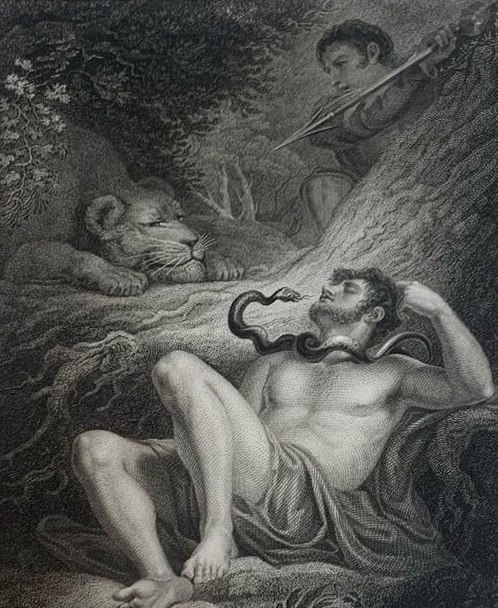
Engraving of Oliver under atack from a lion and a snake with Orlando about to save him AS YOU LIKE IT by R. Rhodes, after James Northcote RA, published in 1815 by John Murray.
Ultimately, this scene in the Forest of Arden underscores Oliver’s journey from moral darkness to redemption. It shows how confronting the harsh realities, embodied by these wild animals, and experiencing profound grace can lead to a complete transformation, allowing him to leave behind his past and embrace a new beginning.
Readers are always welcome to explore their own interpretations (which certainly exist) of this rich encounter, uncovering further nuances in Oliver’s dramatic escape from the jaws of death and his subsequent, unexpected redemption.
