

Soulton Wood & Fictional Arden: Spaces for Contemplation and Transformation
From the verdant ‘desert’ of Arden in Shakespeare’s play to the spiritual journeys of St. Brendan and the trials of The Magic Flute, literature, drawing from scripture and mythology, is filled with stories of transformative spaces, or heroes’ journeys. This blog explores how these narratives illuminate our understanding of Soulton Wood, a real-life location with deep literary connections.

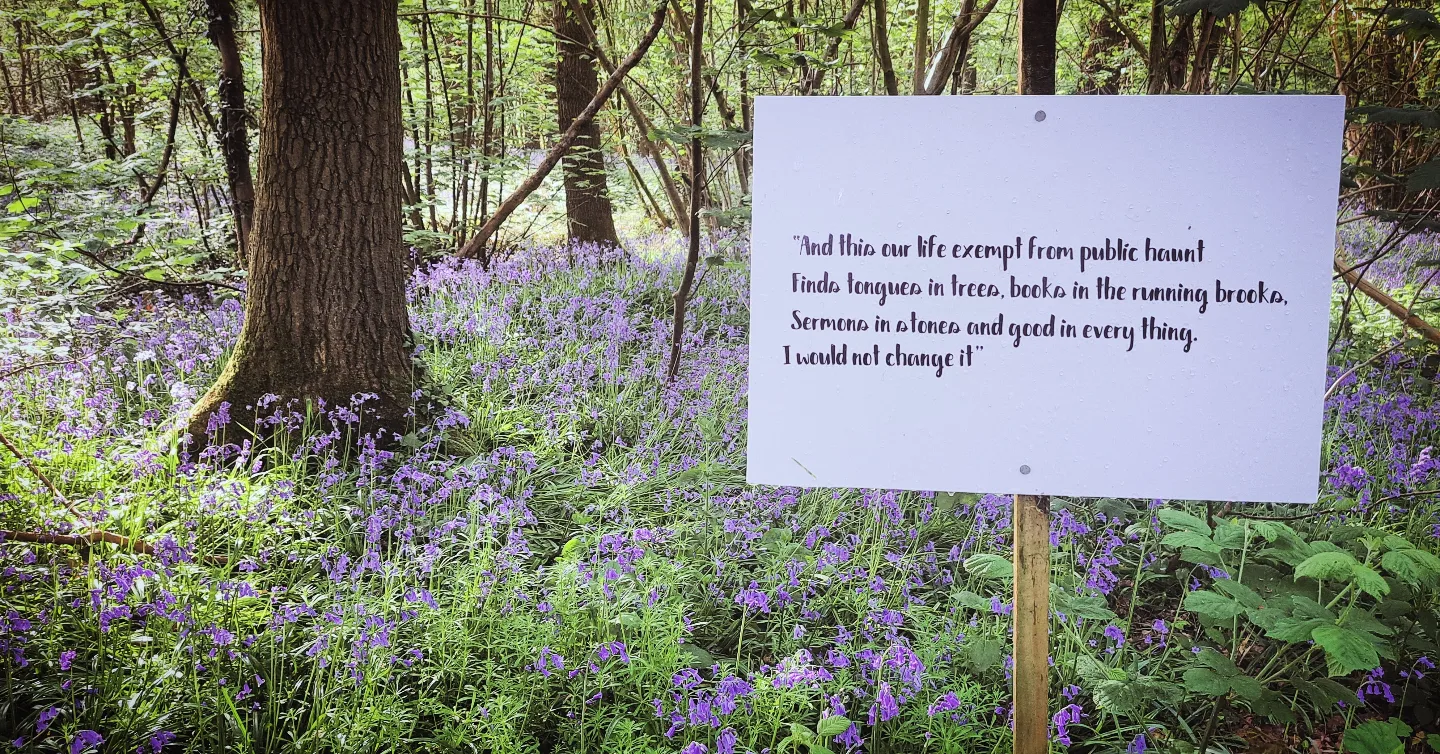
Early Bluebells in Soulton Wood, the AS YOU LIKE IT wood
How should we (and do we) approach Soulton Wood, given its associations? (Please note access is managed and it is private land).

The Forest of Arden is central to Shakespeare’s ‘As You Like It’: it is a realm of transformation and harmony. Inspired by Thomas Lodge’s Rosalynde (1590), which found its roots in Soulton Wood, on the Lodge family estate, and then the estate of ‘Old’ Sir Rowland Hill. The local of Soulton Wood thus connects these two pivotal texts.
Shakespeare’s Forest of Arden, repeatedly termed a “desert,” presents a curious paradox:
It is verdant and abundant.
BUT
It is menacing and some kind of desert.
So is it truly a place of mere pastoral escape, or is it something more? We are dealing with Shakespeare, so of course, it can be (and is) more than one thing at once.
********
An interesting way to see it is as a symbol, or a testing ground where not just the artifice of courtly life but indeed nearly all of the wider rigid social lattice we are used to is thoroughly stripped away and critiqued, revealing the raw, unadulterated self in a kind of vacuum:
..venison?
… it irks me the poor dappled fools,
Being native burghers of this desert city,
Should in their own confines with forked heads
Have their round haunches gored..
Thinking of it his way, you might find a parallel with the Magic Mirror Gate in The NeverEnding Story.

Film poster for The NeverEnding Story
But, in contrast to the terrifying, illusion-filled experiences of Atreyu’s trials, Lodge and Shakespeare’s ‘desert’ forest presents an introspective challenge, a space devoid of social connection. While modern discourse might frame this as mindfulness or applied psychology, historical perspectives evoke retreat, pilgrimage, or the solitary Arthurian quests—resonating, incidentally, with our own Shropshire landscape.
Shakespeare’s repeated use of “desert” to describe the Forest of Arden is not really a geographical descriptor at all (and it is unhelpful to misunderstand him as using the word that way), but rather a profound commentary on the characters’ state of being. He is invoking the older, more archaic meaning of “desert” – not as a traditional wasteland, but as an act of forsaking, akin to deserting one’s post in the army or abandoning a spouse. Arden, in this context, becomes a space where characters have, in essence, deserted (or been deserted by) their former lives:
… Sir, fare you well:
Hereafter, in a better world than this,
I shall desire more love and knowledge of you.
Orlando is worryingly depressed, and needs to escape the compressive and humiliating nature of his environment:
punish me not with your hard thoughts; wherein I confess me much guilty, to deny so fair and excellent ladies any thing. But let your fair eyes and gentle wishes go with me to my trial: wherein if I be foiled, there is but one shamed that was never gracious; if killed, but one dead that was willing to be so: I shall do my friends no wrong, for I have none to lament me, the world no injury, for in it I have nothing; only in the world I fill up a place, which may be better supplied when I have made it empty.
All of this is setting the characters in As You Like It apart from their social obligations, and their very identities.
It is a place of voluntary and involuntary exile:
Ay, now am I in Arden; the more fool I; when I was at home, I was in a better place: but travellers must be content.
Here they are forced to confront the consequences of their actions and the void left by their departures, mirroring the emotional and moral desolation inherent in the act of desertion.
The “desert” in As You Like It is not a literal wasteland. It’s a thought experiment. mental framework or kind of learning technology, to give a contrasting perspective to the court’s rigid structure. So, instead of Atreyu’s fear and disorientation, the forest invites and forces a quiet but no less strong confrontation with the self:
…I came into that desert place:–
In brief, he led me to the gentle duke,
Who gave me fresh array and entertainment,
[re-]Committing me unto my brother’s love;
The rustling leaves and dappled sunlight are thus a soft, reflective mirror, revealing not external threats, but the internal landscapes of our own minds.
Like Atreyu, we are called to navigate a space where illusion and reality blur, but here, the journey is an intentional and internal one of gentle self-discovery (like digital detox), a quiet exploration of our inner selves, and a chance to find clarity amidst the subtle woodland.
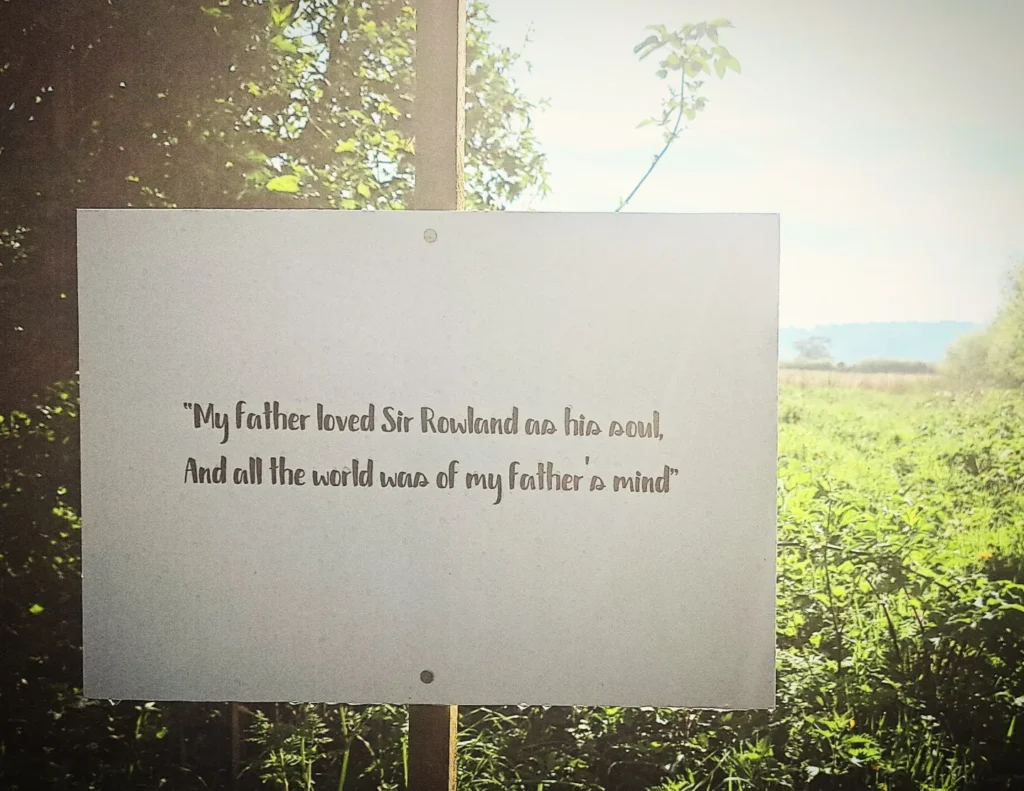
Sign in the Soulton landscape looking at the Old Sir Rowland monument, quoting AS YOU LIKE IT: ‘My father loved Sir Rowland as his soul,
And all the world was of my father’s mind’
This approach to the “desert” sees it as a sort of hall of mirrors, a place of divine encounter (note the end of As You Like It), and how this understanding should shape our approach to the real-life Soulton Wood, calling to mind the popular poem from the C20th by Dale Wimbrow The Man in the Glass.
This forest is a place where basic human needs—sustenance, shelter, and even ‘entertainment’—become points of negotiation, as Rosalind’s plea demonstrates:
I prithee, shepherd, if that love or gold
Can in this desert place buy entertainment,
Bring us where we may rest ourselves and feed
This highlights that even in this seemingly untamed environment, the remnants of social interaction and human necessity persist, further underscoring the ‘desert’ as a space where the essential elements of civilization are shed and questioned.
Here, characters like Oliver (who plotted to burn his virtuous brother Orlando in his bed), Phoebe (haughty and dismissive of the loving Silvius), and Duke Frederick (who usurped the throne, exiled his brother, banished loyal lords, and threatened his niece’s life) are forced to confront their true natures, their inner selves, their flaws and virtues:
And to the skirts of this wild wood he came;
Where meeting with an old religious man,
After some question with him, was converted
Both from his enterprise and from the world,
His crown bequeathing to his banish’d brother,
And all their lands restored to them again
The artificiality of courtly life is shed, and the essential character is exposed. This examination of social masks allows for genuine self-discovery and transformation.
Beyond a mere testing ground, the “desert” in the play and as a concept becomes a space where the divine can actually be heard because the characters are no longer distracted.
Free from the clamour of civilization, characters encounter profound truths.

Book illustration Manuscriptum translationis germanicae Cod. Pal. Germ. 60, fol. 179v (University Library of Heidelberg, Germany), written around 1460 AD
This “desert” of social withdrawal finds a compelling parallel in Thomas Lodge’s Rosalynde, the source text for As You Like It. Written during his voyages on the Atlantic, Lodge’s work is imbued with the spirit of the sea, a ‘desert’ in its own right. Given his conversion to Roman Catholicism in 1597, and his known engagement with Catholic themes even earlier, it’s highly probable that the Navigatio Sancti Brendani Abbatis, with its themes of spiritual journey, testing, and divine encounters, significantly influenced Lodge’s depiction of the woodland setting. The sea, in this context, like the forest, becomes a place of testing and divine revelation, a concept further deepened by Lodge’s own spiritual journey and Catholic perspective.
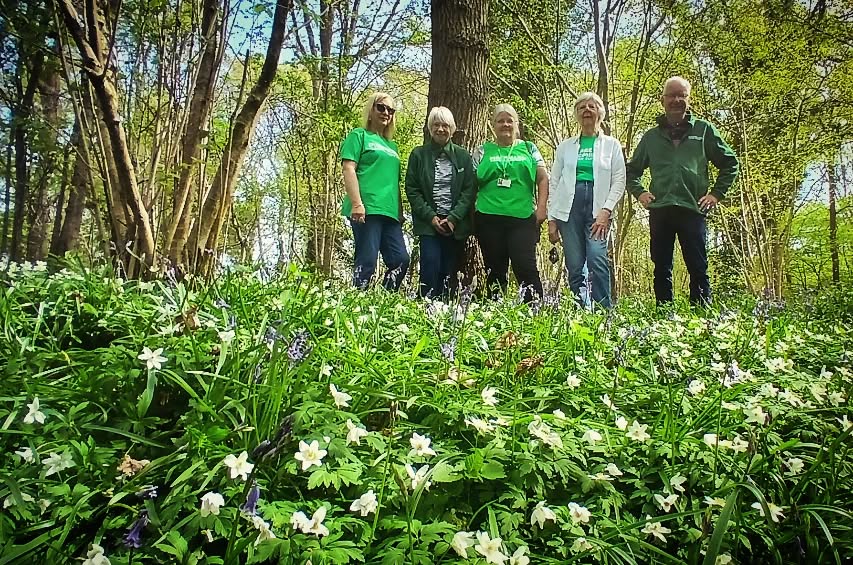
Some of the Team from Macmillan Cancer Fundraising Shropshire in the AS YOU LIKE IT wood
The island of Jasconius, a place that is not what it first appears, is a perfect metaphor for the idea of the forest as a place of illusion and revelation.

Rosalynde’s Cottage in the AS YOU LIKE IT wood
This ‘desert’ of social isolation (in contrast to an more immediately conjured arid expanse of a traditional desert), a space for spiritual leveling, resonates deeply with archetypal narratives of isolation and divine encounter. Like Job’s trials, Jonah’s introspection within the whale, and Christ’s forty days of fasting and temptation in the wilderness, the characters’ sojourns in Arden represent a period of intense personal and spiritual testing:
…I will bear
thee to some shelter; and thou shalt not die for
lack of a dinner, if there live any thing in this
desert.
These narratives, spanning across religious and literary traditions, underscore the enduring human need to retreat from the familiar, to confront the self in solitude, and to emerge spiritually upgraded through trial. The ‘desert,’ whether physical or metaphorical, becomes a crucible for spiritual growth, a space where the soul is forged anew, elevated through isolation and contemplation:
I thought that all things had been savage here;
And therefore put I on the countenance
Of stern commandment. But whate’er you are
That in this desert inaccessible,
Under the shade of melancholy boughs,
Lose and neglect the creeping hours of time
If ever you have look’d on better days,
If ever been where bells have knoll’d to church,
If ever sat at any good man’s feast,
If ever from your eyelids wiped a tear
And know what ’tis to pity and be pitied,
Let gentleness my strong enforcement be:
In the which hope I blush, and hide my sword.
Like those figures of faith and legend, the characters in Arden, and by extension, those who seek to understand the wood in real life, are invited to engage in a similar process of self-discovery and spiritual renewal, emerging refined and strengthened.
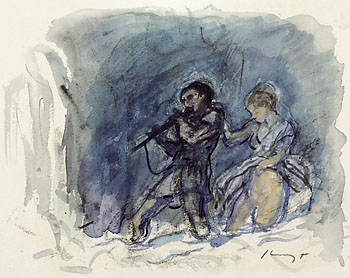
Tamino and Pamina undergo their final trial; watercolor by Max Slevogt (1868–1932)
Seen this way the play and the wood is operating in a way that is trials in Mozart’s The Magic Flute. Like Tamino and Pamina, the characters in As You Like It are subjected to trials that purify their souls and lead them towards enlightenment. The “desert,” like the temple in The Magic Flute, is a symbolic landscape where characters embark on a journey of self-discovery, encountering higher truths.

A path in Soulton’s AS YOU LIKE IT WOOD, covered in snow
Arden’s ‘desert,’ which is essentially a state of social detachment, functions as a kind of green screen, a liminal space where the core of societal agreements and civilization are held in a suspended superposition, isolated from the wider cultural matrix. It’s a controlled environment, where the building blocks of social structures are laid bare, allowing for a unique form of social experimentation. Away from the complex and often corrupting influences of the court, the characters are forced to re-evaluate their relationships, their roles, and their very understanding of community. This isolation allows for the exposing of artifice, exposing the raw elements of human interaction, and enabling a re-calibration of social values. It’s a space for social transformation, where the raw aspects of human nature are refined into something closer to their ideal form. More specifically, they are tested as to whether they are able to be leaders, capable of discerning truth from illusion, and maintaining a just and harmonious society. The ‘desert’ becomes a whetstone to hone their moral and intellectual fitness, a proving ground for those who might lead a better world.
Why should this a desert be?
For it is unpeopled? No:
…
Some, how brief the life of man
Runs his erring pilgrimage,
That the stretching of a span
Buckles in his sum of age;
Some, of violated vows
‘Twixt the souls of friend and friend:
But upon the fairest boughs,
…
Will I Rosalinda write,
Teaching all that read to know
The quintessence of every sprite
…
Therefore Heaven Nature charged
That one body should be fill’d
With all graces wide-enlarged:
Nature presently distill’d
Helen’s cheek, but not her heart,
Cleopatra’s majesty,
Atalanta’s better part,
Sad Lucretia’s modesty.
Thus Rosalind of many parts
By heavenly synod was devised,
Of many faces, eyes and hearts,
Given its literary associations, how should we approach Soulton Wood, the inspiration for Arden?
It is scenery and nature first and foremost. It is a beautiful natural place.
It is slightly elevated from that because it is a space that has links to literature and in particular the ‘desert’ tradition of social withdrawal, which Shakespeare was drawing from.
Understanding this, it is a place for intentional disconnection, deepening friendships, and personal growth. It has these properties as an output of conscious choices that to do philosophical work in that place by some many people over so many years, but that is an output of people coming there so often to join in that long tradition and nothing more.
Soulton Wood therefore offers a unique opportunity for reflection and transformation, allowing us to dismantle and dissected daily artifice and connect with our true selves, mirroring the journeys in the other Ardens.

Soulton Wood, inspiration for Thomas Lodge’s Rosalynde and for Shakespeare’s AS YOU LIKE IT
