

For over two centuries, a tantalizing mystery has lingered in the world of ancient science. A manuscript discovered in 1819 by Cardinal Angelo Mai suggested that we might be able to unlock at a lost work by the famed astronomer Ptolemy, but deciphering its secrets proved a daunting task. Thankfully, a recent breakthrough has finally yielded results, shedding light on a revolutionary astronomical instrument – the Meteoroscope.
Ptolemy, a scholar hailing from Roman-era Alexandria, left an indelible mark on scientific history. His expertise spanned mathematics, geography, music, astronomy, and more.
While some of his works were preserved by scholars throughout the Middle Ages, others vanished.
Mai’s discovery initially seemed like a lost Ptolemy manuscript resurfacing.
However, a cruel twist awaited researchers. The parchment had been reused centuries ago, overwritten with the text of “Etymologiae,” a renowned encyclopedia. Ironically, this “recycling” act may have inadvertently preserved Ptolemy’s work. Unraveling the secrets of the manuscript proved a long and arduous journey. Early efforts relied on meticulously copying legible portions and comparing them to known Ptolemy texts. The advent of modern technology finally offered a breakthrough. Techniques like UV fluorescence and multispectral imaging helped unveil the previously hidden text.
The long-lost manuscript details a fascinating astronomical instrument – the Meteoroscope. This sophisticated tool, featuring nine interlocking rings, served various purposes. It aided astronomers in:
- timekeeping,
- locating celestial objects
While the Meteoroscope was mentioned in Ptolemy’s other works, its precise design and operation remained shrouded in secrecy. This newly deciphered manuscript offers valuable insights into its construction and usage. Imagine a complex series of nested rings, each with a specific function, allowing for precise celestial observations and calculations.
Despite the compelling evidence, one question remains – is this truly a work by Ptolemy himself? While the researchers strongly believe so, citing the author’s distinctive vocabulary, the absence of the first and last pages (where author attributions typically reside) presents a challenge.
Regardless of the final authorship verdict, this discovery offers a remarkable window into the scientific methods and tools employed by one of antiquity’s greatest minds. The knowledge gleaned from the Meteoroscope manuscript promises to enrich our understanding of ancient astronomy and Ptolemy’s pioneering contributions to the field.
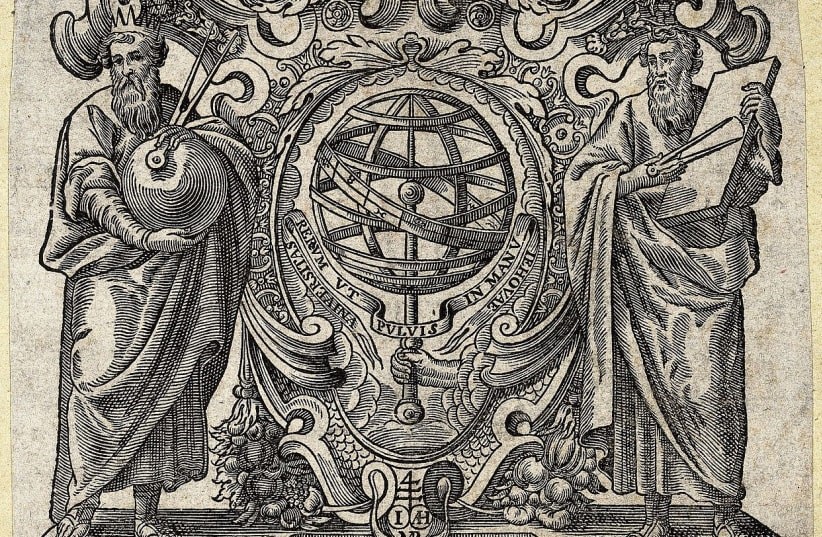
Depictions of Euclid and Ptolemy with a cosmological diagram between them. Engraving. (Illustrative).
(photo credit: Wikimedia Commons)
At Soulton Hall, and as the work of James Wenn and Byrgah Genhit progresses, the importance of Ptolemy to Old Sir Rowland Hill is becomng clearer.
Ptolemy, a master of astronomy and geography, also developed music theory. His treatise, Harmonics, explored the mathematical relationships between notes. He believed the perfect fifth (a 3:2 ratio) was the most harmonious interval. By dividing a tetrachord into two perfect fifths, he derived other Greek intervals.
Ptolemy recognized the Pythagorean tuning system’s limitations, where twelve perfect fifths result in a slightly sharp final note (the Pythagorean comma). He proposed alternative tuning systems to address this issue.
Ptolemy’s ideas influenced later music theorists and composers. While his specific tuning systems aren’t used today, his work laid the groundwork for our modern understanding of musical harmony and temperament.
