


All these centuries on, the legacy of Sir Rowland Hill is evident in so much of how Soulton Hall still presents itself, and in the care taken to preserve it to this day.

The mid c16th semi-concealed chapel at Soulton Hall, with the Easter dawn light entering
This influence finds expression in its construction, which expresses Renaissance codes designed to convey information about statecraft and the role of the arts and mathematics, among other things. As a statesman with a keen interest in theology, and holding positions on commissions during both the Counter-Reformation and the Elizabethan Settlement, Hill occupied a unique place in his time.
These things being said, it is unsurprising that his house reflects, in ways that are interesting to note, his engagement with faith in ways that would later find echoes at Wollaton and in the buildings of Thomas Tresham.
As Christians approach Holy Week and the festival of Easter 2025, it is important to notice that in 2025, Easter will be celebrated on the same day by both Orthodox and Western Christians, which is Sunday, April 20th, a rare coincidence that has sparked discussions about potentially unifying the date of Easter celebrations, though it is also important to remember that the date of its celebration varies between Western and Orthodox Churches, we are in a season when numerous spiritual traditions observe periods of reflection, connecting with themes of renewal and abundance, so vividly displayed in the natural world during spring.
Holy Week, a time of deep significance within the Christian faith, would have held particular importance during the Reformation in the mid-16th century. It is worth noting that the Council of Whitby, held in England, addressed the very question of the Easter date, a legacy of the falling out of communication that arose within the undivided church in the period preceding that event.

The chapel in Soulton Hall has an aligment to the dawn sun on Easter morning
At dawn, this room is arranged so that the sun’s light enters the chapel’s aged stones. This interaction between light and structure invites reflection on the enduring nature of human belief and the universal search for illumination, both literal and metaphorical.
This moment, regardless of one’s personal faith, becomes a reminder of the shared human desire for peace and understanding.
It is acknowledged that there is a semi-concealed small chapel of the 1550s in the basement of Soulton Hall, and next to it the Prayer Room for the use of the household. Fashioned during the Tudor years, it is a quietly powerful reminder of times of societal tension and persecution for belief, and the importance of maintaining a faith practice despite prohibition to adherents.
Returning to the house’s codes, there are other gentle codes that were left to underline this period’s significance to Tudor people:
- in the cross that is seen in the west windows on the galleries on Good Friday,
- and is projected above the chapel,
- and the cross formed of beams of light that meet in the centre of the house outside the chapel door, echoing mathematics which is put into the window mullions.

As the Easter story on Good Friday reaches the point of the crucifixion the setting sun backlights a cross and puts a halo on the cross. This is an intentional Sir Rowland Hill device in the house at Soulton Hall.
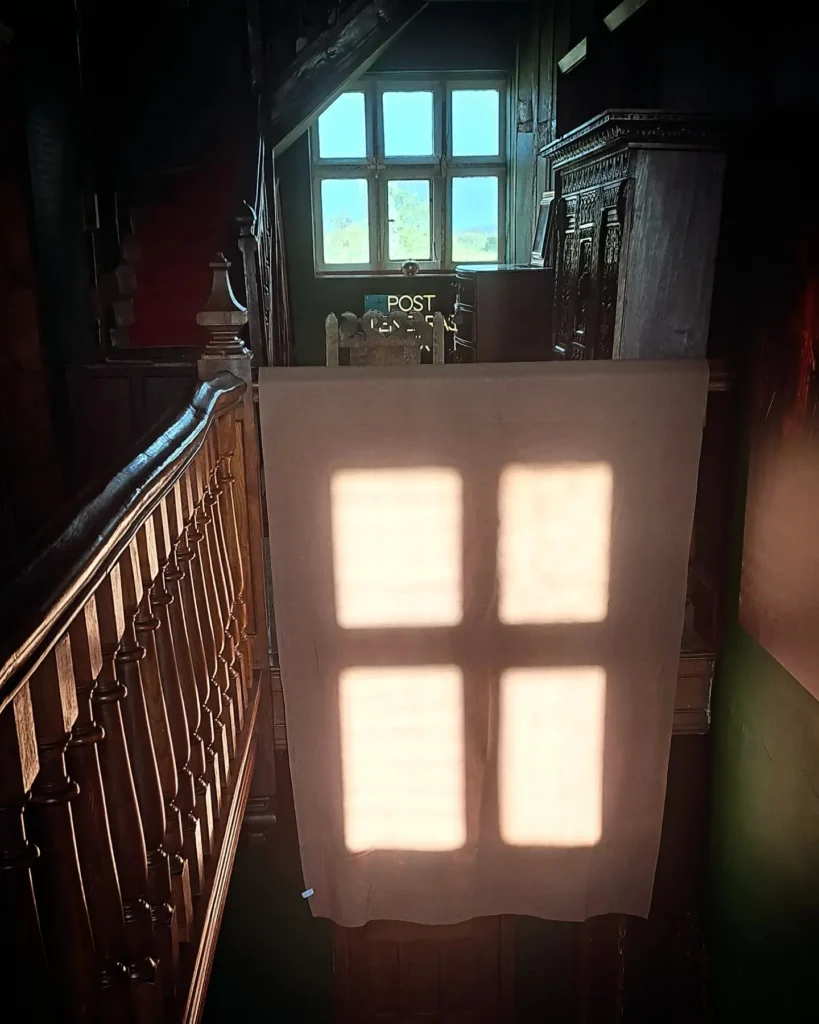
As the Easter story on Good Friday reaches the point of the crucifixion the setting projects a cross onto the hall above the secret chapel in Soulton Hall. This is an intentional Sir Rowland Hill device in the house at Soulton Hall.

9 grid window in the basement of Soulton Hall – a borrowed light to unlock a light message

beams of light crossing (a stock image, creative commons)
********
Across diverse religious traditions, the impulse to seek solace and uphold convictions remains a constant, and in our own time and across time people of faith are suffering for their faith in ways this room asks us to keep in mind.
The Ashton family approach these rooms with a profound respect for their historical significance.
The chapel and Prayer Room’s place within the Hall’s long narrative is part of an important heritage and sits within a complex tapestry of religious experience in England. In honouring the memory of Sir Rowland Hill, and all those whose lives have touched this place, the intention is to ensure its preservation as one of the many ways in which humans have sought to connect with the sacred.
Soulton Hall, through careful stewardship, invites visitors to engage with history in a way that acknowledges the breadth of human spiritual experience. It is a place where the past is treated with reverence, not as a collection of artefacts, but as a living record of the diverse ways in which humans have sought to express their faith and find meaning in their lives.
