


Shrewsbury High Cross: A Landmark of Local History
SCENE XXIV, Shrewsbury, England.
Enter Mortimer and Officers, the Friar, Jack, and the Harper, with Sir David drawn on a hurdle, and Lluellen’s head on a spear.– George Peele, The Famous Chronicle of King Edward the First (1593)
At the bustling intersection of Pride Hill, Castle Street, and St Mary’s Street in Shrewsbury, a small monument stands largely unnoticed.
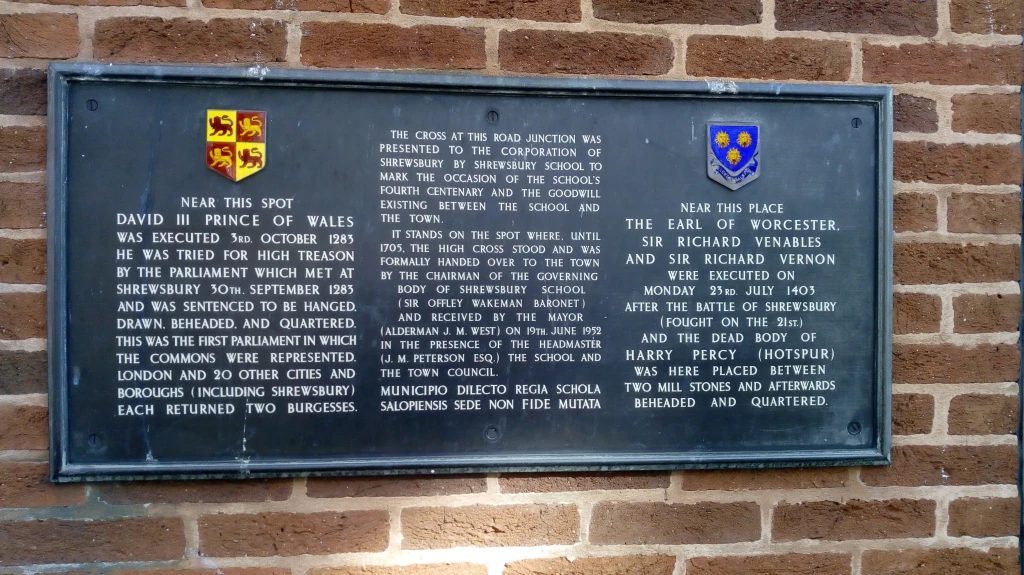
A plaque on the wall of Barclays Bank in Shrewsbury commemorates the execution of Dafydd ap Gruffudd, the last independent Prince of Wales, at this site in 1283.
Known as the High Cross, this unassuming spot marks the termination of the old market street and was once a key starting point for civic and religious processions in medieval Shrewsbury.
While the original cross, removed in 1705 and replaced in 1952, is gone, the location itself resonates with a dark and significant past, as this is Shrewsbury’s historic execution site, dating back to at least the 1100s, a place that has witnessed both triumphs and tragedies.

The 1952 replacement High Cross in Shrewsbury, a gift from the school. Photo by Geoff Charles. Creative Commons Attribution-Share Alike 4.0
A plaque across the street offers a clue to the site’s importance, a significance that reverberates deeply within the narrative of Wales. This was where Dafydd ap Gruffydd, the last independent Prince of Wales, met his gruesome end, marking the tragic loss of Welsh independence.
Dafydd wasn’t the only one to meet his fate here. The High Cross also served as the execution site for the Earl of Worcester and others following the Battle of Shrewsbury in 1403.
Dafydd’s capture on June 22nd, 1283, was swiftly followed by a parliament convened in Shrewsbury on June 28th to deal with this emergency.
That Shropshire Parliament (it is not the only one) is sometimes cited as:
“[The First Parliament] in which the Commons were Represented” (see the plaque above)
a claim that, while debated, raises important questions about the timeline of parliamentary development and its eventual culmination in the more representative ‘Model Parliament’ of 1295.
The verdict was swift and brutal: death for “high treason against the King.”
Edward I, enraged by Dafydd’s breach of the Treaty of Aberconwy and his attack on a royal castle, ensured a punishment as cruel as the era.
Dragged through the streets tied to a horse’s tail, he was hanged alive, then revived only to be disemboweled, his entrails burned before him. Finally, his body was divided into four quarters.
History records Dafydd ap Gruffydd’s execution at Shrewsbury in 1283 as the first full instance of hanging, drawing, and quartering, cementing the town’s place in the narrative of this gruesome punishment.
The repercussions of Dafydd’s execution were far-reaching. His daughters, Gwladys and Gwenllian, were sent to convents, while his sons were imprisoned in Bristol Castle, effectively ending the line of succession.
Dafydd’s story is complex, intertwined with the turbulent politics of 13th-century Wales. He was a Prince of Gwynedd, alongside his brothers Owain and Llywelyn. While Llywelyn is often remembered as “Llywelyn ein llyw olaf” (Our last leader), Dafydd’s legacy is more complicated. He allied himself with both Henry III and Edward I against his own brother, only to be forgiven by Llywelyn time and again. He even conspired to assassinate Llywelyn, a betrayal that forced him into exile.
The ascension of Edward I, with his ambition to control Wales, changed the dynamic. Dafydd, then allied with English forces, witnessed Llywelyn’s resistance to Edward’s growing power. A reconciliation followed, but it was short-lived. Dafydd’s attack on Hawarden Castle on Palm Sunday 1282 ignited a rebellion that ultimately led to Llywelyn’s death and Dafydd’s own downfall.
Hunted and on the run, Dafydd eventually found himself captured and brought to Shrewsbury.
His trial and execution at the High Cross sealed the fate of Welsh independence.
Today, as people rush past the High Cross, few pause to consider the weight of history contained within this seemingly ordinary space. It stands as a silent testament to a dramatic chapter in Welsh and English history, a reminder of the complex and often brutal struggles for power in the medieval world. Edward I’s 13th-century engagement with the town, culminating in Dafydd’s execution, was later dramatized in Elizabethan play The Famous Chronicle of King Edward the First (c. 1592) by George Peele (Tudor dramatist, author of The Troublesome Reign of John, King of England [a source for Shakespeare’s King John], and sometimes credited with Titus Andronicus collaboration) further cementing the High Cross’s place in both local and literary history.
This pivotal event, along with other historical moments associated with the site, solidifies the High Cross’s place in both local and literary history.
