


A Tale of Two Manors: Castle, Court, and Literary Connections
We were delighted to have the opportunity to return to Tretower Court and Castle, an inspiring place.
This site, a remarkable witness to Welsh history, offers a compelling parallel, and a useful cousin, to the story of Soulton, providing valuable context for understanding the evolution of power and domesticity in medieval Wales and the Welsh Marches of England.
Intriguingly, both Tretower and Soulton share literary associations, enriching their historical significance and demonstrating the diverse ways in which literature can intersect with the history of place. At Tretower, the court of Sir Roger Vaughan, a powerful figure in the Wars of the Roses, became a known centre for Welsh poets and artists.
This patronage fostered a vibrant cultural scene, where bards like Lewys Glyn Cothi, a renowned poet of the era, and possibly others, would have entertained and celebrated their patrons through their verse. These connections to the rich tradition of Welsh intricate system of patronage that sustained Welsh literary culture in courtly manors of civilised elite patrons in the country.
The presence of these poets at Tretower suggests that the court served not only as a centre of political and economic power, but also as a vital space for the preservation and promotion of Welsh language and literary traditions.
Soulton’s literary links, while different in nature, are equally compelling. The manor is associated with Thomas Lodge, the writer whose Rosalynde, Euphues’ Golden Legacy served as the primary source for Shakespeare’s As You Like It. This connection to a pivotal work in English literature adds a fascinating dimension to Soulton’s history, placing it within the broader context of Elizabethan literary production and importantly on a manor away from court.
Furthermore, Soulton’s later association with Sir Rowland Hill, a prominent Tudor merchant and Lord Mayor of London, connects the site to the world of civic humanism and the burgeoning print culture of the Renaissance.
While Tretower’s literary connections emphasize the oral traditions of Wales, Soulton’s links to Lodge and Hill highlight the growing importance of written texts and the influence of classical learning on Tudor society. These distinct literary associations are not mere coincidences – they offer valuable insights into the cultural landscape of their period and underscore the ways in which literature is closely tied to place and there client effects of support and patronage in those places.
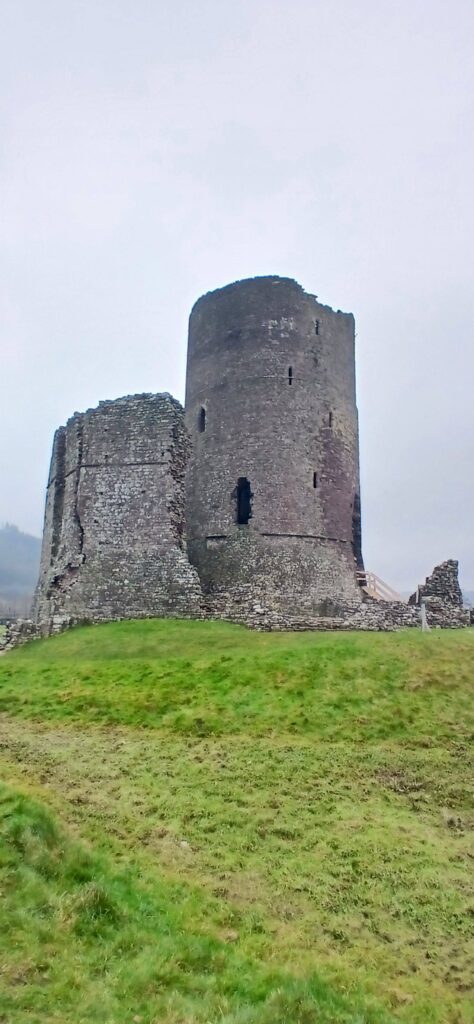
Tretower Castle
Soulton and Tretower also experienced a similar trajectory, beginning with a fortified presence and transitioning towards a more demonstrably domestic character. The sites’ dual natures, encompassing both a robust Norman/High Mediaeval castles and a later, more refined medieval court, offers an opportunity to examine the changing architectural and social landscapes of the region.
At Tretower, the initial fortification, a timber motte and bailey castle erected by the Norman lord William fitz Osbern, served as a strategic stronghold in the newly conquered territories. This early structure, later replaced by the more substantial stone keep that dominates the site today, reflects the initial period of Norman consolidation and the need for defensible positions. The circular tower, a classic example of Norman architecture, embodies the principles of military engineering prevalent in the 12th century. Its strategic placement afforded commanding views of the surrounding valley, reinforcing its function as a symbol of Norman authority.
At Soulton, on the Castle Mound site a similar defensive footprint on an older site is also seen.

DigVentures archaeologists investigate the Soulton Castle Mound site
The subsequent development of Tretower Court, particularly under the ownership of Sir Roger Vaughan in the 15th century, marks a significant shift in the site’s character.
This transition from primarily military function to a more demonstrably domestic space reflects broader changes in the political and social climate of Wales.

The Upper Hall in Tretower Court, very like the Moot Hall in Soutlon Hall
The court was added on a new site, with its emphasis on spacious halls, private chambers, and formal gardens, speaks to the growing importance of display and comfort. It embodies the increasing sophistication of the Welsh gentry and their adoption of more refined lifestyles.

The Moot Hall in Soulton Hall – a civic room from the medieval Base Court here.
The architectural contrast between the austere strength of the castle and the relative opulence of the court provides a tangible representation of this evolution. While the castle’s architecture emphasizes defence and control, the court’s design prioritizes social interaction and the projection of status. The great hall, a central feature of the court, served not only as a space for dining and entertainment but also as a venue for the conduct of business and the administration of justice.

The Great Hall Tretower Court, timbers re-used in Soulton Court survive from this feature which Soulton Court had up to the C17th when it was reconfigured into the Model Farm
This multifunctional space highlights the interconnectedness of social, political, and economic life in the late medieval period.

Tretower Court
The same happened at Soulton where Base Court was construed which is on footprint occupied by Soulton Court, which is the successor of this building and is actually very similar in massing and contained recycled materials from the older building configuration.

Snow in Base Court, looking on to Soulton Court
You can also see very similar buildings at Bach y Graig, which Sir Richard Clough modelled on Soulton.

Brisck work in a court at Bach-y-Graig – showing crosses which line up to make light effects, repeating a practice observed at Soulton
Bach y Graig and Tretower are very helpful for showing features that were at Soulton but got over written, including the Proter’s Lodge.
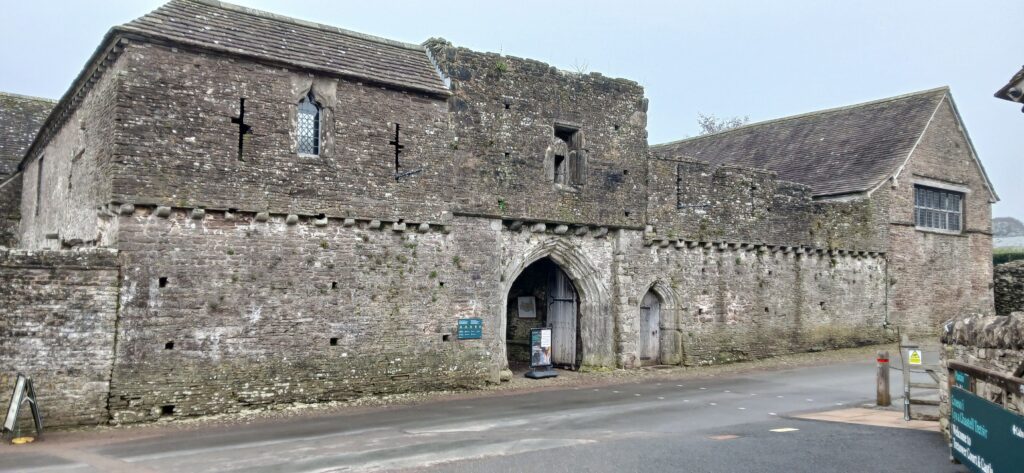
Tretower Court – Porter’s Lodge: this feature survies at Soulton Court, but is within a Model Farm Rendering of the C18th
They are not lost – they are just not here!
Prior to the arrival of Sir Rowland Hill at Soulton, the sites at Tretower and Soutlon would have been very closely related, sharing a similar trajectory of military occupation followed by domestic expansion and a literary association.
However, the divergent paths taken by the two sites after this point offer further insights.
While Tretower saw no makor devolpement from the mid 1500s onwards, Soulton experienced a different phase of evolution. Crucially, at Soulton, we know a High Renaissance phase was unlocked and the current hall was added as part of a phased development, a process of architectural refinement that Tretower, did not experience. This distinction highlights the varied responses to changing social and economic conditions in the late medieval period.

Scholarly reconstruction of Soulton Hall in accession created by James D. Wenn and James R. Syrett of Byrga Geniht Ltd for Soulton Hall in 2024. This was added to the existing complex of Base Court,
Comparing these two sites, therefore, allows us to appreciate the range of architectural and social adaptations undertaken by the elite in medieval Wales, and the adjacent bit of England, offering a nuanced understanding of the period.
The study of Tretower, in conjunction with the ongoing research at Soulton, provides a rich tapestry of evidence for exploring the nature of medieval life and the diverse ways in which individuals and communities shaped their built environment.
