

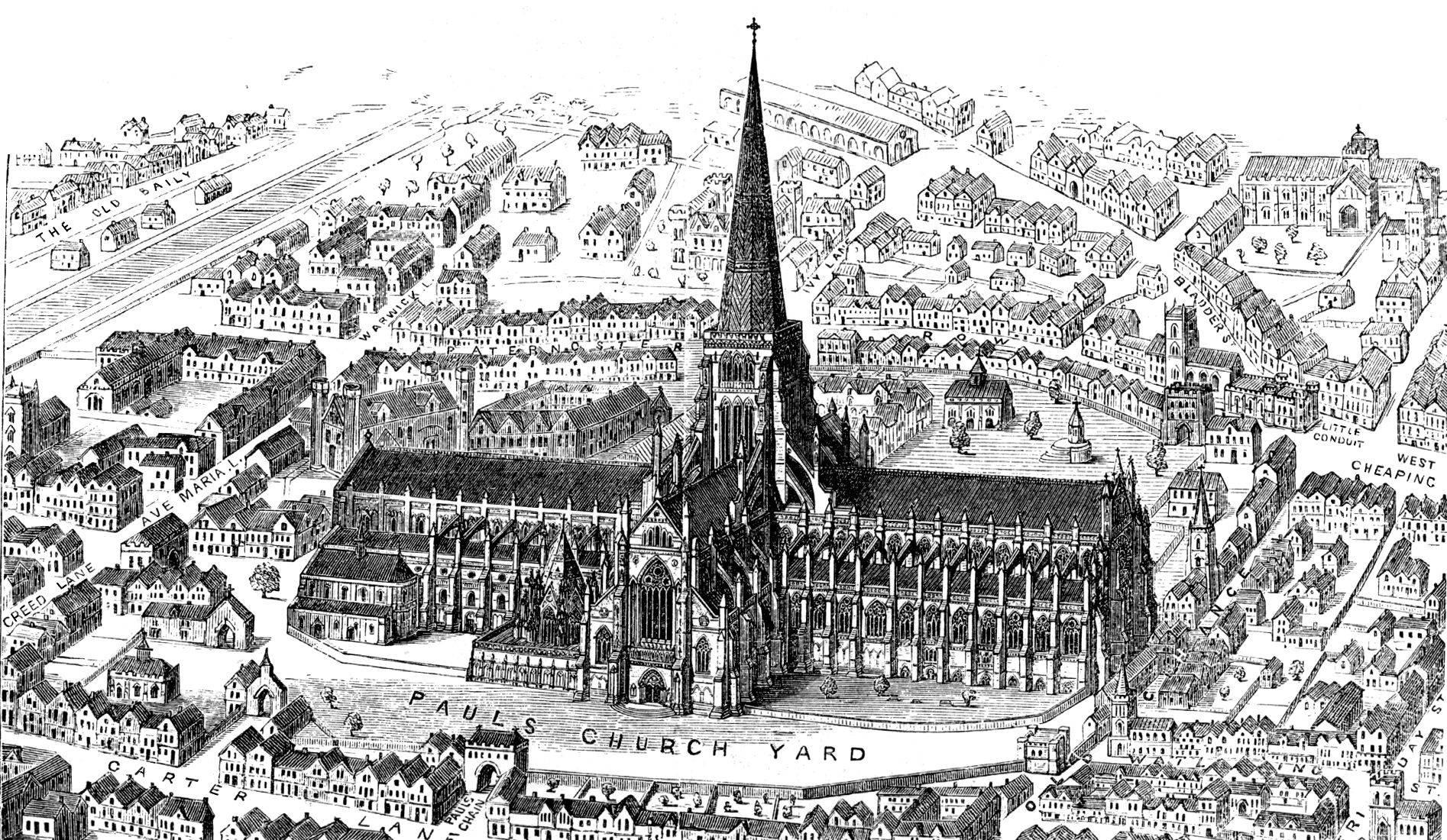
Following the recent conference, we have taken the opportunity to share the poem St Erkenwald, which has links to the Shropshire area below.
********
“Saint Erkenwald” is a Middle English poem that tells the story of a miraculous discovery made during the construction of St. Paul’s Cathedral in London.
The poem begins by describing the history of the site, which was once a pagan temple of Hengist.
After the reconversion of that part of England that holds London to Christianity, the temple was destroyed and replaced with a new church.
During the construction of the new St. Paul’s, workers unearthed a remarkable tomb. The tomb contained the body of a man who appeared to have been preserved for centuries, wearing rich garments and a crown. Despite extensive research, no one could identify the man or his origins.
The bishop of London, Saint Erkenwald, was called to investigate the mystery. Through prayer and divine intervention, he was able to communicate with the the man in the tomb who awoke. The man revealed that he was a judge decended from the lines of the people of the city of Troy.
He had lived centuries earlier, before event the time of the Roman occupation of Britain.
He had been buried with great honor for his just and righteous rule.
The bishop was deeply moved by the story and offered a prayer for the man’s soul while crying. Miraculously, the man’s body began to decay, and his spirit was finally released:
Ryȝt now to soper my soule is sette at þe table,
********
The poem is the greatest work of surviving from Middle English, perhaps composed in the late 1380s or early 1390s.
It would have been familiar to Old Sir Rowland Hill as an important part of the medieval and early Tudor civic identity of London.
One of the most thought-provoking aspects of the poem is its careful handling of the question of what happens to virtuous people who have not heard the Christian message. The man in the tomb, despite his righteous life and contributions to his community, was ultimately judged by God based on his lack of faith, at least initially. This raises important questions about the nature of salvation and the role of divine grace.
However, the bishop’s prayers and blessings are instrumental in freeing the man’s soul, highlighting the power of spiritual intervention and the hope of salvation. This invites us to contemplate the nature of time for souls existing beyond mortality.
********
Saint Erkenwald
Notes:
Original text dates to the late 14th century, by an unknown author. Source language text is public domain.
