

The Importance of Patience: A Medieval Perspective
“Patience” is a late 14th-century Middle English poem attributed to the enigmatic Pearl Poet. This author, also believed to be responsible for “Cleanness,” “Sir Gawain and the Green Knight,” and possibly “Pearl,” and perhaps also “Earconwald” lived in the North Shropshire/Cheshire/Staffordshire dialect region.

Sir Gawain and the Green Knight (from original manuscript, artist unknown).
The manuscript containing “Patience,” Cotton Nero A.x, is housed in the British Library. The poem’s first complete publication was in 1864. While “Patience” is considered by some to be the least significant of the four/five poems attributed to the Pearl Poet, it shares a common structure with others of the set: a statement of theme, a biblical text, a discussion of another passage, and an elaborate paraphrase of exempla.
Despite the limited information available about the Pearl Poet, their knowledge of theology, Latin, and French, as well as their deep connection to the West Midlands, is evident in their work. Fields named “Massey’s Rough” and “Massey Barn” near Soulton suggest a possible link to John Massey of Cotton, a potential candidate for authorship.
********
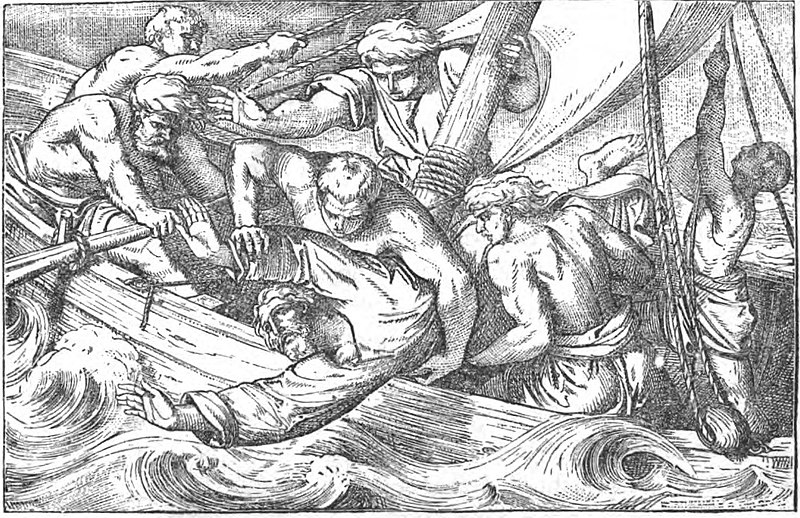
The sermonizer poet begins by extolling patience as one of the eight Beatitudes, closely associating it with poverty. He warns against grumbling or fighting one’s fate, as Jonah did. The remainder of the work uses Jonah’s story as an example to illustrate and justify the admonition to accept God’s will patiently.
Jonah’s impatience, his inability to handle the burden of preaching to the Ninevites, serves as a stark contrast to the virtue of patience. While medieval schools of thought condemned sloth, Jonah’s story demonstrates that even those who fall into impatience can receive God’s loving mercy.
The poem ends with its opening lines, emphasizing the importance of patience as a virtue to be embraced.
