

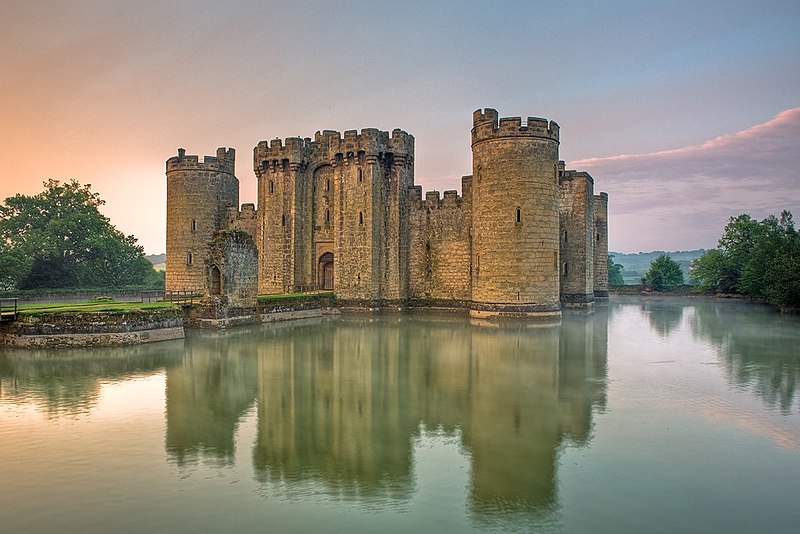
It was a delightful experience to visit Bodiam Castle recently. The castle’s picturesque setting, well-preserved ruins, and rich history make it a truly memorable destination.
Bodiam Castle, is a stunning example of a medieval moat castle. Its imposing silhouette, surrounded by a deep moat, offers visitors a glimpse into the past and a chance to explore the rich history of this iconic national landmark.
It is quite a funny castle though….
…it is not a conventional military fortress: the castle’s thin walls, shallow moat, and large windows suggest a focus on aesthetics and symbolism rather than purely practical military considerations. This is because it is addressing chivalric values of its time, which emphasized honours, courtesy, and the pursuit of knowledge. Its design incorporates elements of sacred geometry, such as the rhombic dodecahedron, which can also be found in other notable British buildings, and the Cosmati Pavement.

A Curious Contradiction: The Hexagonal Shafts Within Bodiam Castle’s 4 Cylindrical Corner Towers: like the Cosmati Pavement
A recent James D. Wenn’s presentation at the Farmers’ Club explored these the significance of the rhombic dodecahedron, the natural shape of the garnet crystal, in British art and architecture. He demonstrated how this shape has been referenced in influential British buildings for centuries.
The presentation also touched on the historical significance of Bodiam Castle, highlighting its role as a prominent example of medieval architecture and its connection to the broader themes of sacred geometry
