


From Newgate to the Old Bailey
Justice, Mercy, and the Law: A Reflection on the Old Bailey
The office of Sheriff of the City of London is one of the most ancient civic positions in England, dating back to the Anglo-Saxon period. Its origins can be traced to the role of the “shire reeve,” a royal representative responsible for law and order within a county or shire. Over time, this position evolved into the modern-day sheriff.

City of London Dragon Sculpture
The specific origins of the Sheriff of the City of London are somewhat obscure, but it is believed to have been established sometime in the 7th or 8th century in the days of St Erkenwald. The office gained significant importance during the Middle Ages, with sheriffs playing a crucial role in the administration of justice, the collection of taxes, and the maintenance of public order within the City.
Sir Rowland Hill served as Sheriff of London in 1542, alongside his colleague, Henry Suckley.

Sir Rowland Hill – Museam of London Image
Originally appointed by the king, the sheriffs were responsible for collecting taxes and enforcing the law within the City. Over time, the role of the sheriff has evolved, reflecting the changing political landscape and the growing autonomy of the City of London.
During the Norman Conquest in 1066, London had two sheriffs who were appointed by the king. These officials held significant power within the City, overseeing the collection of taxes and the administration of justice. In the early 12th century, London gained a degree of self-government, including the right to elect its own sheriffs. This marked a significant shift in the relationship between the City and the Crown, as sheriffs were no longer directly appointed by the king.
The introduction of the mayor in 1189 further transformed the role of the sheriffs. The mayor, who was elected annually by the citizens of London, became the chief magistrate of the City, taking precedence over the sheriffs. While the sheriffs remained important figures in the City’s governance, their authority was diminished.
Despite their reduced role, the sheriffs continued to perform a number of important functions. They were responsible for overseeing the City’s prisons, maintaining public order, and assisting the mayor in the administration of justice. The sheriffs also played a ceremonial role, participating in various civic events and representing the City at official functions.
In the 14th century, the Common Council of London stipulated that every future Lord Mayor should have previously served as a sheriff. This tradition continues to this day, ensuring that the Lord Mayor has firsthand experience in the administration of the City.
Today, the sheriffs of London remain active participants in the City’s governance. They serve as ceremonial magistrates, attend civic events, and support the Lord Mayor in his duties. While their role has evolved significantly since the Middle Ages, the sheriffs continue to be an important part of London’s rich history and tradition.
********
We were honored to be invited to a luncheon at The Old Bailey with His Majesty’s Judges, at the request of Alderman & Sheriff Alastair King DL. As an ancient custom and duty of the Sheriffs of the City of London, they are responsible for attending to the welfare and providing refreshments for the justices of the court.
The luncheon at the Old Bailey provides a much-needed respite for the judges presiding over the court’s demanding criminal trials. These cases often involve harrowing and emotionally charged testimonies that can take a significant toll. The luncheon offers a moment of pause and reflection, allowing the judges to recharge and reconnect with their colleagues in a less formal setting. Attendees are drawn from across the arts, culture, and other parts of civic life. This diverse mix of individuals is intended to help direct conversation into a diverting and nurturing way, providing a welcome break from the intense nature of the court’s work.
This cituation could not but take our mind to Sir Rowland Hill, as Lord Mayor of London, was a prominent figure in the Tudor legal system. He served as a senior judge of the City of London, presiding over numerous trials and participating in treason proceedings. His judicial duties also extended to hearing cases involving moral offenses, reflecting the broad scope of his responsibilities within the City’s legal system.
To this day, the Lord Mayor of London holds a judicial position, their role is primarily ceremonial and administrative. The City of London’s unique status as a special jurisdiction allows it to maintain its own legal system and courts, providing a distinct legal framework within the broader English legal system. Within the Old Bailey, to this day, the residing seat is reserved for the Lord Mayor.
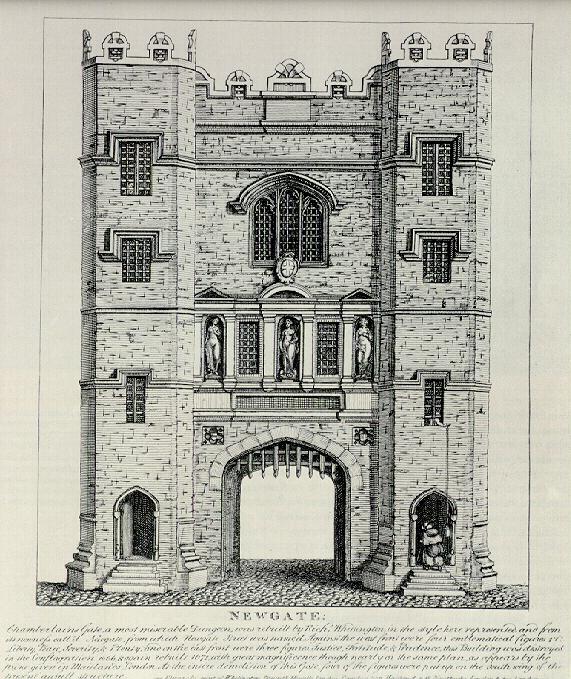
Newgate, the old city gate and prison
The Old Bailey is built on the site of the former Newgate Prison. Newgate was one of London’s most notorious prisons for centuries, housing a wide range of criminals, from petty thieves to murderers. It would have been well-known to Old Sir Rowland. It had been a prison since 1188, in response to King Henry II’s legal reforms. Initially intended as a temporary holding place for accused individuals awaiting trial, it quickly became a permanent institution.
Over the centuries, Newgate underwent several expansions and renovations to accommodate the growing prison population. In 1236, a new wing was added, including dungeons and additional buildings. In 1406, a separate tower was constructed for female prisoners due to overcrowding and poor conditions in the existing women’s quarters.
Despite these improvements, Newgate remained a harsh and dangerous place. By the 15th century, the prison was in dire need of repair, with many prisoners suffering from disease and death due to overcrowding and unsanitary conditions. In 1419, the prison was temporarily closed due to these issues. Lord Mayor Dick Whittington’s executors funded a major renovation of Newgate in 1422. The prison was rebuilt with new facilities, including a central hall, a chapel, and additional cells. However, conditions remained harsh, with prisoners separated by social class and gender but living in close proximity.
Throughout its history, Newgate served as a holding place for a variety of prisoners, including heretics, traitors, and rebellious subjects. It played a significant role in the English legal system for centuries.

“Newgate Chapel,” hand-colored etching and aquatint by Thomas Rowlandson and others, 1809.
Despite the harsh conditions at Newgate Prison, compassionate individuals throughout its history expressed concern for the welfare of its inmates. Efforts were made to improve conditions and provide opportunities for rehabilitation and redemption.
The enduring nature of questions about justice, governance, and the role of individuals in society is a testament to the complexity and timelessness of these issues. Even centuries after the time of Plato and Rowland Hill, we continue to grapple with similar questions and seek answers. Plato’s ideal state, with its emphasis on justice, wisdom, courage, and temperance, has provided a framework for countless thinkers and leaders throughout history. Hill’s engagement with these ideas demonstrates the ongoing relevance of philosophical inquiry and its ability to inform our understanding of governance and social responsibility.
********
Alderman Alastair King DL will become the 696th Lord Mayor of London in November 2024.
