


The Renaissance of Healthcare: Sir Rowland Hill’s Contributions
A Champion of Health and Welfare and a Beacon of Hope in Tudor England
The dissolution of the monasteries under Henry VIII was a pivotal event in English history, with far-reaching consequences that extended beyond the realm of religion. One of the most significant impacts was the collapse of the social provisions that had long been provided by these religious institutions. This breakdown had a profound effect on various aspects of Tudor England, including healthcare and public health.
In the wake of the dissolution, a void was created in the provision of medical care. Many monasteries had operated hospitals and dispensaries, offering essential healthcare services to the local population. With their closure, these vital services were lost, leaving many individuals without access to medical treatment.

‘Old Sir Rowland’: Patron of the Geneva Bible and inspiration for AS YOU LIKE IT
In this context that Sir Rowland Hill emerged as a prominent figure in yet another context: medicine.
Recognizing the critical need for healthcare, Hill dedicated himself to filling the void left by the dissolution of the monasteries. He worked tirelessly to establish new hospitals and medical facilities, and his efforts had a profound impact on the health and well-being of the English people.
Hill is also connected via his association with the Rouland Hall Press with a notable contributions to the field of medicine : publication of “Certaine vvorkes of chirurgerie” in 1562. This book was sent to the presses during Hill’s lifetime.
This book shows one part of his wider commitment to advancing medical knowledge and improving healthcare practices.
Hill’s civic work helped to address the medical needs of the population and played a vital role in the development of healthcare in Tudor England.
********
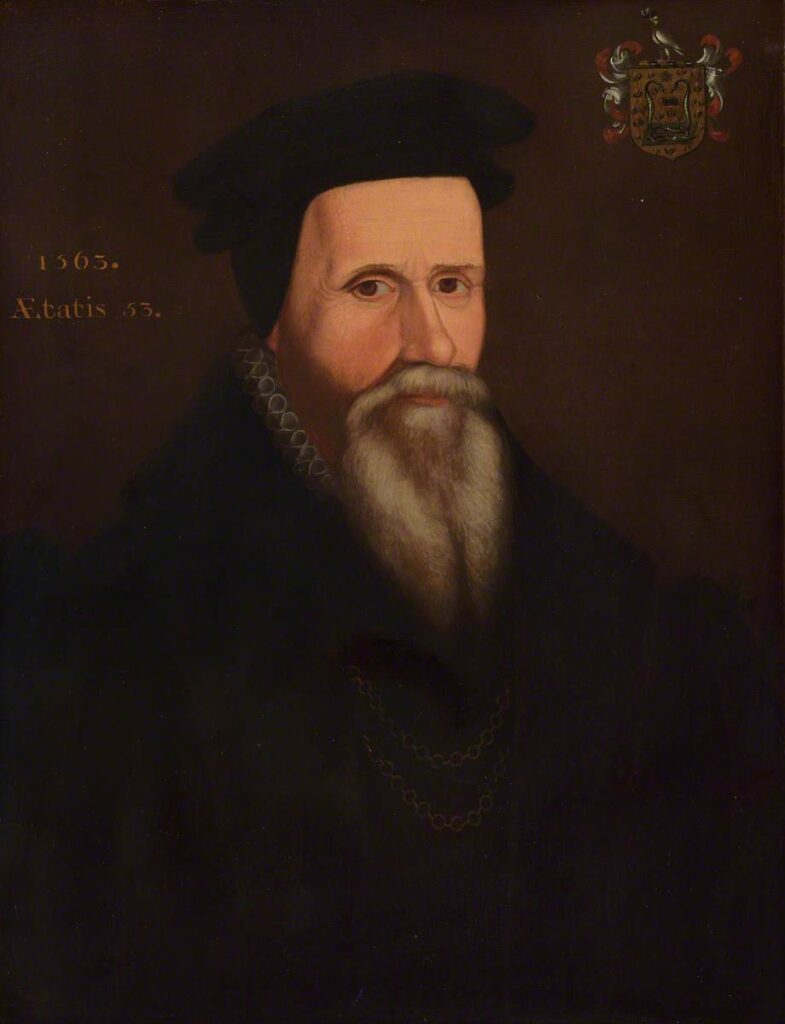
Dr John Caius
Sir Rowland Hill represented the city in the first parliament of Queen Mary’s reign. He replaced Sir Martin Bowe, a Catholic, and was widely regarded as a Protestant. The London delegation to that Parliament focused on commercial matters, particularly legislation related to regulating physicians. They took the task of the guild system and placed it in a statutory Royal College, which was headed up by Dr. John Caius, an associate of Hill’s since he had attended to the sweating sickness in Shrewsbury at the instruction of the Council of the Marches.

Gonville and Caius College, Cambridge, Gate of Honour
In 1557, Hill collaborated with Sir Martin Bowes to prepare the comprehensive guide to the administration of London’s hospitals, titled:
“The Order of the Hospitals of King Henry the viijth, and King Edward the vjth, viz. St. Bartholomew, Christ’s, Bridewell, St. Thomas’s. By the Maior, Commonaltie, and Citizens of LONDON; Governours of the Possessions, Revenues, and Goods of the sayd Hospitals, Anno 1557.”
In 1557, the administration of Bethlem Royal Hospital was placed under the authority of the Bridewell Governors, and Hill became the first president of this institution.
Sir Rowland Hill also served as the first president of Bridewell from 1557 to 1558 and again from 1559 to 1561. He also held the position of surveyor-general of all London hospitals from 1559 until his death.
Hill shared his prominent role in the re-establishment of hospitals with Richard Grafton, a fellow Shropshire native who was instrumental in printing the Great Bible.
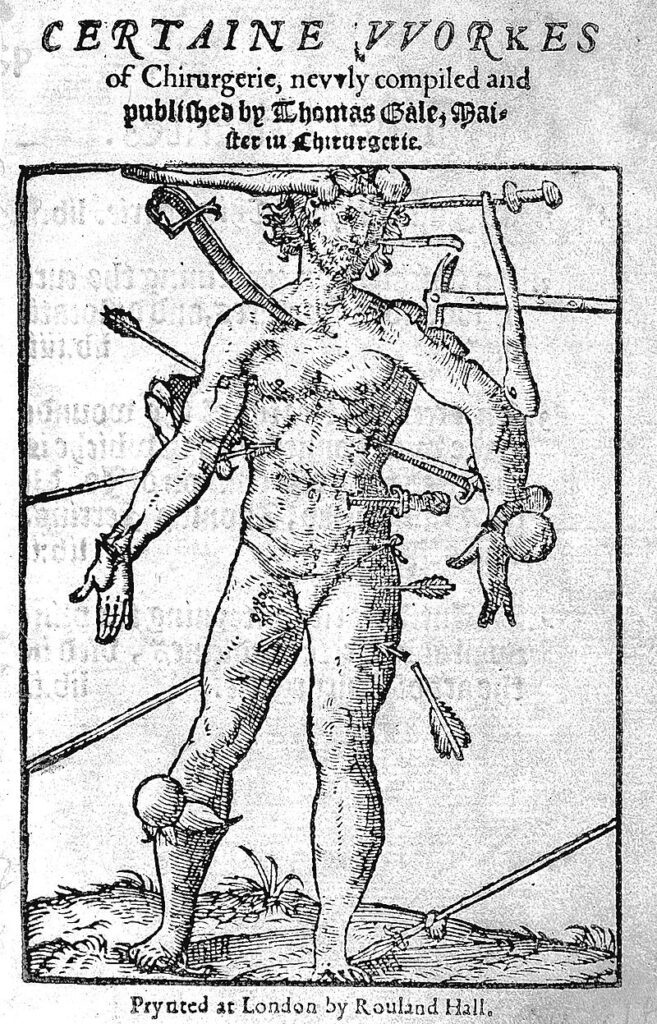
A “wound man” seen on the frontispiece of ‘Certaine vvorkes of chirurgerie’.
Beyond medicen, Hill was a strong supporter of education and social welfare initiatives, including schools, the Bethlem asylum, and the new Bridewell hospital. Hill was also involved in pioneering efforts to establish early labor exchanges and poverty relief programs.
********
Sir Rowland Hill’s legacy is one of public service, philanthropy, and religious dedication.
A contemporary described him as “ready to further the cause” of the common good. Thomas Fuller noted his generosity, including his forgiveness of tenant rents and his mandate for long-term leases.
His charitable works, including the establishment of hospitals and schools, have benefited countless individuals over the centuries. Hill’s epitaph highlights his unwavering commitment to virtue, learning, and justice. He was a respected citizen, a wise counselor, and a fervent advocate for the betterment of society. His contributions to the city of London and the broader community continue to be celebrated today.
