

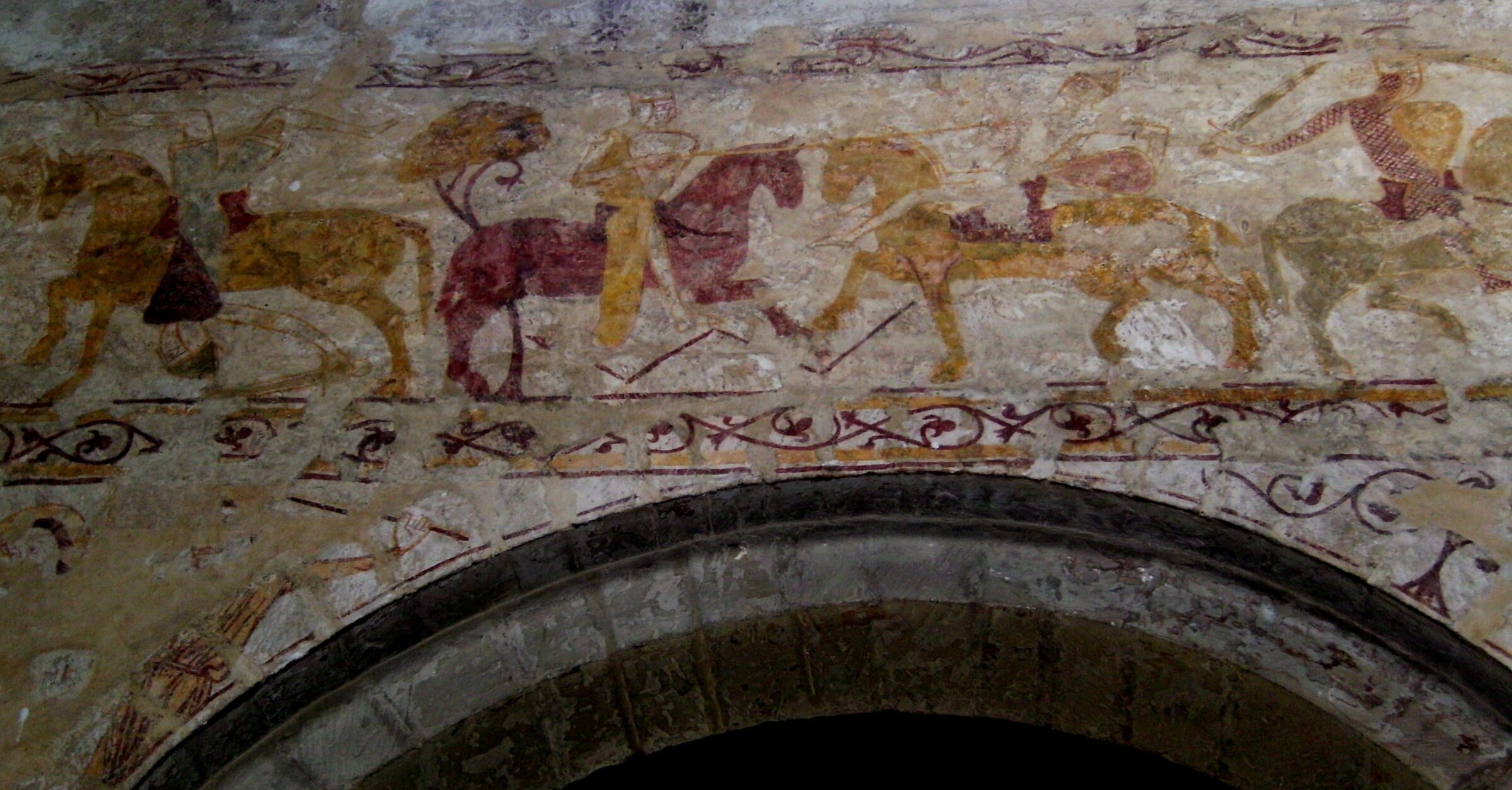
Hidden within the walls of All Saints Church in Claverley, Shropshire, lies a remarkable medieval treasure: a series of wall paintings depicting a dynamic battle scene.
Often referred to as ‘England’s Bayeux Tapestry’, these vibrant frescoes, dating back to the 13th century, are unique and captivating.
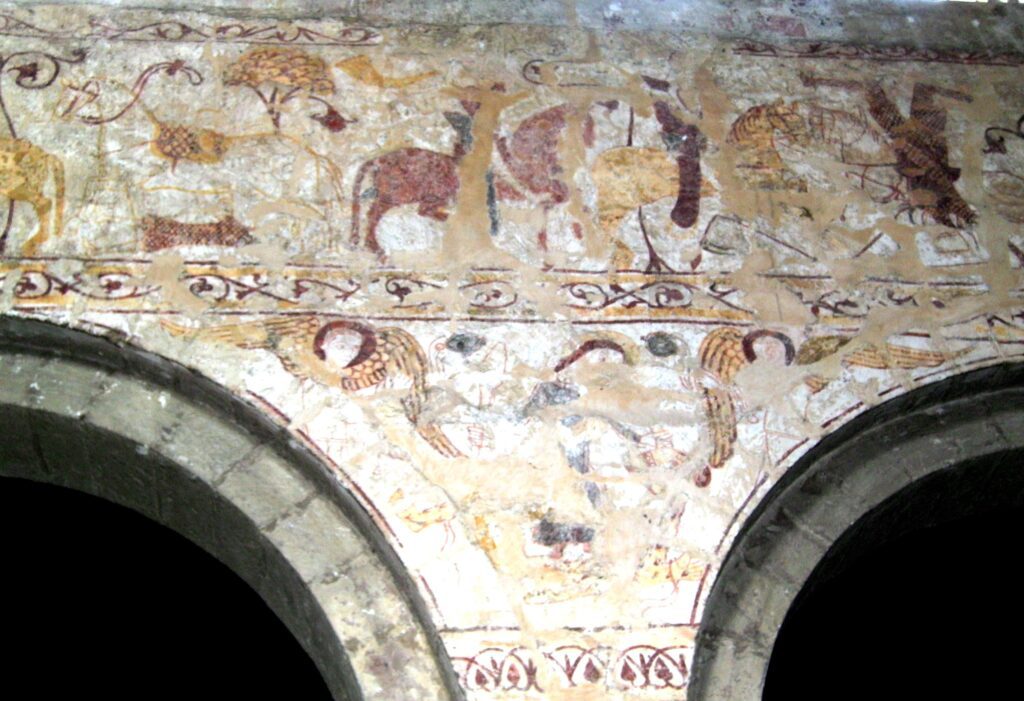
Medieval paintings in All Saints Claverley
Recent research has unveiled an extraordinary connection between the Claverley paintings and the legendary Charlemagne. Scholars believe the artwork depicts a scene from the epic poem, The Song of Roland, chronicling the Battle of Roncevaux Pass. Roland was the nephew of the famous Charlemagne, King of the Franks, who ruled from 768-814 AD.
This discovery places the Shropshire frescoes within a wider European historical and literary context.

Claverley All Saints medieval paintings
There is an upcoming celebration at All Saints Church on July 21st promises to look deeper into this captivating story, with experts discussing the potential meanings and interpretations of the artwork. This is a rare opportunity to explore a hidden gem of England’s medieval heritage.
The Hill family, which Old Sir Rowland is part of, traditionally claim decent from Charlemagne in tow lines, and were well embedded around Court of Hill, close to Claverly by the time these paintings were done. The name Rowland is frequently used in the Hill family and that may be linked to these traditions.
Parts of the Hill family were also involved in the early Crusades during the time of Tancred, Prince of Galilee, and were in Antioch during that period.

Tancred of Antioch, Tancred, Prince of Galilee
********
The Song of Roland is an epic poem, believed to have been composed in the late 11th or early 12th century in the langue d’oïl, the northern dialect of Old French. It is considered one of the most important works of medieval French literature.
The poem centers on the life and death of Roland, a legendary knight and nephew of Charlemagne, the Frankish emperor. Its most famous episode recounts the Battle of Roncevaux Pass, a real historical event that took place in 778 AD. In this battle, Charlemagne’s rearguard, led by Roland, was ambushed and massacred by Basque forces.
The poem, however, transforms this historical event into a heroic tale of chivalry, courage, and ultimately, sacrifice. Roland, as the poem portrays him, is a paragon of knightly virtues: brave, loyal, and steadfast in his duty to his emperor. His death becomes a symbol of Christian martyrdom, inspiring subsequent generations.
The Song of Roland has had a profound influence on European literature and culture, shaping the ideals of chivalry and heroism for centuries to come. It is a cornerstone of the chanson de geste, a genre of epic poetry that celebrated the deeds of Charlemagne and his knights.
