


At Soulton, the name Sidney holds a special resonance. Sir Philip Sidney (1554-1586), is celebrated figure of the Elizabethan era, a literary giant and valiant soldier.

Sir Philip Sidney, after Antonis Mor
He was the son of Henry Sidney, a close colleague of our own Sir Rowland Hill, and a pupil of Thomas Ashton’s at Shrewsbury School, which Sir Rowland Hill was involved in founding.
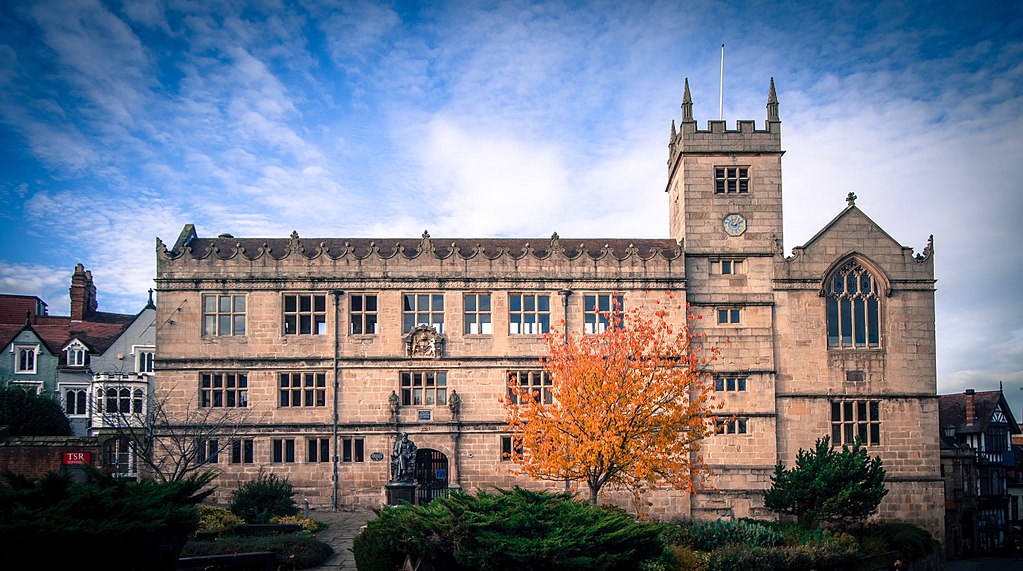
Shrewsbury School old buildings, now the Shrewsbury Library
Both Hill and Sidney Sr served on the Council of the Marches, working together to maintain order in the border region between England and Wales and to govern it in a fair and popular way.
Their professional bond extended to a personal friendship, fostering a connection that would shape young Philip’s life.
Sir Rowland, a visionary leader, played a pivotal role in arts commisionng and drama and was a serious scholar. This will not have escape the notice of a young man, Sir Phillip Sidney, who could have seen him as a kind of godfather.
Philip’s brilliance blossomed under this distinguished tutelage. He went on to become a renowned poet, penning the now-famous “Astrophel and Stella” sonnet sequence. His prose masterpiece, “The Countess of Pembroke’s Arcadia,” captivated readers for generations. His insightful essay, “An Apology for Poetry,” remains a cornerstone of literary criticism.
But Philip wasn’t just a man of letters. He embodied the spirit of a Renaissance gentleman, excelling in military service as well. His tragic death at the Battle of Zutphen, fighting for the Protestant cause, only elevated his image to legendary heights.
Here we feel a special connection to Sir Philip Sidney. His story, connected as it is with the legacy of Sir Rowland Hill, reminds us of the enduring power of education, mentorship, and the pursuit of excellence in all its forms. His life serves as a testament to the remarkable individuals who once lived and visited here, and the enduring impact they left on the world.
********
An intersting side-note to this concerns Michael Drayton, a significant figure in English literature, who bridged the Elizabethan and Stuart eras. Known for his historical poetry, Drayton also achieved distinction as the first English author to compose odes in the Horatian tradition: when he wrote in a pastoral mode such as, The Shepherd’s Garland, he wrote under the pseudonym of Rowland.
