

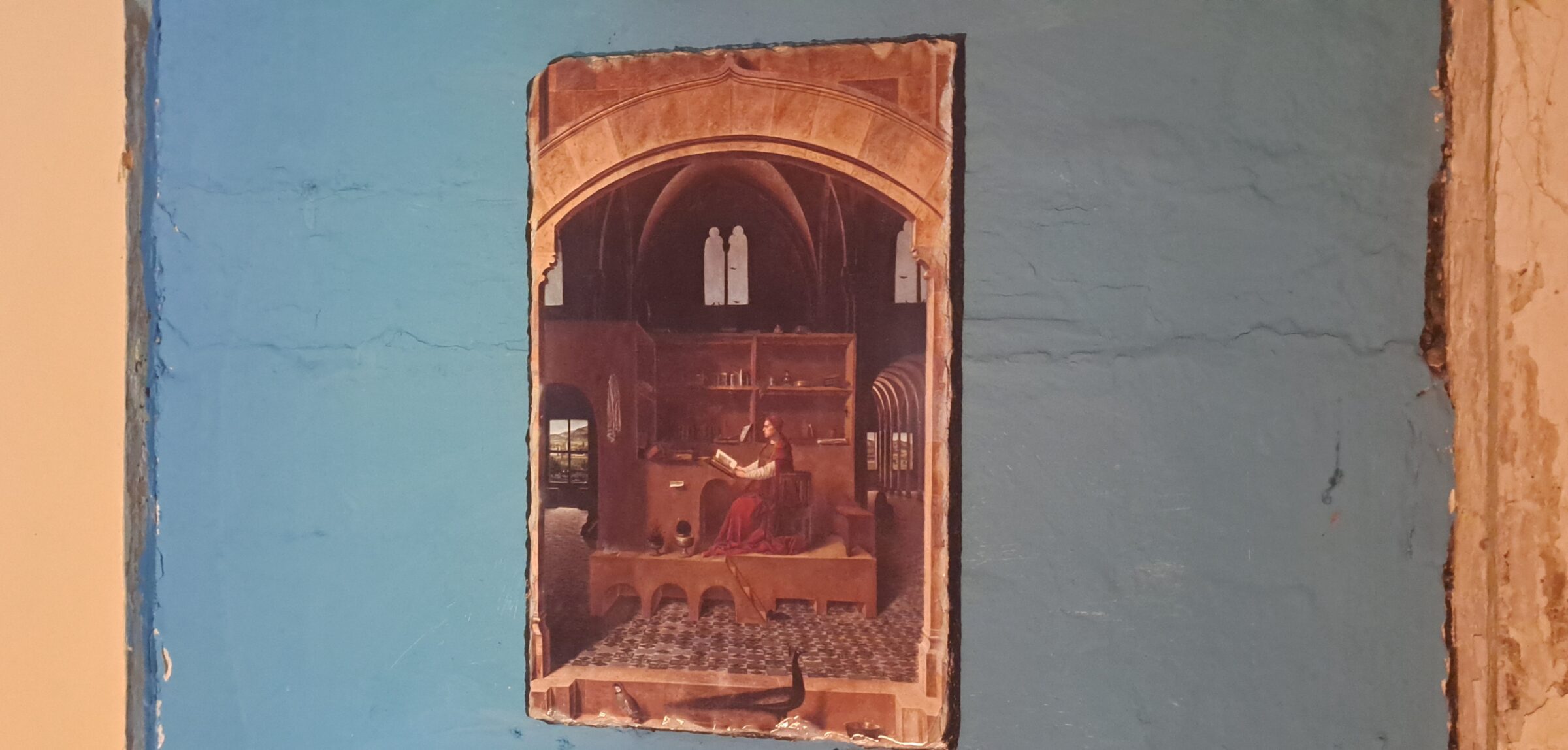
On the way into the Rithmomachia Room, Sir Rowland Hill’s prayer room, there is a copy of Antonello da Messina’s “Saint Jerome in His Study” (c. 1474). This image exemplifies the Italian Renaissance’s embrace of Flemish detail and naturalism. The meticulously rendered study, bathed in complex lighting, portrays Saint Jerome translating the Bible. Symbolic objects like the peacock (immortality) and partridge (truth/deceit) enrich the scene. This work highlights the interplay of light, perspective, and symbolism in Renaissance depictions of scholarly pursuits.

Saint Jerome in His Study (Antonello da Messina)
Both Saint Jerome and Sir Rowland Hill were deeply dedicated to scripture. Jerome’s life work involved translating the Bible into Latin (the Vulgate), making it more accessible to scholars. Similarly, Hill championed the publication of the Geneva Bible in English (and other texts), putting them the hands of ordinary people.
The painting depicts Saint Jerome in his study, surrounded by books and scholarly tools; this reflects the emphasis on learning and interpretation central to the production of the Geneva Bible. Hill was a polymath with a keen interest in education and knowledge dissemination.
“Saint Jerome in His Study” showcases a scholar actively translating scripture, potentially echoing Hill’s role in making the Bible readily available in English. Both figures aimed to bridge the gap between the written word and a wider audience.
