

The Mystery from the Missing Monument: Sir Rowland Hill and the Great Fire
Sir Rowland Hill, the man who brought the Geneva Bible to England, deserves more recognition than history has afforded him. While some might attribute his lesser fame to the Bible’s awkward reception or the abundance of men named Rowland Hill, a more intriguing reason lies beneath the ashes of the Great Fire of London.

Portrait of Sir Rowland Hill, in the Hall Mercers’ Company
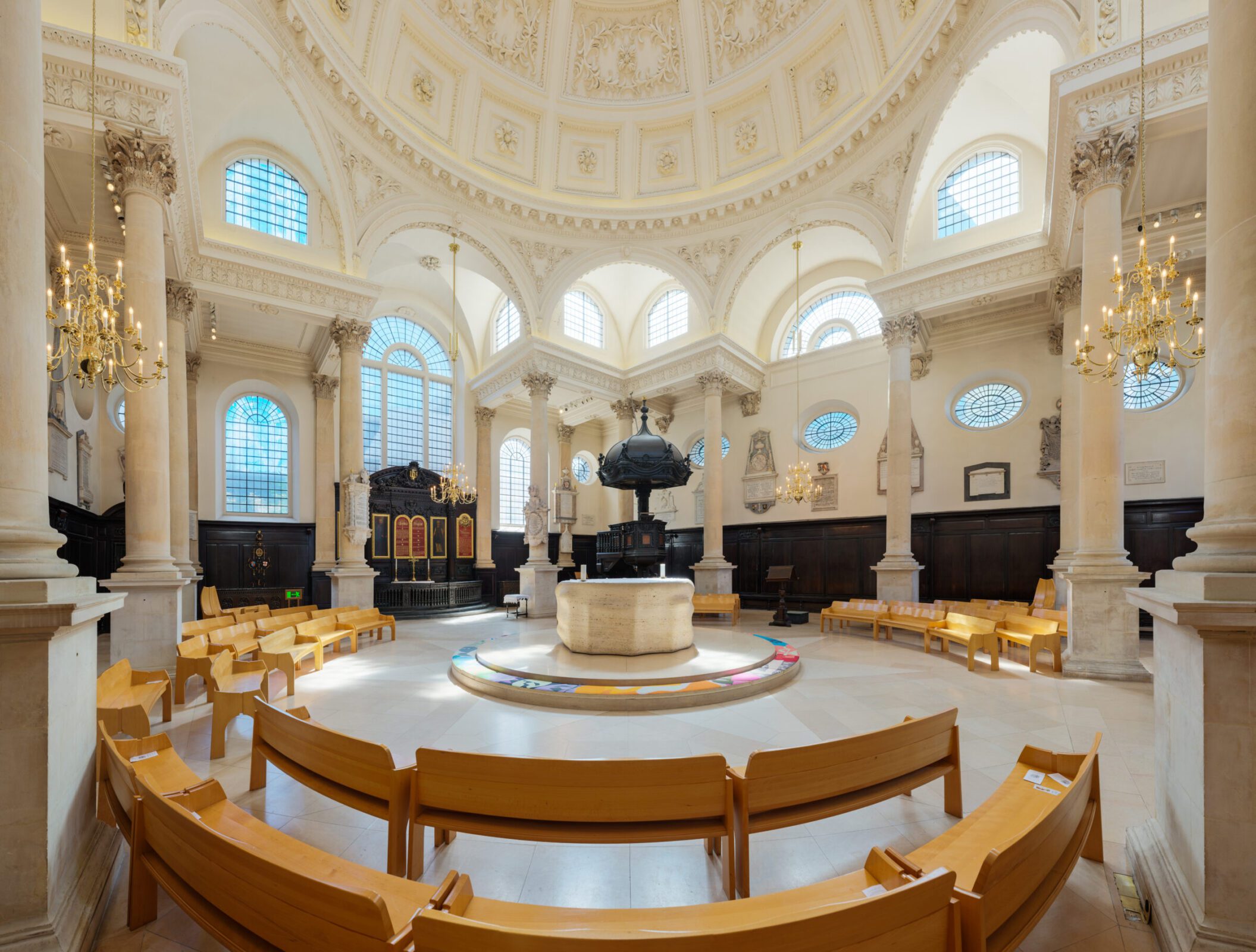
Records tell of a remarkable Tudor monument dedicated to Sir Rowland Hill. This life-sized statue, depicting him holding the Magna Carta, once resided within a medieval church on the very site now occupied by St Stephen Walbrook. Sadly, the Great Fire ravaged much of London in 1666, and the monument’s fate remains a mystery.
This lost monument hints at a forgotten significance Sir Rowland Hill once held. Unearthing its secrets could not only shed light on his legacy but also offer valuable insights into Tudor funerary practices and artistic styles.
It is understood that the origianal statue of him on the “The Obelisk”, a column of 110 feet, and was :
a copy from an ancient monument, which before the fire of London stood in the church of St. Stephens Walbrook
– Brayley, Edward Wedlake. The Beauties of England and Wales, or original delineations, topographical, historical and descriptive of each county
The text on the lost monument read:
A friend to virtue, a lover of learning,
A foe to vice and vehement corrector,
A prudent person, all truth supporting,
A citizen sage, and worthy counsellor,
A love of wisdom, of justice a furtherer,
Lo here his corps lieth, Sir Rowland Hill by name,
Of London late Lord Mayor and Alderman of same.
– Betham, William (1803). The Baronetage of England. Vol. III. p. 208.
Here is an account of the funeral of Old Sir Rowland from the time:
The v day of November was bered in sant Stephen’s in Walbroke ser Rowland Hylle, latt mare and altherman and mercer and knyght, with a standard and v pennons of armes, and a cott armur and a helmet, a crest, sword, and mantyll, and xj dosen of skochyons of armes; and he gayff a c. gownes and cottes to men and women; and ther wher ij haroldes of armes, master Clarenshux and master Somersett, and my lord mayre morner, the cheyff morner; ser Recherd Lee, master Corbett, with dyvers odur morners, ser Wylliam Cordell, ser Thomas Offeley, ser Martens Bowes and master Chamburlan althermen, and the ij shreyffes, and master Chambur . . and master Blakewell, with mony mo morners, and a 1. pore men in good blake gownes, besyd women; and the dene of Powlles mad the sermon; and after all done my lord mayre and mony and althermen whent to the Mercers’ hall and the craft to dener, and the resedu to ys plase to dener, and grett mon mad for ys deth, and he gayff myche to the pore.
– The Diary of Henry Machyn, Citizen and Merchant-Taylor of London, 1550-1563. Originally published by Camden Society, London, 1848.

Rowland Hill Monument, Hawkstone Park
