

Soulton Hall Contributes to Inaugural John Weaver Dance Festival in Shrewsbury!
Soulton Hall is delighted to be a part of the Shrewsbury’s exciting new John Weaver Dance Festival, celebrating the legacy of this pioneering figure in English ballet.
John Weaver, a Shrewsbury native, is hailed as the “father of English ballet,” and this inaugural festival promises a vibrant exploration of his life and work.
Soulton Hall is honored to have contributed to the festival’s exhibition by lending materials from our extensive archives, specifcaly:
- the book in which Hanah Deakin designed the Soulton Dancing Pavement
- the accounts showing the payments made to the masons for installing the pavement
- examples of the dance pattern on the material culture of Soulton Hall items
We hope these items will offer a unique glimpse into the artistic and social landscape of Weaver’s era, enriching the visitor experience.
The festival program boasts a captivating student performance, a captivating lecture by a renowned dance historian, and a comprehensive exhibition. Held at the prestigious Shrewsbury School, known for its long-standing tradition of dance education, the festival promises a truly immersive experience.
We are thrilled to support this initiative that celebrates a pivotal figure in British dance history.
The John Weaver Dance Festival offers a wonderful opportunity to learn about Weaver’s groundbreaking work and its lasting impact on the art form.
We encourage the community to attend this exciting event!
For more information and tickets, please visit the Shrewsbury website here.
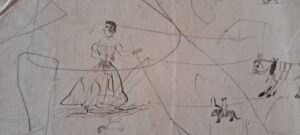
Marginalia in by Hannah Deakin in the 1830s Soulton Day Book; in the 1840s this was book used to design the Soulton Dancing Pavement.
Exhibition text
In collaboration with country house expert James D. Wenn, the following text was prepared to support the exhibition of the Soulton items:
Dance as statecraft
The courtly elite of Medieval and Early Modern Europe, saw dance as sincere component of government and harmonious administration.
To modern minds, this may initially be a challenging thing to entertain. Yet, if you recall that the royal courts of these times were self-consciously invested in taking the examples of the classical world and the Bible and inhabiting them this becomes a more relatable idea –
particularly when you consider the temple dancing of King David (2 Samuel 6:14-22).Weaver call’s attention to Miriam, Moses and Aaron doing devotional dancing for civic and religious purposes in materials I this exhibition, having plainly stated of his own culture:
“Our Judges, great councillors and Statesmen; as well as the Ancient Senators at some peculiar Times Dance… Plato in his Commwealth would have Dancing Schools”
— John Weaver, An Essay Towards an History of Dancing (1721), pp. 58
Dancing of this kind was considered in a supernatural way and represented resource of power, for good or ill:
“though Dancing be a pleasant and innocent recreation, when modestly used; yet may it (and so may the most holy things) be perverted, and made a Property of ill Designs…”
— John Weaver, An Essay Towards an History of
Dancing (1721), pp. 58Dance as a learning perspective
Within this exhibition is Weaver’s copy of Harmonics by Ptolemy. This text text gives a sense of a universal harmony, and Ptolemy’s work can be seen to be part of Plato’s philosophical project of celebrating divine forms rooted in mathematical and geometrical purity. By locating dance inside this thought perspective, and making plain the association of dance with statecraft Weaver is setting out that dance is used by at least some of the holders of public office in his time and before as a way of explaining and performing the obligations of Plato’s guardians: to target and perform harmony.
Shakespeare
This role for dance feels a lot more natural when we look at the role of dance in the performance of Shakespeare. Let us take As You Like It as an example. The play begins in disharmony. A violent and dangerous court under a usurping Duke Frederick forcing the sympathetic, righteous (i.e. harmonious) court into exile in a forest.
Harmony return when involves confused identities and marginalised people recovery recover what was taken from them, and weddings officiated by the classical god of marriage ceremonies, inspiring feasts and song and then a dance.HYMEN: Then is there mirth in heaven,
When earthly things made even
Atone together.
— Shakespeare, As You Like It (written and performed about 1598-1600). Act V, Scene 4. The Forest of Arden.To a courtly audience of Shakespeare’s time, embedded in the culture Weaver is reporting this scene carries a freight of meaning which escapes contemporary audiences. Not in particular the presidency of a classical god at the wedding, firmly linking the event in a classical context, which was a springhead for these concepts in Renaissance minds.
It is uncontroversial that Shropshire in general, and Shrewsbury School in particular was of foundational importance in the development of English Drama. Thomas Warton, the English literary historian, critic, and Poet Laureate of the 1700s credits this area with incubating drama a generation before Shakespeare.
The plays of Thomas Ashton (Headmaster 1561-71) were of national significance, attracting the attention of Elizabeth I, and the prior to the move to Kingsland the school’s current site was peppered with arbours for guild drama. Note also the role of the School in educating Sir Phillip Sidney, Fulke Greville and (via Ashton after he departed the school) Robert Devereux, 2nd Earl of Essex 1 , and in turn the role of these figures in national literary life: their education involved routine day drama and plays taking over parts of the River Severn, and the town walls for visits of state, and consider how this culture went on to inhabit the court.
Emerging scholarship (signposted below) is examining the links between Sir Rowland Hill of Soulton (c. 1495-1561) and As You Like It. Hill was “The First Protestant Lord Mayor of London”, a privy councillor, statesman, scholar, merchant and patron of art and philanthropist active through the reigns of Henry VIII, Edward VI, Mary I and Elizabeth I. He is associated with the publication of the 1560 Geneva Bible, and his name appears on its frontispiece.
The deeds that secured his house at Soulton connect him and that place intimately to Thomas Lodge, the writer of the source book for As You Like It, well established to be Rosalynde (1590). In As You Like It the dead hero is called ‘Old Sir Rowland’, which is a creative choice made by Shakespeare to substitute ‘Old Sir John’ in the primary material.
There are further reasons to identify Rowland Hill with ‘Old Sir Rowland’, which are awaiting publication, but it may be plainly stated that one of the identities of the house he built at Soulton is explicitly a pre-1560 classically-inspired theatre.
It is highly likely that Sir Rowland Hill was involved in the founding petitions that established Shrewsbury School.
The Soulton Dancing Pavement
At Soulton Hall there is a dancing pavement. It is for a circle dance of lozenge shaped box steps. It dates from 1847 and was designed by the 5/6 times great grandmother of the current generation. This exhibition contains the book the pavement was designed in along with the accounts showing the payment for the work
(carried out by Lewis, which is a masonic name). This device has been in consistent use at the house for centuries of material culture (see the contemporary embroidered cushion).Like the dance in as You Like It, it is a dance for eight people. It is understood by scholars that this pavement shows the choreography for the dance in As You Like It. This is supported by the surviving material culture of Rowland Hill at Soulton: this design is fond on his wood panelling, and Chair of Estate.
Sir Rowland Hill was earnestly involved in statecraft in the turmoil of the Reformation, saving cultural treasures (such as a Statue of Christ from the Ruins of Mercers’ Hall) and lives by hiding people and things targeted by zealots and iconoclasts. He was involved in targeting
harmony: in being one of Plato’s guardians.It is interesting to note that the Victorian throne in the House of Lords also follows this
design.Soulton is intimately linked with dance having its own Jigg, The soulton Jigg a longways dance for’ as many as will’ recorded in The Second Book of the Dancing Master, first edition (p. 2), published in London by John Young in 1713.
Further Reading
This above work is part of live study, with forthcoming publications expected as follows.
- James D. Wenn Stones of the Magi. Canalside Press. Forthcoming.
- Christine Schmidle and Tim Ashton, Who is ‘Old Sir Rowland?’ Forthcoming Journal Article
You may also find this explanation of Ptolemy useful:
- James D. Wenn, From Egypt to East Anglia: design in the Sutton Hoo scabbard bosses. 2023.
