


The Wemian has just published an account of the lecture in Ss Peter and Paul’s repreating the City of London lecture on Shakespeare.
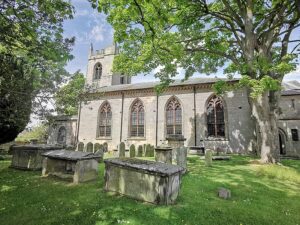
Wem Church of Ss Peter and Paul
The london version of the talk was recorded and can be found embedded below:
The account in TheWemian was as follows:
“I like this place and could willingly waste my time in” William Shakespeare’s familiarity with Wem
On 10 February a public lecture was delivered in the Church of Ss Peter and Paul, Wem; repeating a lecture before dignitaries in The City of London on 18 January. This article sets out some what was spoken into the record at those events.
The lecture, titled Who is Old Sir Rowland, concerned the legacy of Sir Rowland Hill, the sixteenth-century statesman, theologian, polymath, and defender of culture, and in particular his connections (and thus those of Wem) to William Shakespeare’s much-loved comedy set in the Forest of Arden.
The central case made in the lecture was that Sir Rowland Hill, the real sixteenth century person who published the 1560 Geneva Bible and was Lord Mayor of London in 1560, shaped and inspired the fictional character Old Sir Rowland in Shakespeare’s play As You Like It. Shakespeare is known to have incorporated real-life people and events into his plays, and the identity work of the character ‘Old Sir Rowland’ was noted to be closely congruent with this Tudor resident of Wem Rural.
The sixteenth century deeds to Soulton were shown which definitively link the manor to the writer of the As You Like It source book, which is Rosalynde: Euphues Golden Legacie (1590). That book was written by Thomas Lodge Jr, whose father Thomas Lodge Sr transferred Soulton to Sir Rowland Hill during his dramatist son’s boyhood. Descriptions of the woodland setting were noted to evoke North Shropshire in describing a flat plain bonded by mountains.
Attention was called (past the obvious and familiar love stories) to the play’s political story. In this, a usurping Duke Fredrick has taken control of the state, and good statesmen are forced to leave for the Forest of Arden to find harmony. The territorial extent of the Forest of Arden was shown to conjure Shropshire in the minds of Tudor audiences, and the political arc of persecution and intolerance bending back to harmony was seen to mirror the political situation in England during the sixteenth century, when Rowland Hill was working to establish harmony out of the chaos and iconoclasm of the Reformation, work he was particularly engaged in at Soulton Hall.
The lecture also explored the connections between ‘Old’ Sir Roland Hill and William Shakespeare through material culture: Hill’s chair of estate, and other personal items, along with the 1847 the dancing pavement at Soulton Hall, and the book plate that appears after “As You Like It” in the First Folio all contain references to each other and knowledge of geometry that suggest a link between the two figures.
The biographical links between Shakespeare and ‘Old’ Sir Rowland Hill were then set out. Chief among these is Hill’s status as a cousin of Shakespeare’s mother, Mary Arden arising from the alliance of the daughter of his heiress, Alice Gratewood, to Robert Arden. Links were also show to the Vernon, Stanley, Devereux, Wrotesly and Sidney dynasties.
Sir Rowland Hill’s contributions as an architect and learning theorist were discussed, in particular how his house at Soulton Hall is designed to hold information, with references to biblical and classical illusions. For the purpose of the case being explored the coded references to the ancient theatre at Epidaurs and the temple at Eleusis were of most importance, though others were set out.
Returning to the famous dance of harmony that closes the play As You Like It, it was stated that the dance is one known since classical antiquity and that the choreography, thought lost, has in fact survived at Soulton Hall in stones laid in a pavement, “sermons in stones”. This was underlined by Hill’s clear involvement in protecting books, artefacts and persecuted people, made most explicit in the protection of the Statue of Dead Christ in the chapel of the Mercer’s Company and the priest hole in Soulton Hall – quite possibly the first in England.
Beyond these connections, Sir Rowland Hill’s work in arts, publishing and commissioning were explored. Hill published on medicine, mathematics, statecraft, the history of England’s European allies and Turkey, the discovery of America, and the laws of Geneva (this last book used a publishing stamp that was later used by the publishers of the First Folio). Elsewhere, attention was called to Sir Rowland Hill’s extravagant cultural commissioning work, for example in Shropshire’s St Catherine’s Fair and London’s midsummer watches, as well as his status as the regulator of dram in London the generation before Shakespeare was born (a role in which it was noted he liberalised the regulation of the art).
In conclusion it was said that it was clear Sir Rowland Hill was a vastly more significant figure in English history and culture than previously thought in our own time, and that Wem and the surrounding area stood to unlock much cultural and economic opportunity in embracing this legacy.
With thanks and acknowledgement to Byrga Geniht and Christine Schmedle.
The London version of this lecture was recorded and is available via YouTube under the title: “A Shakespeare Mystery Solved: Who is Old Sir Rowland?”. A transcript was also placed in the Wem Library.
********
The current edition of ‘The Wemian’ is carrying an account of #Shakespeare/#asyoulikeit/Wem intersection.. pic.twitter.com/TkI65wDmxN
— Soulton Hall (@SoultonHall) May 21, 2024
