


The Bridge at Soulton goes all the way back…
Although the current bridge was overseen by Thomas Telford, it replaced an earlier (narrower) bridge. We do not currently know how old the structure Telford replaced was, but there was certainly a bridge during the Middle Ages when Soulton Castle was built to protect it. The Welsh Marches were a volatile place, and the history of Wem is full of repeated attacks, skirmishes and even burnings of the town.
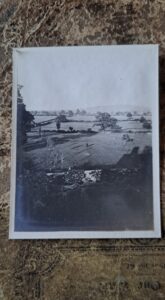
The Lost Avenue for Soulton Hall: part of the Sir Rowland Hill concept it adressed the rising Easter sun, began at a Well of Catharsis and came to and end at a gate into the Soulton presinct closed up in the 1780s.
In the Tudor period the construction of a new corps de logis (living block) at the top of the hill brought the sprawling ancient manor complex into view from this water crossing, and that building (the present-day Hall) faces the bridge. The Hall dates from the acquisition of the manor by the Hill family, and the two projecting towers, along with the lantern on top of the original pyramid roof, formed the castle on the Hill coat of arms.
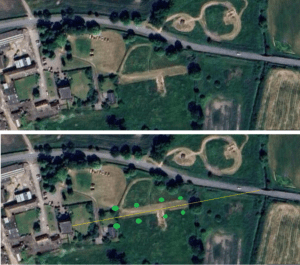
a labeled image of the Soulton landscape during exchvation by Dig Ventures
