


The recent departure of the hereditary peers from Parliament marks a significant milestone in a democratic journey.
It is a decision made by an elected legislature, moving the machinery of the state toward a more “efficient” and logical model.
Yet, as the “daylight” of reform fills these historic chambers, we are left with a fascinating psychological landscape to observe.
Across the country, the reaction to such transitions is rarely neutral. We see a visible tension in our streets: symbols displayed on public furniture to the pleasure of some, and to the less positive reactions of others.
The fact that people have such potent feelings at all is the phenomenon we want to look at. This is not really a question of national origin and certainly not one of “ethno-genesis,” but a question of how any complex organization communicates its values and invites human participation.
In the 19th century, Walter Bagehot famously argued that the British Constitution required both “Efficient” and “Dignified” parts. He believed the “Dignified” elements—the Monarchy and the Lords—were a kind of “magic” necessary to win the loyalty of a public he viewed with a certain condescension.
By today’s standards, Bagehot’s view is patronizing. It suggests a divide between a rational elite and a public that needs to be “managed” by pageantry. However, if we look at this in a detached and comparative way, we can see that Bagehot was touching on a fundamental truth of human psychology: human beings do not easily process large-scale abstractions.
A nation, a town, or even a local council is a massive abstraction. To make it “knowable” to the human heart and mind, it must be distilled into something tangible—a theater of presence.
This is not about being “fooled” by a show. Instead, it is about what John Vervaeke calls Participatory Knowing.
-
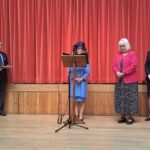
- Pauline BEM and Graham Furber DBE being presented with thier hours from HM The King by Shropshire Lieutenancy in Wem Town Hall
-
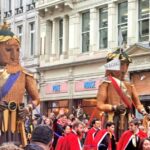
- Gog and Magog, the traditional guardians of the City of London, and they have been carried in the Lord Mayor’s Show since the reign of Henry V.
-
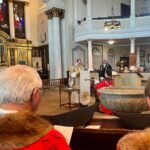
- Inside the service, Cllr Wagnar receiving the civic sword of Shrewsbury from Rev’d Samuel Mann, Vicar of St Chads. Image: Ben Jephcott.
We do not just want to live under a government; we want to feel we are part of a meaningful system. We see this need for “buy-in” expressed in rituals that are deeply local and human:
-
The Wem Town Carnival: A vibrant display of community presence. It is a moment where the town stops being a collection of houses and becomes a shared event.
-
Mayor-Making Ceremonies: The formal “handing over” of responsibility. This ritual takes the abstract concept of “civic duty” and gives it a face and a chain of office.
-
The Lord Mayor’s Show: A display of continuity and trade that connects the modern city to its historical roots.
-
Citizenship Ceremonies: A formal “threshold” that turns a legal contract into a felt reality of belonging.
The Social Reproduction of Virtue
Beyond mere belonging, these symbolic structures facilitate the social reproduction of virtue. Virtue is not a static set of rules; it is a living quality that must be caught from one person by another. This mimetic learning is how a society maintains its character.
We see this clearly in how we choose our heroes and symbols. Young footballers celebrate their heroes not just for the goals they score, but for the “virtue” of their dedication. We see it in the identity-forming power of figures like David Bowie, who modeled a courage of self-expression, or David Attenborough, whose presence embodies a lifetime of stewardship and curiosity.
Even on a global scale, this explains why Shakespeare remains a vital symbol. He is adored in Japan and quoted in Washington D.C. not because of his nationality, but because he provides a theater where we can practice being human. He is a “Dignified” vessel for shared humanity that transcends the “Efficient” borders of any single state.
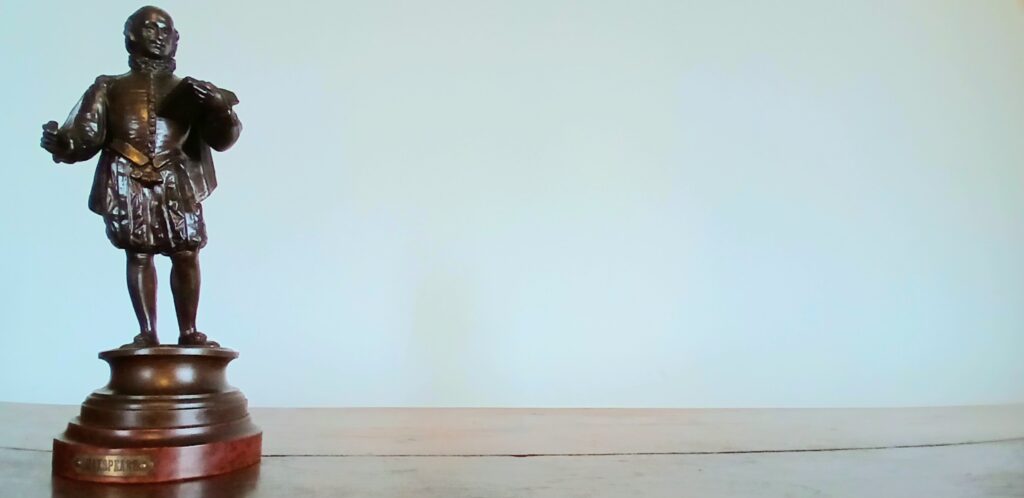
Shakespeare: a “Dignified” vessel for shared humanity
The Tension of the Symbol
The removal or replacement of symbols often creates tension because these objects function as the “connective tissue” of a society. In an era defined by digital abstractions and a pervasive “Meaning Crisis,” there is a profound psychological need for symbols that feel grounded and enduring.
The departure of hereditary peers represents a logical evolution for a modern democracy. While this shift does not necessarily reflect the individual service of those involved, it marks a transition from “Being” to “Doing.” For some, these figures served as a symbolic vessel existing outside the realm of professional resumes and temporary political appointments—offering a perceived link to “Deep Time.” Whether or not one shares this view, the perspective itself highlights a significant argument: that power is not merely transactional or purely rational.
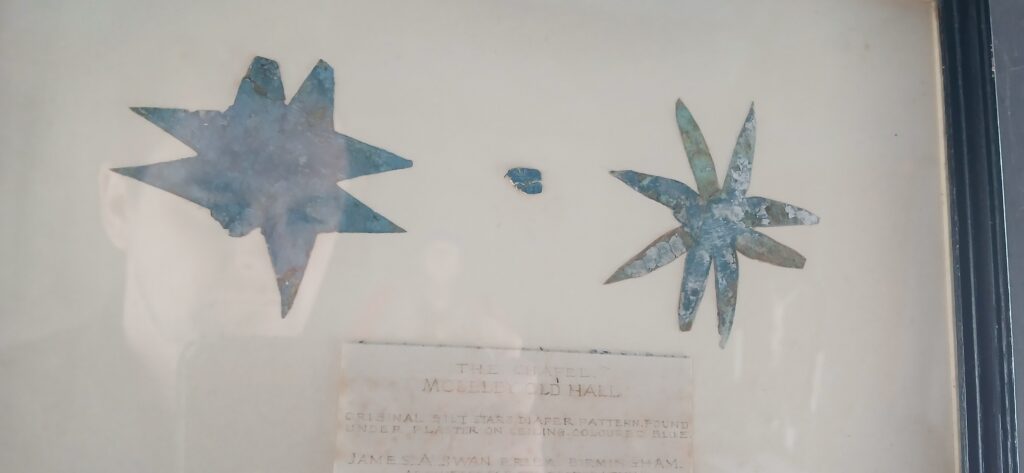
C18th(?) stars found during restoration work at Moseley Old Hall
The importance of such non-transactional symbols is well-supported by cognitive science, which indicates that human beings require tangible, stable anchors to navigate and find meaning within complex social structures. This explains why many find profound meaning in moments that transcend partisan politics, such as the visit of the King to America this week or the late Queen’s address during the pandemic. These events provide a sense of continuity and shared identity that logic and efficiency alone cannot produce.
The Persistent Need for the “Dignified”
Whether one celebrates or questions the fading of old traditions, the psychological reality remains: a state that is purely “efficient” risks becoming cold and purely mechanical.
The theater of state—and the theater of the town—is the “garment” we wrap around the cold bones of the law.
We look to these rituals and icons not because we are simple-minded, but because we are seeking a way to inhabit our community and reproduce the virtues that sustain it.
Going into an AI-dominated future, the challenge is not just to be more “logical,” but to ensure that our institutions continue to provide the theater of belonging that human psychology so clearly craves.
A significant challenge of our age is not merely to refine the “Efficient” machinery of the state, but to ensure that the “Dignified” load is transferred to new, healthy symbols.
We must build a theater of belonging that is compatible with democracy, yet robust enough to satisfy the persistent human craving for a world that is not merely logical, but meaningful.

‘THE DANCE’ in the chantry chapel of Tong Church – a Vernon family monument
