

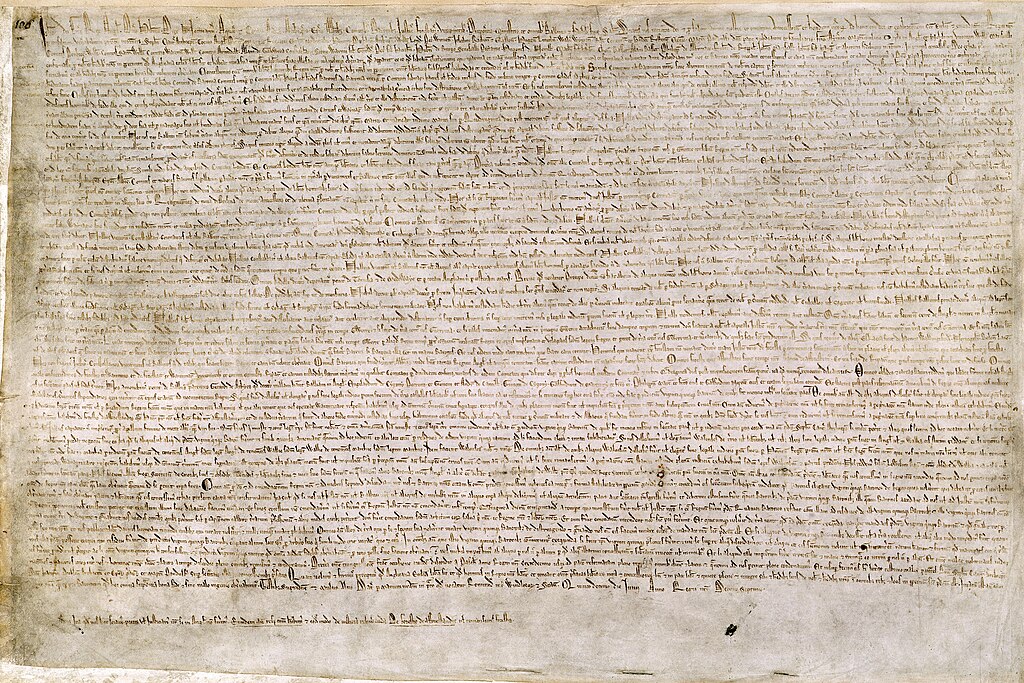
A continuity Erkenwald secured, Serlo negotiated, and the Magna Carta reclaimed: the English system Sir Rowland Hill lived to protect.
The history books often fixate on June 1215 and the drama of Runnymede, but that version of the Charter was a failed treaty, signed under duress and discarded within weeks.
The real turning point for England happened on this day, 11 February 1225. On this date, 800 years ago, King Henry III reissued the Magna Carta “of his own free will.” This was not a desperate ceasefire; it was a permanent settlement. By doing so, the monarchy finally abandoned the “Conqueror” model of rule and accepted the price of the English crown: the Law. It was the moment the Norman era was finally overwritten by the original English tradition.
The Great Charter was never a radical leap into the unknown; it was a high-stakes return to form.
The Barons were not inventing rights.
They were demanding the restoration of an English stability that had been meticulously built five centuries earlier by Erkenwald, Chad, and Cuthbert.
To understand the Charter, you have to foreground Erkenwald.
London had functioned as an independent node since the fall of Rome—there was still trade, as there always is.
In the 7th century, the Laws of Ine were already explicit about London’s unique status. The city sat in a legal “superposition” between the Saxon kingdoms, belonging to the system of trade and law rather than any single tribal warlord. Erkenwald ensured this continuity, establishing that the law lived in the community and the written record, rather than the King’s whim.
Erkenwald is a figure of immense interest here at Soulton. He represents the persistence of the old way that survives even when the surface of the land is conquered. This continuity was maintained by figures like Bishop William, who secured London’s ancient customs during the Conquest, and Serlo the Mercer, who negotiated the 1225 reissue. Serlo was a leading merchant who understood that legal autonomy was the primary plank of London’s wealth and stability. He looked back to the work of Bishop William, whom the merchants thanked ritually and civically during their mayor-making ceremonies for centuries.
When the 1225 Charter protects London, it is reaching back across the 1066 divide to find the reality Erkenwald secured.
The Charter did not grant London its rights; it finally forced the King to admit he had no power to take them away.
This deep-coded English identity is exactly what Sir Rowland Hill is memorialized with.
His monument stands not just for a person, but for the endurance of this specific legal and social framework.
As a leading Mercer himself in 1550, Rowland Hill clearly understood the importance of these foundations. He likely held a copy of the Charter because he recognized its symbolic and practical value and the Mercers having negotiated it obviousl held a copy. At a time when the Reformation was upsetting all old certainties, the legal autonomy established by Erkenwald remained the bedrock of the City’s power.
Hill’s legacy is a tribute to the idea that the system of the country—the one Erkenwald saved, Serlo negotiated, and the Magna Carta reclaimed—is what truly defines us.
Henry III realized that to rule England, he had to stop acting like a foreign occupier and start acting like the keeper of the English tradition.
To survive, the monarchy had to be “Saxonized.”
By reissuing the Charter on this day, the Crown realigned itself with the original English protocols: the return of the Witan (the “Common Council”), the bargain of taxation for law, and the reliance on the Shire Grid. Power was pushed back into the local centers of life—the Shires and the Hundreds—the very network that Erkenwald and his peers spent their lives weaving towards. At Soulton, we see this history in the land. The Norman superstructure of top-down control was always a temporary layer compared to the deep, decentralized English foundation. Magna Carta was the moment the Saxon English tradition finally finished its recovery.
It proved that the work of the 600s was more durable than the steel of 1066.
We do not celebrate a “new” law today; we celebrate the day the house was finally reclaimed, and the original architects—Erkenwald and his peers—were vindicated.
