

The Guardian Who Never Turns Up: Why Soulton Hall’s Legacy Listing is a Discredit to the Quango
The legal framework for protecting our heritage is built on a noble premise: that certain things are so significant they require a voice of their own.
We grant these buildings a form of standing — much like a child in a safeguarding case or a river given legal personality.
We do this because we don’t necessarily trust the incumbents—be they owners, developers, or the state itself—to act as perfect stewards.
In this relationship, the building is the minor, and the statutory body is the court-appointed lawyer meant to defend its best interests. But right now, the lawyer hasn’t just failed to turn up; they’ve forgotten who the client is.
The National Heritage List for England is largely a collection of “Legacy Records,” a polite term for entries that are, in plain English, horrific.
Soulton Hall’s entry dates back to 1958, a period of war-ravaged post-WWII exhaustion.
While that era was poorly resourced, it was often more sincere than the bureaucracy we face today. However, for various reasons, the 1958 listing of Soulton was not done well, nor was it done entirely honestly. It was a product of a specific moment that failed to capture the truth of the site, yet it has been allowed to calcify into an unquestionable legal “truth” for nearly seventy years.
This isn’t an isolated problem, but it is one that requires an exhausting amount of private energy to fix.
They eventually won, securing a Grade I listing that properly recognized the site’s exceptional importance, and “hurray for them”—it was a victory for the building.
But the fact that such a battle was necessary proves the system is broken.
A steward should not have to go to war with the guardian just to get the guardian to open its eyes.
Soulton Hall is now the “smoking gun” for this systemic rot.
Its current listing is misleading, unhelpful, and—following recent scrutiny—downright discreditable.
When a building’s description is so wildly inaccurate that it provokes a written answer from a Minister of the Crown in the House of Commons, we are no longer dealing with a minor clerical error. We are dealing with a poor record that actively hurts the heritage it claims to protect. Let us particulariise:
- To list this as Grade II* is a failure of scale. Given the context of the Geneva Bible, Shakespearean connections, and the polymathic genius of Sir Rowland Hill, the current grade is an insult to the site’s actual national importance.
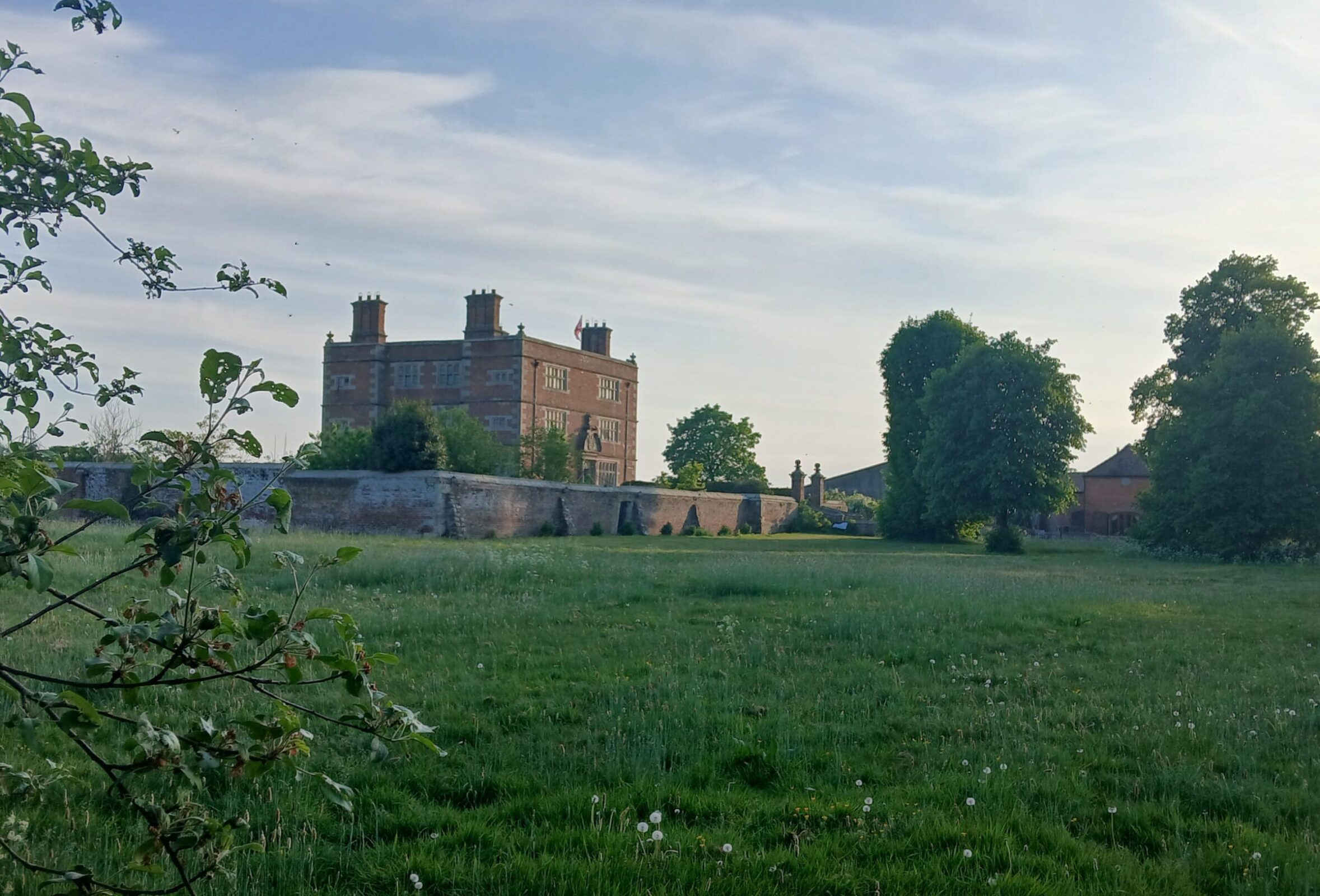
- The entry claims the house is dated 1668 for Thomas Hill, probably “incorporating parts of an earlier building.” This is a fundamental misreading. It wasn’t a piecemeal evolution; it was a single, sophisticated phase in the 1550s.
- The record hallucinates 18th-century features where they don’t exist: the “C18 balustrade” to the front is actually 17th-century, and the “square urn finials” are quite clearly oil lamps.
- The “mid-C18” steps are also 17th-century. The record notes a floral panel as “possibly not in situ,” which is true, but misses the point that it is almost certainly 16th-century.
- the gate piers are mislabeled; those “ball finials” are chess pawns, part of the building’s deeper, coded meaning.
- Worst of all, the record suggests timber framing was “incorporated to the rear left corner” from the 16th century. That is not the story at all. The house doesn’t “incorporate” the 16th century; it is the 16th century.
The only thing they got right was that the C20 owl statues were discordant and unpleasant – we agree and they have been removed.
We tried to get them to sort this out in 1986, pointing out that the “1668” date likely commemorated a marriage rather than the construction.
They ignored the evidence then, and they are ignoring it now.
This deficiency undermines the public’s understanding and forces us into a wasteful, performative dialogue where everyone is required to pretend that a manifest mistake is actually a valid legal standard.
The situation has descended into farce.
High-level meetings have been held in Parliament to discuss these failures—meetings where faith community leaders and stakeholders gathered to address the “missing” history of our national patrimony.
The statutory body was invited; it simply did not attend.
When those left in the room have to laugh off such a discourtesy as “silly” rather than an insult, the mask of professional stewardship has officially slipped. The most bizarre part of this “ward of court” relationship is that the burden of correcting errors has been flipped. Despite the record being a “conscious mistake” called out at the ministerial level, the state expects the private family to fix it.
On top of the burden of maintaining the fabric, funding research, and supporting faith community access, we are now expected to compile reports of an unclear extent to address undefined questions—all to correct the state’s own bad homework.
This ridiculous listing will eventually face the chop because it has become a public embarrassment to the department.
But until then, it remains an obstacle.
If the state expects us to prioritize its administrative mess over the actual survival of the heritage, it is mistaken.
We have a lot of other things to do first.
The very system designed to shield our ancient heritage is currently choking it, ignoring its own client while the rest of us are left to manage the reality on the ground.
