

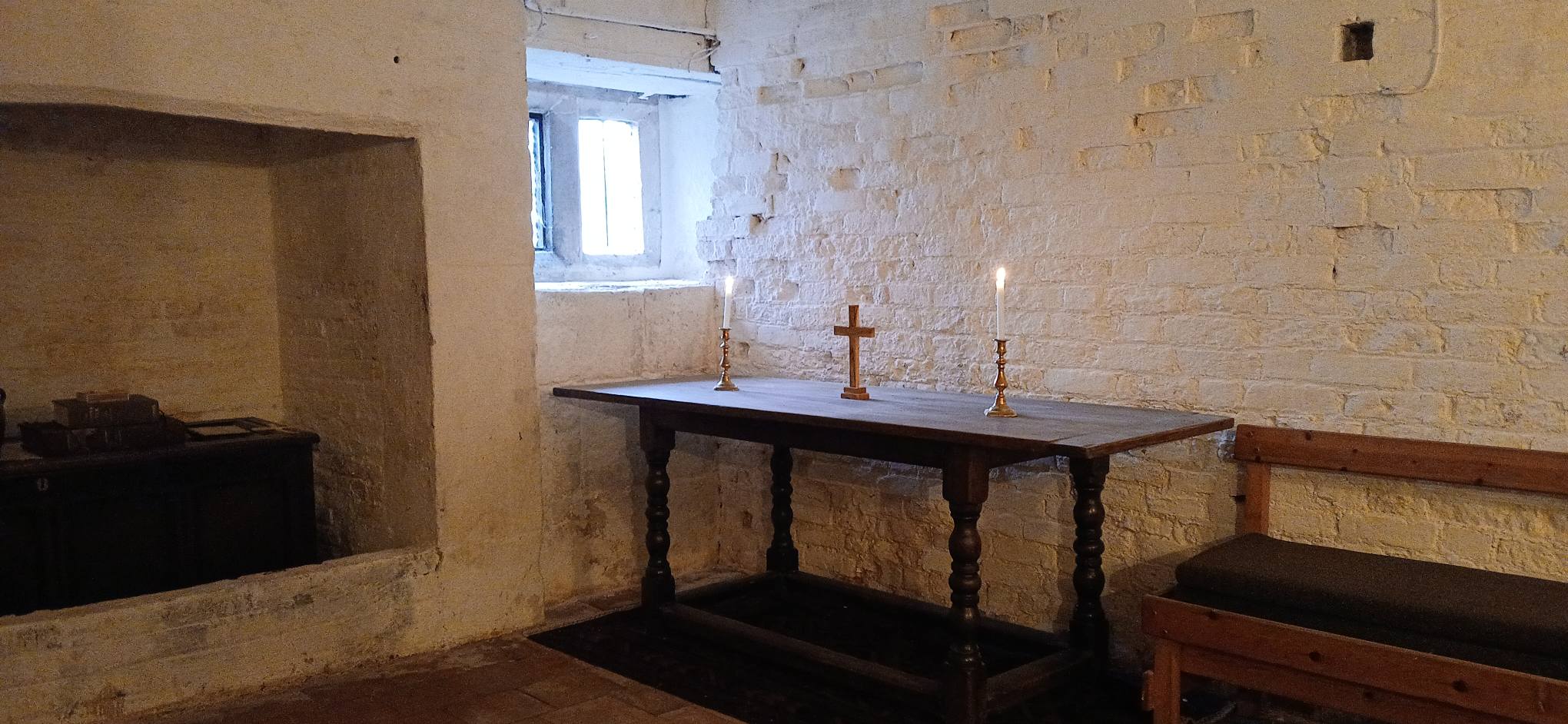
Today, an olivewood cross, handmade in Bethlehem, arrived at Soulton.
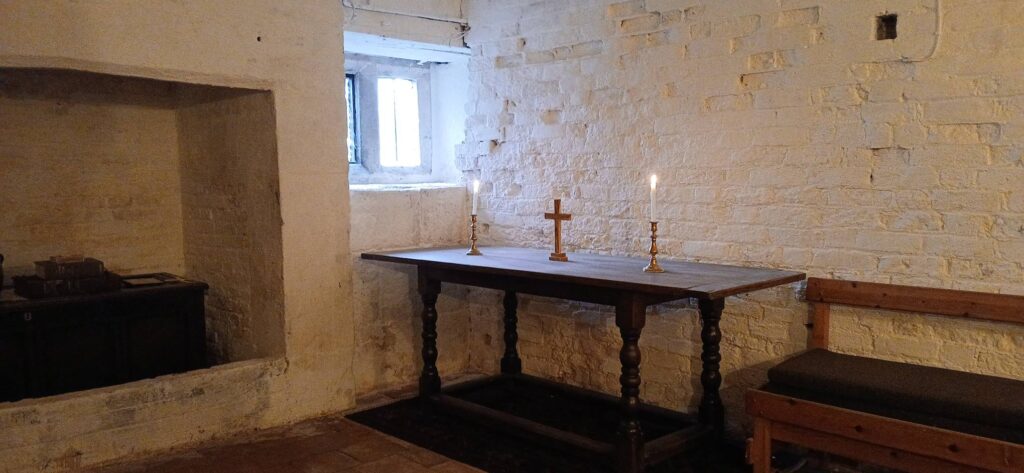
Olive Wood Cross in the Soulton Hall Prayer Room
In a house deeply associated with, and culturally still marked by, the complex and often fractured religious history of the English Reformation, the introduction of any new resonant object must be handled with a reaction of care and soberness.
Soulton Hall exists at a historical intersection. The depths to which Soulton was attended to by Sir Rowland Hill as a sanctuary—protecting both people and artifacts from the dual threats of iconoclasm and persecution—is increasingly understood as a vital response to, and a part of the process of, the “tumult of the Reformation.” This was an early, courageous engagement with the via media. This is not merely academic history; it is a legacy we live with, and a time-consuming, careful, and cautious thing to see reactivated.
As a family, we approach these questions first through the lens of sensible heritage presentation, ensuring that the house is legible and honest about its past.
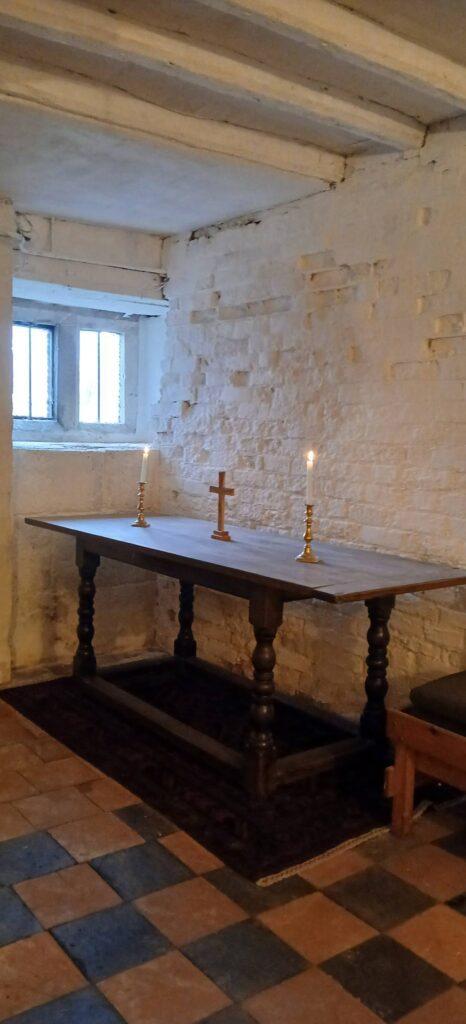
Simple Communion Table in the Prayer Room: a careful heritage presentation and a working space for ecumenical engagements.
Beyond this, we look through the lens of an ecumenical legacy and bridge-building, seeking a path that maximizes common ground and respect, promoting fellowship and healing while remaining unshy about the difficult nature of those times.
Finally, we attend to these matters through the lens of private thinking and personal reflection, acknowledging that these spaces are part of a home.
As a family home that is also a working estate and heritage site, we have a duty to attend to this history in a way that prioritizes honesty over easy comfort. Our stewardship of this legacy is physically expressed through two distinct spaces nd the undercroft more generally:
The Aedicule is a small, intimate chapel space that represents the “protected” history of the house. It is a site of continuity, profoundly linked with the lost altar stone of Old St Paul’s and the memory of St Erkenwald.
It often houses the resonant brass cross from Hampton Court—a wonderful gift originally used by a Royal Chaplain for devotional purposes.
The Prayer Room is a space we have worked to make serviceable for wider use, containing a communion table and serving as a focal point for visiting groups.
The “intersectional” identity of Soulton means we must honor both the “High Church” and “Low Church” valencies of the house.
While the Hampton Court brass is a magnificent anchor, Soulton is equally rooted in the “Geneva” tradition—the scholarly, sober, and unadorned Protestantism. Until now, we have often had to “loan” crosses between the Aedicule and the Prayer Room, or rely on the temporary, fragile nature of a Palm Sunday palm cross. While the palm cross is resonant, it did not provide the permanent parity required for the Prayer Room to be truly serviceable to all visitors.
The arrival of the Bethlehem olivewood cross is a deliberate response to this need. Its simple, organic form allows the Prayer Room to be configured to respect the conscience of those who visit:
-
For the High Church tradition, the room can be presented with the formal, historical resonance of the Hampton Court brass.
-
For the Low Church or Non-Conformist tradition, the room can be configured with the sober simplicity of the Bethlehem wood, reflecting the Geneva-style focus on the Word and the unadorned.
That this item was crafted in Bethlehem also allows for a modest, practical connection to Palestinian Christian artisans. In a time of significant suffering in that region, it feels right that we should look toward the source of these traditions with a quiet, supportive recognition of those continuing their craft under hardship today.
Soulton Hall is a place where history, trade, and family life meet.
We do not view the configuration of these spaces as a matter of “taste,” but as an output of our duty to provide “responsible accommodation.” By ensuring we have resonant objects that reflect the full breadth of the English tradition, we continue the work started by Sir Rowland Hill: providing a roof under which different traditions can find a sense of sanctuary and shared respect.
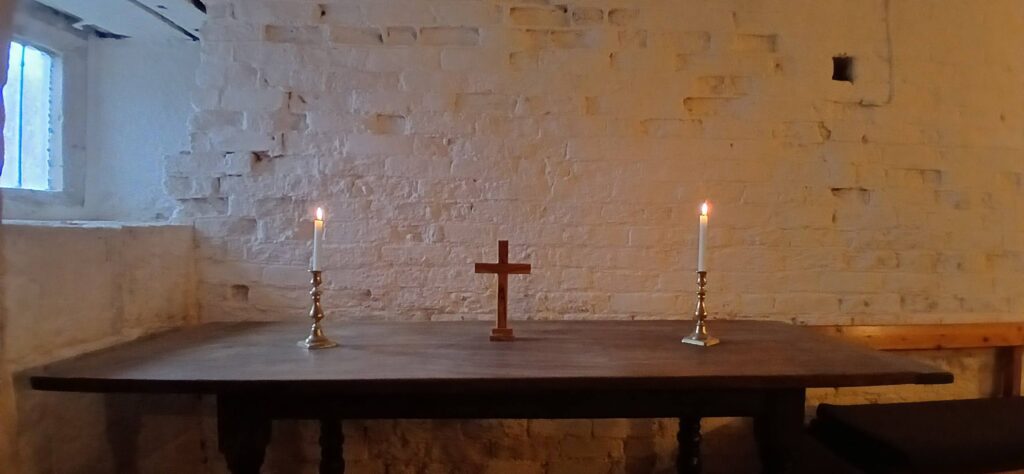
New Olive Wood Cross in the Soulton Hall Prayer Room
