


The frequent comparison between Soulton Hall and the tropes of modern conspiracy fiction—specifically The Da Vinci Code—is a matter we must address with care.
We understand why it happens; it serves as a useful shorthand for explaining how complex information can be encoded into physical space through “self-admitting” patterns—geometry in stone that communicates its own logic across generations.
However, we must be blunt: for many, this comparison is deeply upsetting.
The “thriller” narrative often treats the foundational figures and sacred beliefs of faith with a gratuitous flippancy. By subjecting the core of human devotion to speculative plots for the sake of entertainment, it causes a genuine injury to those who hold these ideas to be sacred.
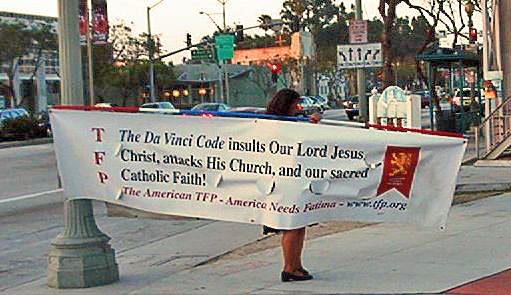
A woman protesting against The Da Vinci Code film outside a movie theater in Culver City, California. CC BY-SA 3.0. Polylerus at the English-language Wikipedia
At Soulton, we do not wish to be pompous about popular culture, but we must distance ourselves from a style of storytelling that “kicks away” at the dignity of belief.
It is unseemly to treat a heritage with so many stakeholders as a playground for sensationalism.
Geometry as a Technology of Resilience
What the modern thriller misidentifies as a “conspiracy” is, in reality, a technology of preservation.
In the 1550s—a theatre of state-sanctioned violence where the wrong intellectual or spiritual alignment was a capital offence—Sir Rowland Hill had to find a way to shield dangerous concepts he believed in very deeply.
He did not “hide” things for the sake of an elite or frvilous game.
Instead, he wove the principles of the “New Learning” and the scholarship of the theological project he was working through into the fabric of the house. He used the rhombic dodecahedron—a shape that fills all space in perfect harmony—as a “learning perspective” standing in plain sight. This wasn’t a puzzle box; it was a time capsule.
Hill was acting as a steward, holding these perspectives in trust until “better days” arrived—a future where they could be shared openly without the shadow of the stake.
A Manifesto Standing in Plain Sight
The “codes” at Soulton are self-admitting.
They do not require an initiation or a secret key; they require only the willingness to observe.
Whether one approaches the house from a position of faith or secular rationalism, the geometry remains a bridge.
For the believer, it reflects an order in creation; for the rationalist, it reflects the immutable laws of mathematical logic. This is the antithesis of the thriller trope.
Where a thriller hoards secrets for the few, Soulton Hall preserves a manifesto of peace for the many.
It is a democratisation of wisdom, standing openly in the landscape, waiting to be found.
Closing Reflection
To treat Soulton Hall as a sensational mystery is to participate in the dismantling of serious history.
It replaces a manifesto of resilience with a hollow thriller.
At Soulton, we do not view the house as a “puzzle box”; we view it as an act of stewardship. Sir Rowland Hill preserved these perspectives not as an exclusion, but as a gift — a standing invitation to a higher way of seeing the world.
The truth of Soulton is not a secret to be cracked by an elite; it is a legacy of human thought, standing in plain sight, waiting for the “better days” we now inhabit.
We asked our consultant James D. Wenn for his thoughts. James shared these insights:
”I have these concerns too.
We have appeared in the press a few times now in contexts where ‘The Da Vinci Code’ framing has filtered through to public-facing media.
Some of this is down to the whole economy of advice and brokering of press access. It is a feature of the modern landscape that people are so high on adrenaline and dopamine that slow-culture (long books, articles, specialist interest topics) are utterly abandoned as legitimate vehicles for public interest and the national memory. It is a kind of public collective lobotomy. As the landscape of power in broadcasting is what it is, all we can do is hope to gain enough traction to face the world one day on our own terms.”

Original Photography: Timothy E. Baldwin Archival Reference: Uploaded via Flickr Bot (August 2008) by Oxyman Licensing: This work is licensed under the Creative Commons Attribution-Share Alike 2.0 Generic (CC BY-SA 2.0) license.
