


Following a completely sold-out summer season, we are delighted to announce the release of our next block of heritage access dates at Soulton Hall, running through the winter months and into 2027. These events have become ever-popular, serving as an important piece of civic engagement and public tradition by keeping our shared history active, vital, and accessible.
These access tours represent a vital connection between the past and our modern community, keeping our national story visible rather than hidden away behind closed doors.

Epidaurus Court, Soulton Hall, with the Fereatry Sculpture protecting the Erkenwald site of memory
Constructed during a perilous 16th-century emergency by the polymath Sir Rowland Hill—who served on the Privy Councils of four Tudor monarchs—the house is designed to convey information by incorporating references to classical studies, scripture, and mathematics.
For the Tudor mind, steeped in Neoplatonic philosophy, the visible world was an imperfect reflection of a more perfect, true reality—the realm of Forms. Sir Rowland designed Soulton Hall as a physical model to unlock his “thinking technology,” using specific architectural proportions to guide the mind toward idealized concepts of harmony and our current reality.

The famous Soulton Dancing Pavement – linked to the dance of harmony for 8 that closes the play
Central to this design is the Garnet Code. Sir Rowland held a deep interest in the mathematical and social allegories of the rhombic dodecahedron (a twelve-sided geometry found naturally in garnets). This shape can perfectly fill three-dimensional space, fitting together seamlessly if its components are carefully arranged—serving as a powerful architectural metaphor for a harmonious society where everyone finds their place.
Visitors will see this geometry visibly projected across the estate, from the layout of the windows to the lines of the towers.
Hiding, Harmony, and the Shakespeare Connection
Soulton Hall served as a clandestine stronghold where Sir Rowland used his unique political position to safeguard precious documents and cultural works from destruction.
This is the place where memory holds that the relics of Saint Erkenwald and the lost altar of Old Saint Paul’s found refuge, if they survived the tumult of the Reformation and the destruction of the English Renaissance.
The estate features a historic priest’s hide in the studiolo—potentially the oldest in the country—which was remarkably used to conceal individuals during fierce periods of persecution.
This history of a dangerous, liminal retreat directly ignited the creative spark of Sir Rowland’s cousin, William Shakespeare. Soulton was the home of the Lodge family before passing to Hill, directly tying the estate to Thomas Lodge’s Rosalynde (1590), the source text for As You Like It.
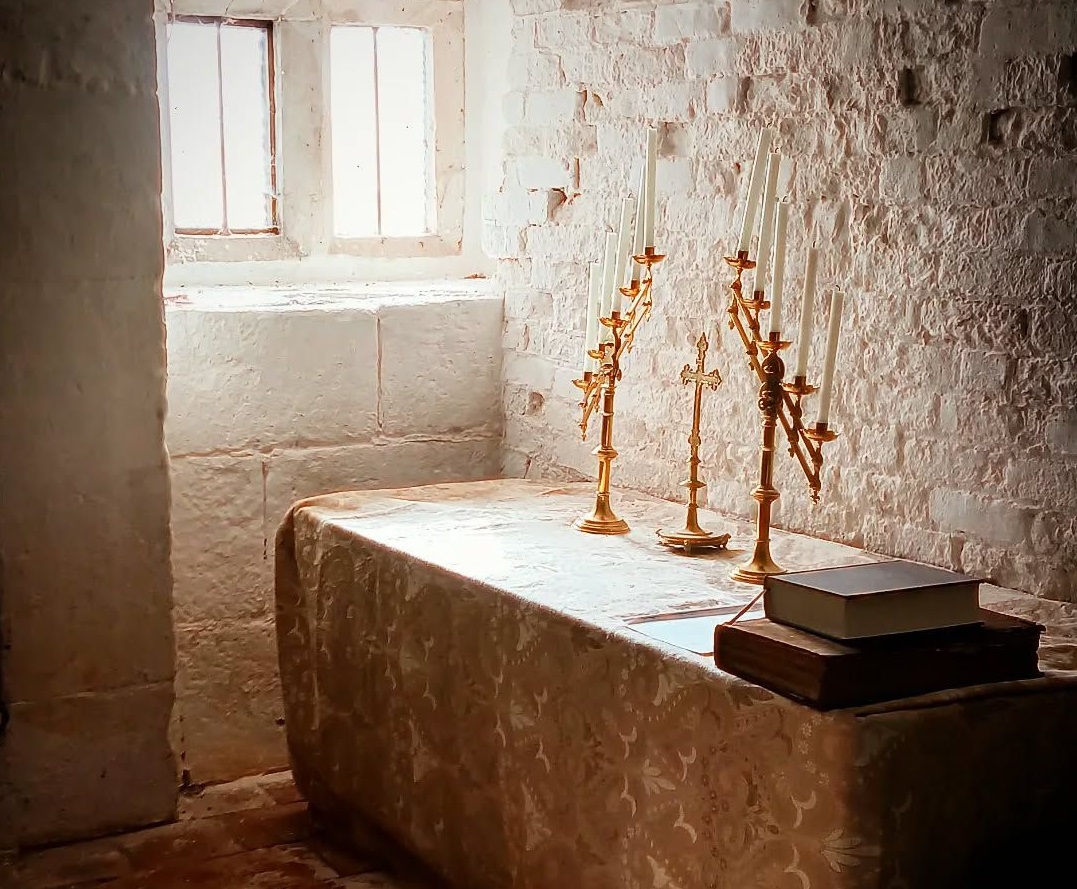
Tudor Prayer Room in Soulton Hall
When writing his famous comedy, Shakespeare honors this connection by naming the virtuous senior character “Old Sir Rowland.” Just outside the window, visitors can view the beautiful Dancing Pavement, a pebble mosaic reproducing the choreographic notation for the harmonious dance that concludes the play, symbolizing the recovery of order.
Unlocking the Architectural Callbacks
Sir Rowland Hill expected his intellectually curious visitors to decode the deliberate visual markers embedded within the estate. These include:
-
The Classical Theatre of Epidaurus: The surviving tower-like projections subtly echo the perfect geometry and acoustics of ancient Greek theatre, inviting guests to contemplate ideal civic order.
-
Solomon’s Temple: The east and west fronts of the house are deliberately designed to evoke scriptural descriptions of Solomon’s Temple, symbolizing wisdom and divine order.
-
The Telesterion at Eleusis: Reflecting the sacred proportions of ancient mysteries, Soulton Hall is built as a 55-foot cube within a precinct composed of nine equal squares, precisely mirroring the 55-yard footprint of the sanctuary at Eleusis. This connection extends to Sir Rowland’s surviving estate furniture, which features direct copies of the Eleusinian frieze.
What the Tour Includes
Your ticket offers an intimate audience with 470 years of history, guiding you through:
-
The Prayer Room, containing a miraculous surviving Rithmomachia Floor based on the ancient “Philosophers’ Game.”
-
The Ædicule, a structurally fascinating room bearing a massive symbolic load upon twelve original joists, precision-aligned with the rising sun at Easter.
-
The First Gallery, featuring original 16th-century stairs and fascinating light alignment effects.
-
The Chess Court and Wren Steps.
-
Tour Admission, including Tea, Cake & Guidebooklet (£25 per person).
Tour Dates and Arrival Times
The newly released sessions will take place on the first Sunday of each month where availability permits, spanning winter and into 2027. While the tours are adaptive to our guests rather than running to a rigid timer, we ask visitors to allow approximately 1 hour and 45 minutes to fully enjoy the experience:
-
Sunday, 6 December 2026 | 2:00 PM — Click here for tickets
-
Sunday, 3 January 2027 | 2:00 PM — Click here for tickets
-
Sunday, 7 February 2027 | 2:00 PM — Click here for tickets
-
Sunday, 7 March 2027 | 2:00 PM — Click here for tickets
Accessibility Information
We want all guests to be fully prepared for their visit. Because Soulton Hall is a highly complex historic structure, it presents several physical access challenges:
-
Main Floor: Accessed via the Wren Steps (seven shallow steps in the gravelled chess court). Once inside, there are three tour rooms on this principal floor.
-
Facilities: Access to the WCs inside the hall is up an additional three steps.
-
Basement & Gallery: The basement rooms (including the Prayer Room and Ædicule) are accessed down 13 stairs, while the first gallery is accessed up a flight of 19 stairs.
