


In a house that has been lived in and adapted for centuries, the most profound truths are often found exactly where they were placed hundreds of years ago.
At Soulton Hall, history isn’t just something we study; it is something we walk upon.
We are currently revising the old service areas to create better public access routes through the Hall.
In the process, we have revealed a floor that has been hidden under a suspended raft since 1993.
This specific part of the house was heavily altered in the 1660s. During the Restoration, fashions changed: ceilings were raised and new external doors were punched through the Tudor masonry to meet the aesthetics of the day. But while the “skin” of the room was updated, the structural logic underneath remained undisturbed.
The revealed paviors very likely date back to the 1550s, and no later than the 1660s.
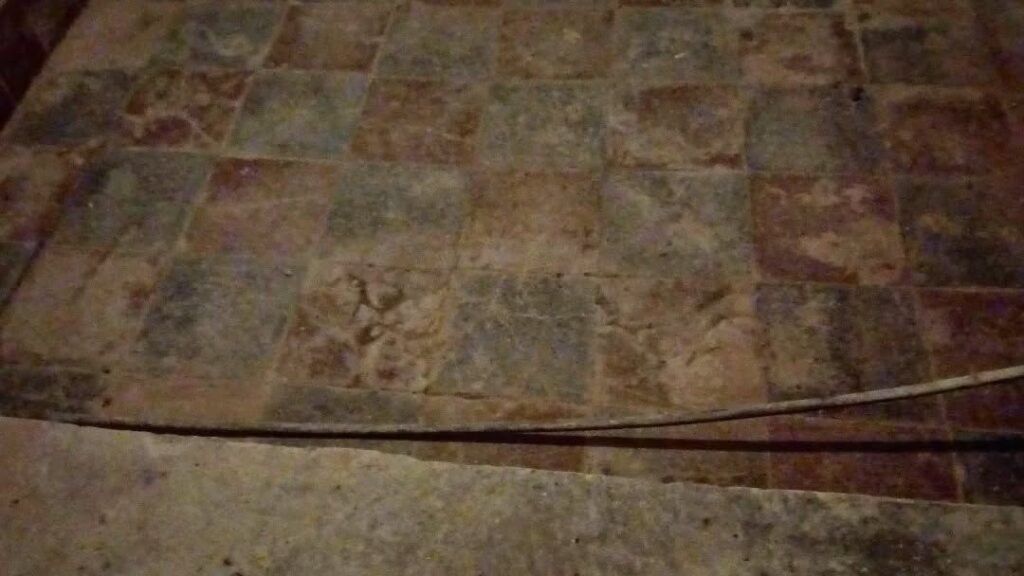
Likely C16th tiled floor in the Buttery Hall
Upon uncovering them, their configuration was immediately clear: exactly eight tiles wide. At Soulton, numbers are never an accident. This isn’t a coincidence of construction; it is yet another manifestation of the “Base-8” mathematical grid. This was the system Sir Rowland Hill used to encode harmony and proportion into the very bones of the building.
While the world outside—and even the rooms inside—changed around it, this floor remained. Now revealed, this path once again serves its intended purpose, leading the way toward the Aedicule and the Prayer Room.
It is a powerful reminder that while the layers of a house change with the times, the foundational logic is immutable. The Soulton Code doesn’t just survive; it persists, waiting for the physical space to align once again with its original intent.
