

A recent article in the Financial Times by Jo Ellison laments how Britain’s historic spaces—from Oxford’s medieval cloisters to Edinburgh’s atmospheric graveyards—are being consumed by “Pottourism.”
She watches crowds hunt for fictional wizards while ignoring the real, groundbreaking thinkers who actually lived and worked in those spaces.
At Soulton Hall, this critique resonates.

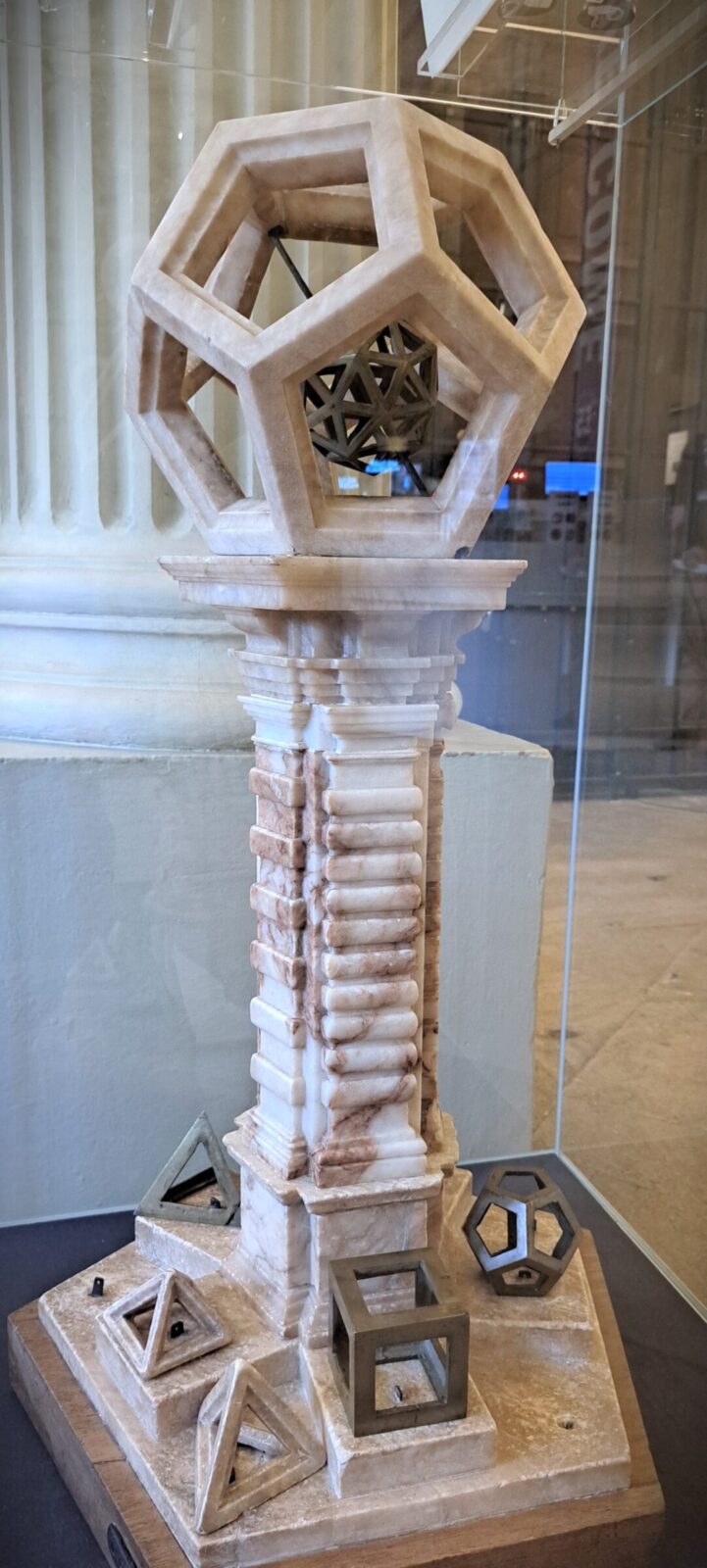
A curious instrument at the History of Science Museum in Oxford: perhaps a lecture prop exploring Platonic solids.
While we have no connection to modern fantasy franchises, we are intensely aware of the danger of reducing a rich culture to mere commercial gimmicks. Instead of looking for fictional sorcery, we prefer to sit with a much older, deeper concept: the actual wisdom that fascinated the builders of the Elizabethan world.
The True Meaning of Magia
When we look at history, figures like Sir Rowland Hill were deeply interested in what their contemporaries called magic.

Portrait of Sir Rowland Hill, Mercer’s Copy
However, this had very little to do with magic wands, arbitrary incantations, or fairy-tale spells. To the Renaissance mind, magic was magia—the ancient wisdom of the Magi, the eastern scholars who studied the alignment of the stars, the harmony of music, and the hidden laws of mathematics.
Magia was the earliest form of systematic scientific inquiry. It was an effort to separate nonsense from clever, observable truths about our world. These early struggles to map the cosmos and understand natural philosophy laid the literal foundations for modern university departments like physics, astronomy, and philosophy. The thinkers of that era understood that explaining the universe required an extraordinary imagination. To look at the natural world and deduce its mathematical harmony required a willingness to see the marvelous in reality.
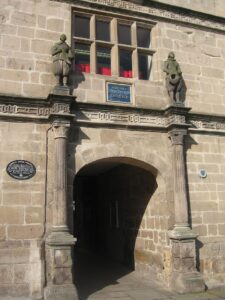
The entrance to the Old Shrewsbury School buildings – a renaisance institution
Prospero and the Library of the Mind
We see this exact concept brought to life in William Shakespeare’s The Tempest. The character of Prospero is often labeled a wizard today, but in the context of the Renaissance, he is something entirely different: a scholar-magus.
Prospero’s influence over his island does not come from a supernatural gift; it comes from his library and his devotion to the liberal arts. His power is the result of intense study, mathematical understanding, and natural philosophy. When he famously promises to command the elements no longer, he does not break a magic wand—he says, “I’ll drown my book.” For Shakespeare’s audience, Prospero represented the height of human learning and the immense responsibility that comes with understanding the deep laws of nature.
Like Prospero’s library, the layout and architecture of Soulton Hall is coded with this exact Renaissance endevour—using classical proportions and mathematical harmony to reflect on and comment on the order of the cosmos.

This image depicts a scholarly reconstruction of Soulton Hall, highlighting its architectural elements inspired by the ancient theater of Epidaurus. The yellow lines trace these features, revealing the Rowland Hill’s homage to the renowned Greek structure.
Preserving the Calm of History
Storytelling is a beautiful part of human culture.
But there is a line where commercial fantasy begins to erase true heritage.
At Soulton Hall, we work diligently to avoid touching that line.
True heritage does not need to be augmented by modern fiction to be extraordinary. The real thoughts, intellectual struggles, and structural breakthroughs of the people who built our culture are far more captivating than any manufactured gimmick.
By focusing on the authentic depth of our history, we hope to offer a space for quiet reflection—a place where visitors can step away from the noisy distractions of the modern world and connect with the genuine wisdom of the past.
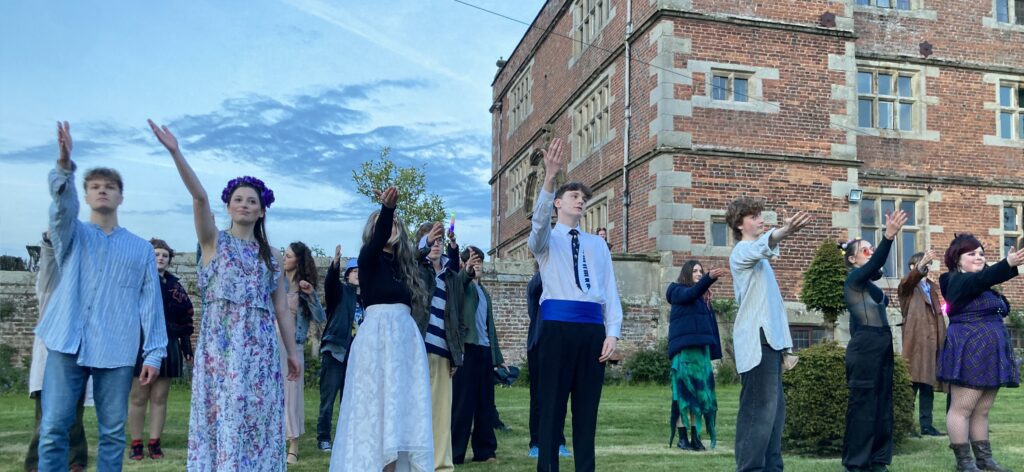
Shropshire Youth Theatre Take a bow after performing AS YOU LIKE IT at its home
