


Today, March 20, the bells of Durham Cathedral ring for Saint Cuthbert.
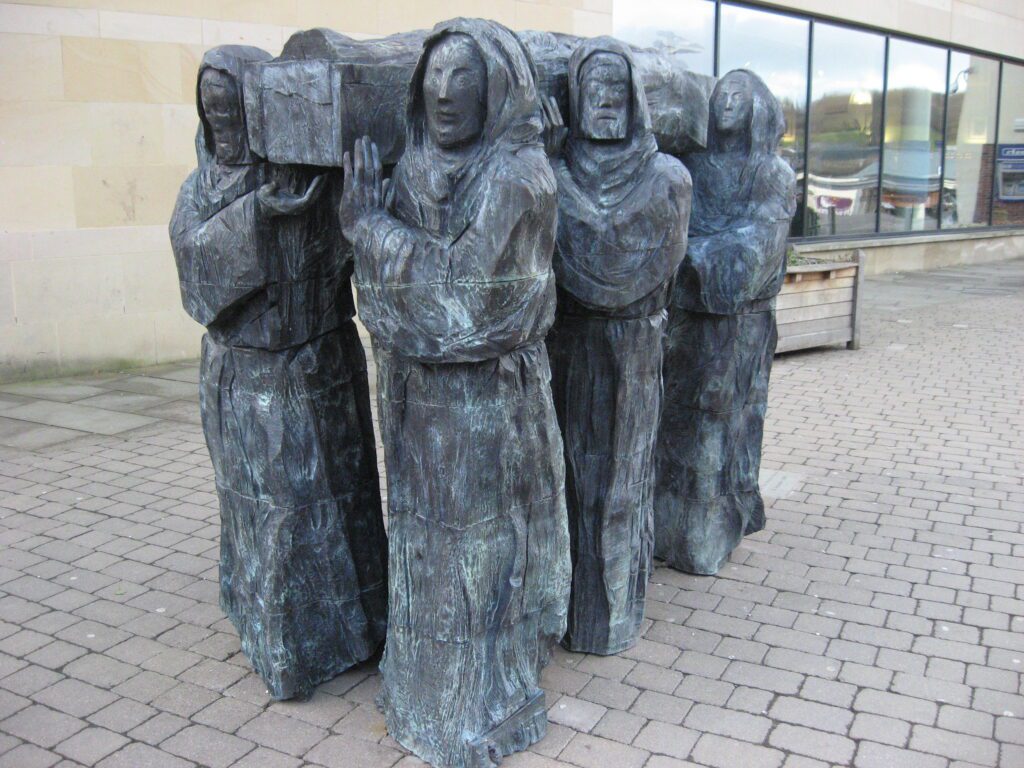
The Journey, a modern sculpture showing the travels of the Lindisfarne community with Cuthbert
While many join the pilgrimage from Chester-le-Street to the high banks of the River Wear, we reflect on a wider map. Cuthbert, Chad, and Erkenwald were a single generation of architects who pulled the threads of what would become England into a unified whole. These men were not strangers; they shared common roots and a language of leadership.
-
- Cuthbert remembered in Durham
-
- Durham Cathedral
Cuthbert was the spiritual anchor of the North. A man of the elements, he famously prayed in the freezing surf of the North Sea, where sea otters were said to warm his feet. He represented a tough, practical stewardship that the Northumbrian people recognized as their own.
-
- Chad remembered in Lichfield
-
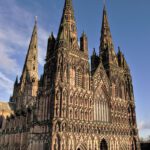
- Lichfield Cathedral
Chad was a Lindisfarne scholar who brought that rugged energy down into the Midlands and Lichfield. Because London initially operated under the supervision of Lichfield via Chad, the foundations of the South were poured using this same Northern mortar. The “Lindisfarne way”—a blend of intellectual depth and physical endurance—became the shared heritage of the whole country.
-

- The lost Shrine of Erkenwald – the inspiration for Soulton Hall’s building
-

- LOST: Old St Pauls
Erkenwald operated where these regional traditions met. He was formed by the traditions that Chad championed and took that influence to build the civic heart of the South at Old St Paul’s. He did not just build a cathedral; he helped draft systems of law that moved society from raw custom to reasoned fairness. He built the systems that allowed different people to coexist and thrive within a single framework.
These figures remain the foundational anchors of our great and ancient cathedrals (Durham, Lichfield, St Paul’s), their presence centered there for centuries.
The storms of the 1500s disturbed this, but the stories of these men proved more resilient than stone. They represented a harmony of diverse parts.
In Durham, the attempt to remove Cuthbert faltered. As the surrounding shrine was stripped of its gold, his remains were ultimately re-interred in the same earth where they had rested for centuries—a rare survival that preserved an unbroken physical link to the seventh century. This survival was underpinned by an intense local loyalty; historical accounts from 1537 describe the opening of the coffin as a moment of profound shock for the royal commissioners, who found the body “uncorrupt” and flexible. Whether viewed through the lens of faith or as a remarkable historical anomaly, this perceived permanence meant that while his famous banner—a physical symbol of Northern identity—was lost, the man himself remained.
In Lichfield, the presence of Chad has seen a restoration; after centuries of displacement following in the Reformation, a portion of his remains was returned to Lichfield Cathedral in the early 2020s through a significant act of inter-denominational diplomacy.

View from roof of Wren’s St Paul’s – the Great Fire of London took the physical form of Old St Pauls and the memory of Erkenwald was turned down
In London and other places, meanwhile, the legacy of Erkenwald is gaining new clarity as discernment continues.
Together, these three men created a tripod of stability: a North anchored in endurance, a Midlands fueled by movement, and a South built on a foundation of reconciliation. They proved that a nation is not a monolith, but a tapestry of overlapping loyalties.
Their example shows that building a world is about finding the overlapping circles where we can work together for the common good.
As the pilgrims reach Durham today, we celebrate the memory of Cuthbert and his peers. They were the original architects of England, and their example of resilience and harmony is still a steadying hand for us in 2026.
