

Standing at Charing Cross in London and looking up at the bronze equestrian statue of King Charles I, it is easy to view it as a simple monument of royal history.
But its most remarkable aspect is not its subject; it is the sheer improbability of its survival.
after Parliamentary forces executed the king in 1649, they ordered his statue broken down into scrap metal.
John Rivet, the Holborn metalsmith given the task, took the contract but secretly buried the bronze intact beneath his property. To cover his tracks and navigate a dangerous political climate, he sold brass-handled knives to the public, claiming they were forged from the destroyed monument—satisfying authorities while quietly keeping the art safe until the monarchy returned.
It was an extraordinary act, but it was not an isolated one.

Equestrian statue of Charles I
A Global Pattern of Quiet Preservation
This instinct to protect culture in times of conflict was shared by entire communities across England. During the English Civil War in December 1642, Parliamentary soldiers rode their horses into Winchester Cathedral, ransacked royal burial chests, and threw ancient bones through the grand 14th-century stained glass windows before using the remaining glass for target practice. Once the soldiers departed, local citizens quietly gathered the shattered, blood-soaked shards of glass along with the scattered bones, hiding them safely in boxes beneath their beds for nearly two decades.
When the monarchy was restored in 1660, the townspeople brought their hidden boxes out to repair the cathedral. Though piecing together the original Biblical scenes proved impossible, they assembled the surviving shards into a striking, mosaic West Window—creating a permanent monument to collective preservation that turned shattered fragments into a lasting work of art.
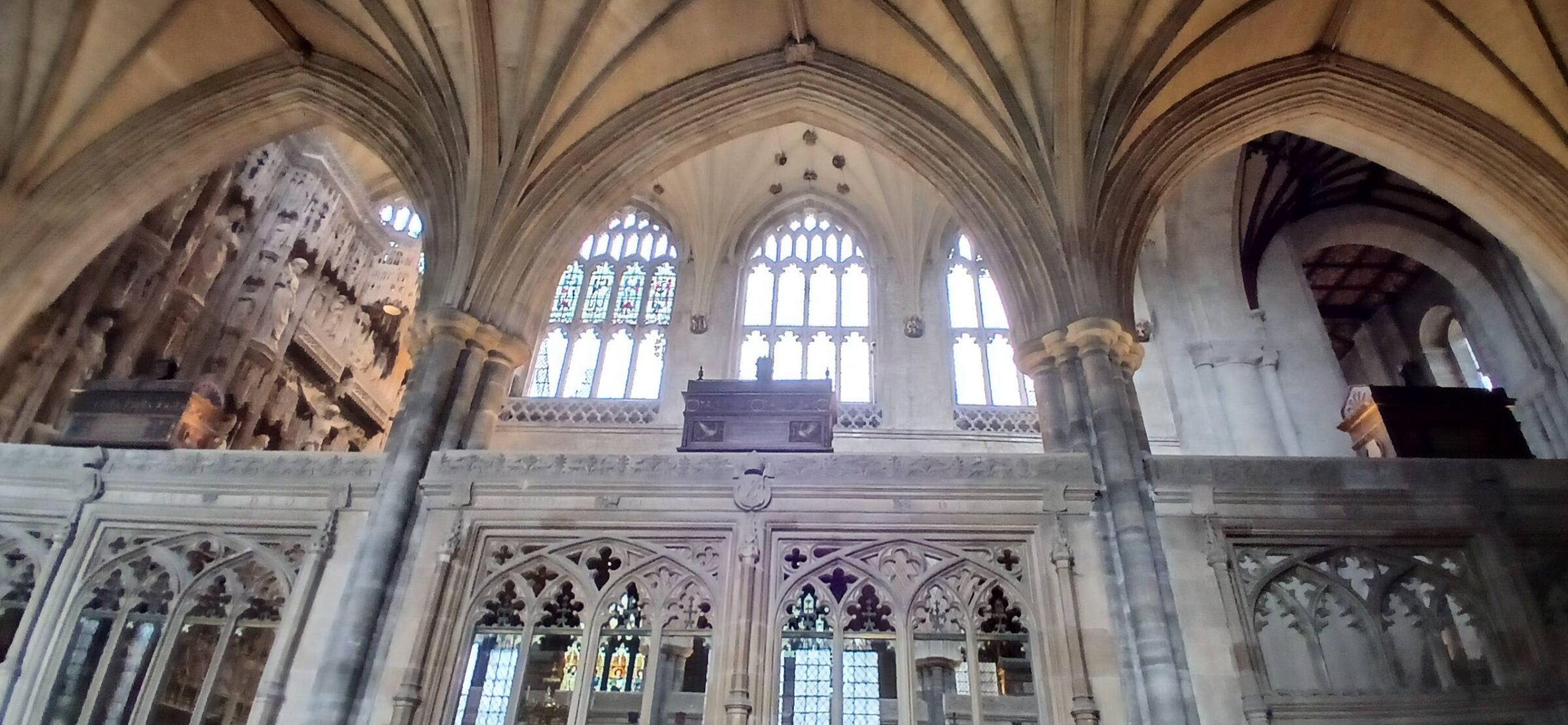
Winchester
Whenever societies undergo ideological convulsions, war, or political collapse, the urge to smash, erase, and replace the past takes hold.
Yet, running parallel to that impulse is an equal, opposing human instinct: the drive to act as quiet caretakers of memory, shielding heritage until the storm passes.
This pattern echoes across time and geography. As detailed in Lord (Peter) Hennessy’s study of UK nuclear planning, The Secret State, the British government devised covert emergency measures for the threat of nuclear war. In the final hours before a potential strike, military forces and fleet transport were assigned to evacuate masterpieces from London’s major institutions—the National Gallery, the Tate, and the British Museum—hiding them in deep underground slate quarries in Wales.
Even when facing total civil destruction, the state committed its military apparatus to safeguard the nation’s art.
In Soviet Russia, during state-sanctioned anti-religious campaigns, curators, museum staff, and ordinary citizens risked forced labor to hide sacred icons, ecclesiastical treasures, and forbidden literature—frequently concealing them beneath floorboards or re-cataloging them under false names in museum archives.
In twentieth-century Europe, as totalitarian regimes swept across the continent during World War II, courageous individuals and networks hid sacred Jewish artifacts, Torah scrolls, and ceremonial silver from systematic destruction—burying them in soil, sealing them inside synagogue walls, or smuggling them out through perilous underground channels.
In modern Syria, in 2011, as political oppression mounted, a father named Abu Bilal built a concrete wall inside his home to seal away hundreds of banned books, Quranic ijazat certificates, and personal manuscripts. He returned fifteen years later with a hammer to retrieve the intact library.
Years earlier in 2015, as ISIS advanced on Palmyra, dedicated archaeologists worked under threat of death to evacuate ancient museum treasures into safety, a resistance for which senior archaeologist Khaled al-Asaad gave his life.
Understanding the Legacy at Soulton Hall
Seen through this lens, the history surrounding Soulton Hall ceases to be an isolated historical anomaly.
It becomes part of a coherent, deeply human story.

The lost Shrine of Erkenwald – the inspiration for Soulton Hall’s building
When the pre-Reformation high altar of Old St. Paul’s Cathedral was dismantled in June 1550, and as the shrine of London’s patron saint, St. Erkenwald, faced destruction amidst religious upheaval, the sacred material did not simply vanish into the void.

The St Paul altar at Soulton
Operating in a like world of high political risk and shifting religious allegiances, took extraordinary measures to secure these treasures, bringing the altar elements and relics to Soulton.
Like John Rivet hiding a bronze king beneath Holborn, a Syrian father bricking up his library, or a government planning to drive art into Welsh mines before the bombs fall, Old Sir Rowland recognized that turbulences pass, but lost heritage is gone forever.
The preservation of the St. Paul’s altar and the Erkenwald relics at Soulton makes complete, logical sense.
It reflects an age-old instinct: when the world outside turns chaotic, people build safe havens for truth, beauty, and history until calmer days return.
