


The quiet threads connecting Shropshire to the wider cultural landscape often surface in extraordinary ways.
A striking example can be found in the work of contemporary artist Jacob Chandler, whose sculptures bringing Shakespeare’s As You Like It into conversation with architectural space carry a deep, quiet lineage rooted in our local soil.

The 15th-century Watling Street Hall (later The Old Hall, Wellington) was home to the Forester family, who administered the ancient Forest Law for the Forest of Mount Gilbert—a subdivision of the ancient Forest of Arden.
Before his work reached London, Chandler’s artistic journey began in a room with a remarkable past: the art room of The Old Hall School in Wellington (which became Wrekin Prep, and moved out of this lovely old site in 2006 [the old buildings have since become homes]).
Unknown to the young sculptor at the time, that very space—historically known in the 15th century as Watling Street Hall—once served as the seat of the Forester family (now at Willey Park since the 18th century (via marriage in the 1740s to a branch of the Weld family, who coincidentaly had the house Rowland Hill had in Lodon after him).
Formally expanded by Kings Henry II and Richard I, the Forest of Mount Gilbert covered roughly 120 square miles from Shrewsbury to Telford, operating as an administrative subdivision of the ancient Forest of Arden. This expanse was far larger than the modest Warwickshire footprint assigned to it in modern minds. As Dr. Will Tosh, writing for Shakespeare’s Globe, reminded readers in 2023:
“[As You Like It a]udience members in Early Modern London will also have thought of the Forest of Arden, an expanse of woodland in the Midlands that stretched from Stratford-upon-Avon in Warwickshire to Tamworth in Staffordshire. Shakespeare, born and brought up on the fringes of that great wood (and whose mother’s maiden name was Arden), must have felt at home there.”
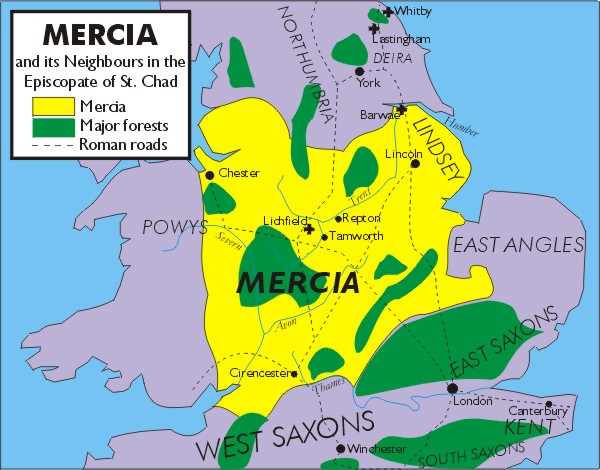
Mercia in the time of Chad: note the Forest of Arden reaching beyond Watling Street
As hereditary wardens, the Foresters were charged to “walk the forest early and late” to protect the venison (the deer and wild boar) and the vert (the forest greenery), presenting any trespassers or poachers to the local forest courts. Because of this custodial role over the Wrekin Forest, a bugle horn became a key heraldic symbol on the Lord Forester Coat of Arms.
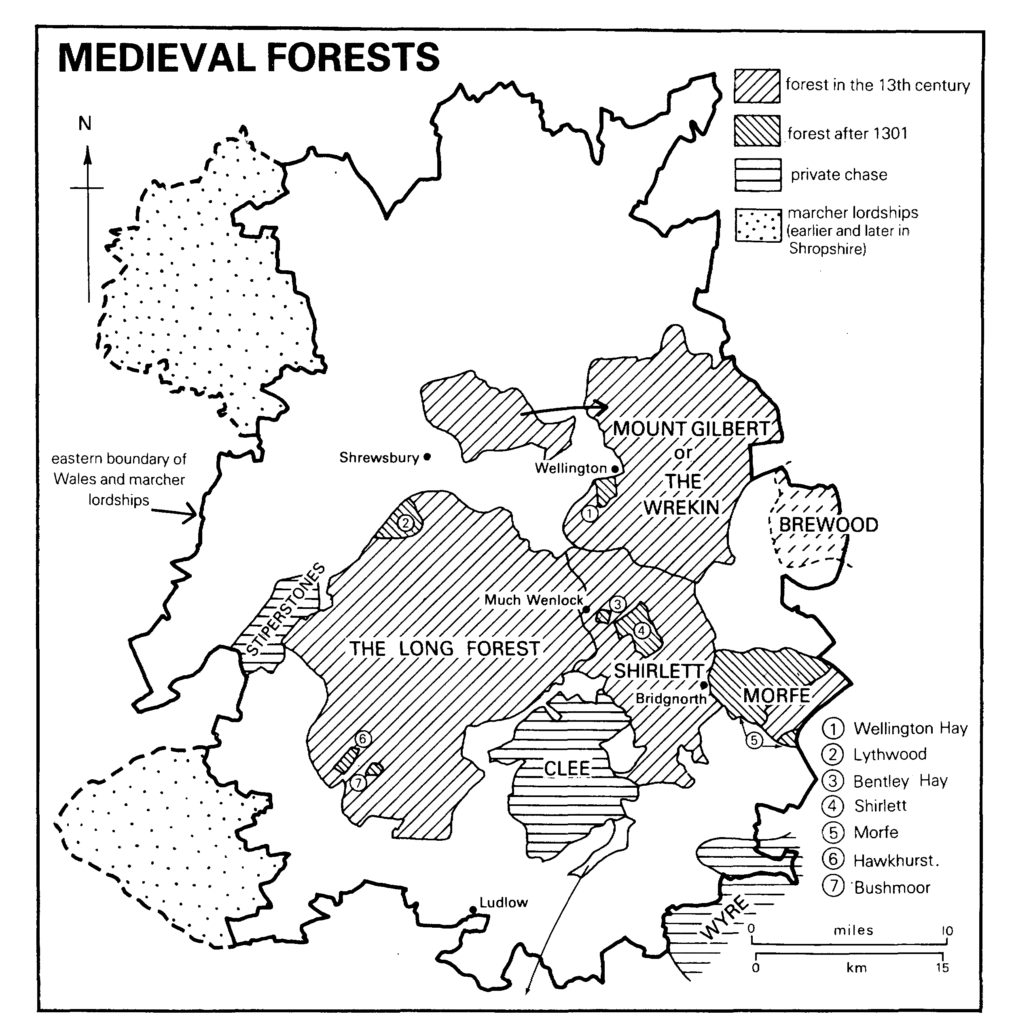
Medieval administrative divisions derived from the ancient Forest of Arden (Credit: British History Online).
Following the “Great Perambulation” of June 1300, royal forest boundaries across England were drastically reduced. The broader Norman forest system practically ceased to exist, leaving only Wellington Hay surviving as royal demesne land into the 15th century—centered on Watling Street Hall itself, where medieval Forest Law for Arden’s northern boundary was once administered.
Reflecting on this discovery, Chandler observed:
“I didn’t realize it as a boy, but the room where I first learned to sculpt was the very room where the law of Arden was once attended on.”
This spatial memory directly informs his creative approach.
The connection between physical place, historic boundary, and artistic output forms an unbroken arc across centuries:
“Five hundred years before I picked up a pencil in that room, it was a court governing part of the Forest Law of the Forest of Arden. My connection to this story started before I even knew it.”

Jacob Chandler working on the AS YOU LIKE IT figures
At Soulton, this living connection to As You Like It remains central to our work and research. The historical links connecting Sir Rowland Hill—the Tudor statesman, publisher of the 1560 Geneva Bible, and inspiration for Old Sir Rowland de Boys—to Thomas Lodge Jr. and the surrounding Shropshire landscape remind us that heritage is not a static artifact. It is an active environment, shaping how artists understand form, boundary, and balance today.
Whether standing in a medieval court room, exploring the geometry of relief sculpture, or encountering contemporary works framed by historic stone, the landscape of Arden continues to speak to those who learn to observe it.
