

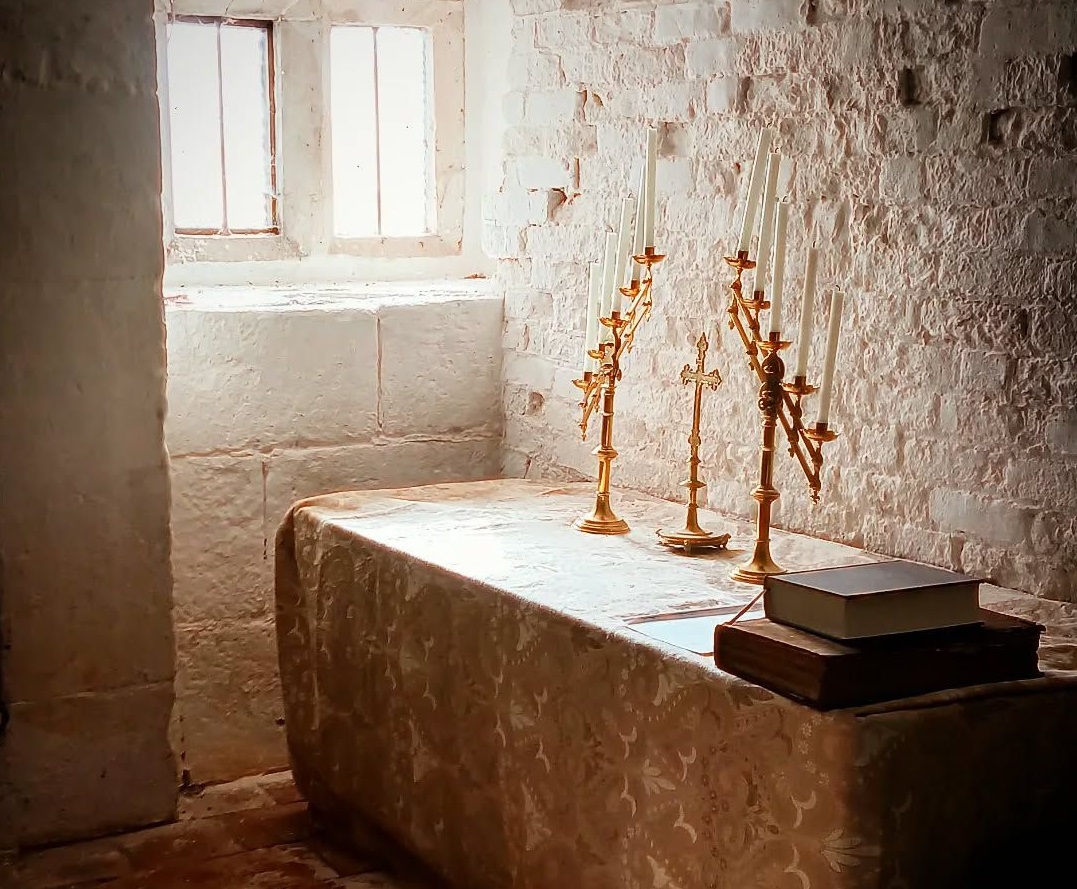
The General Register Office has officially registered the Prayer Room and Aedicule at Soulton Hall as a place of religious worship under the Places of Worship Registration Act 1855, under the reference 87059.
This legal milestone confirms that part of the house’s status as a sanctuary of public record and marks a pivotal moment in the Ashton family’s years-long diplomatic and historical work to honour the hall’s complex material culture.
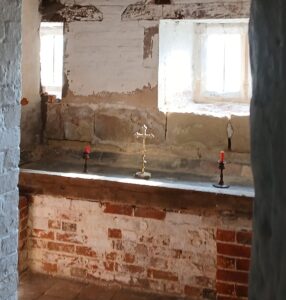
The mid c16th semi-concealed chapel at Soulton Hall, with the Easter dawn light entering
The Ashton family, as incumbents of Soulton Hall, have long recognised that the 16th-century architecture of the building was specifically designed to reconcile and protect older traditions. Research suggests the Tudor structure was a deliberate, coded effort by Sir Rowland Hill not merely to honour a memory, but to secure physical elements—potentially including an altar and relics—so that they might be rediscovered and thought of in other times. While the definitive nature of these objects may remain beyond absolute proof, the architectural and historical evidence points towards a serious effort to safeguard them. Central to this is the site’s connection to St Erkenwald (d. 693 AD), a figure of immense significance to the heritage of both London and Shropshire.
This work is further supported by the scholarly and cultural insights of Byrga Geniht, which have helped to illuminate the deep historical and intellectual layers of the site. The formal registration follows an intense period of relational work involving high-level leadership within the Christian community in both London and Shropshire. Over the past three years, the hall has hosted a series of Anglican, Catholic, and ecumenical services, and the family is pleased to now also be providing welcome to the Orthodox Church on a basis that is still being discerned. Senior figures have formally acknowledged the epistemological and diplomatic care the Ashton family has brought to these developments.
Tudor Prayer Room in Soulton Hall
The importance of this work has recently been acknowledged in Westminster.
Written questions were put in the House of Commons to support these efforts, making these matters formal citations on the state record for the first time only a short time ago. Furthermore, the project has bridged the gap between the capital and the county, with the provision of blessings for the protective structures that house the site’s significant material culture. This work is supported by ongoing dialogue with several leading universities and the Historic Houses Association, ensuring the heritage is handled with the gravity it requires.
Within this story, the Ashton family occupies a secular role that mirrors the historical function of houses of this status.
By attending to these Tudor spaces in this way, they have created a kind of breakwater within the house—a protected setting where historical memory and modern conviction can meet. Regardless of personal perspective, the family maintains that the moral and compassionate path is to avoid gatekeeping such significant heritage. They view their incumbency as a duty to provide hospitality and a neutral, welcoming ground for all traditions.
For the Ashton family, the discovery of such serious material culture has necessitated a role beyond mere ownership. In light of the site’s significance for the Undivided Church, the family has acted as providers of hospitality, creating a space of inclusion and welcome for all who seek to examine this Anglo-Saxon heritage. Tim Ashton noted that when a family is entrusted with material culture of this importance, hospitality is no longer a choice but a responsibility. After years of quiet, careful work to plot this course, the family is pleased that the site is now a matter of public record, allowing the work to move into a more settled space where this history can be shared respectfully by all.
The newly registered Prayer Room will host its first formal ecumenical service since registration on 14 November, the feast day of St Erkenwald.
This service will bring together representatives from various traditions to witness a history that connects the ancient past with a hopeful, shared future.
This was reported in the Herald here,and the Shropshire Star here.
