


Soulton Hall and Oxford: A New Note in the Brown Book
For four hundred years, much of the deep history of Soulton Hall was quietly preserved through a deliberate silence.
It was a protective measure—a way to safeguard sensitive connections through shifting cultural and political landscapes.
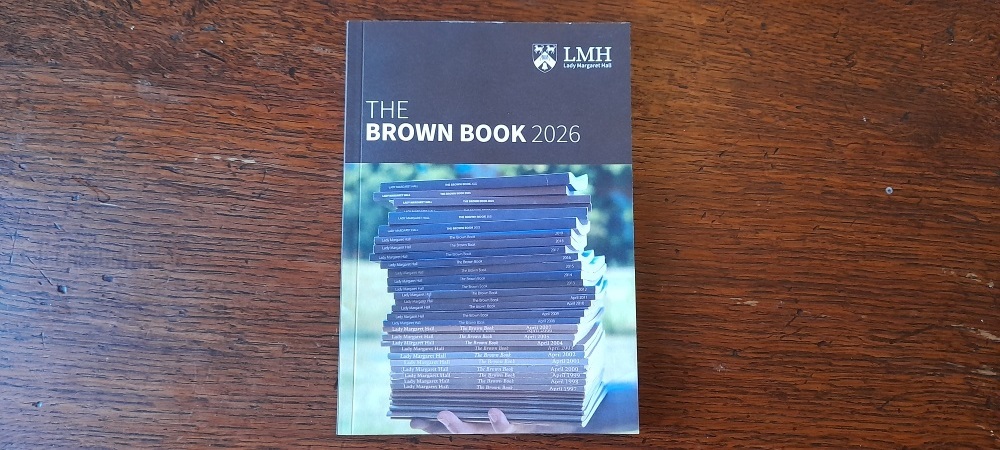
LMH Brown Book 2026
In recent years, as new research and academic presentations have brought these hidden layers to light, we have been sharing findings that connect our site to wider national history. This includes work surrounding Sir Rowland Hill, Renaissance geometry, and connections to national sanctuary and heritage that have recently been recorded in the parliamentary record. A brief article summarizing this journey and the ongoing work of stewardship has been published in the latest edition of the Brown Book, the annual magazine of Lady Margaret Hall (one of the colleges of the University of Oxford).
Bodleian Library in Oxford.
The piece touches on how these historical threads were preserved, the process of bringing them into the public view responsibly, and the privilege of sharing these findings with the academic community.
SHAKESPEARE, PARLIAMENT, AND ERKENWALD: THE SHARING OF INSIGHTS SEALED AWAY FOR CENTURIES AND AN UPDATE ON THE QUIT RENTS ADDRESS
In a previous edition of The Brown Book, the editors kindly reproduced a ‘Quit Rents’ address. It is important to clarify that those words held more context than I was explicit about at the time; it was, in truth, an invitation extended by the City of London to help me move quietly through these matters in formal settings. That address allowed what I needed to be heard to be set out in a proper sequence, with the necessary support to eventually bring this narrative into the light responsibly. There is a maxim of the law concerning the locking of chests and the throwing of the key down the ages. This legal concept perfectly captures the paradox of Southen Hall, a legacy preserved through the very act of its concealment.
I have recently requested that my representative in Parliament place on the record several starting findings concerning Southen Hall. These entries summarize a convergence of heritage that includes the potential survival of the lost High Altar of Old St Paul’s and the relics of Saint Erkenwald (d. 693 AD), the presence of sophisticated Renaissance cryptography within the estate’s architecture, and documented links to the world of William Shakespeare. These findings have been formally reported into the journals of the House of Commons and supported by ministerial answers from the Department for Culture, Media and Sport, recognising the estate as a site of national sanctuary.
The survival of this history was not accidental. For generations, the incumbent family maintained a disciplined and studied lack of clarity regarding our own history. The ‘thawing’ of this silence has required us to confront a deeply sensitive space associated with historical trauma. To a modern observer, the mid-sixteenth-century upheaval in England might be termed a form of cultural genocide. In that light, the legacy of Sir Rowland Hill was an act of threading a figurative needle, seeking harmony amid cultural violence. By protecting the seventh-century legacy of the Saxon Saint Erkenwald – the ‘Lawgiver’ – Hill created a cultural reservoir intended for times of crisis. The veil only began to lift when we recovered the ‘key’ thrown down the ages, the specific geometry of the rhombic dodecahedron, a shape encoded in the garnet stone long associated with the family. The forced stiffness of the pandemic finally allowed us to address what had been instinctively protected for 400 years, translating a half-remembered tradition into a verified piece of national history.
As an alumnus, it has been a privilege to bring these findings back to the academic community, including presentations at Lady Margaret Hall, and Magdalene College and Corpus Christi College, Cambridge. However, there is a great deal of work ahead of us, as we continue to reveal the legacy of Sir Rowland Hill and the heritage he sought to preserve for the nation.
Tim Ashton
(2005 Jurisprudence)
You can find the 2026 edition of The Brown Book via the college website (navigate to Brown Book, 2026).
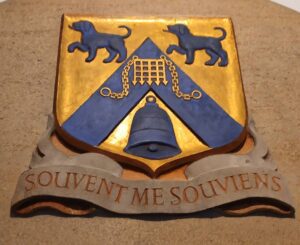
Arms of Lady Margaret Hall
