

Today, a significant material alignment occurs on the Essex coast. At the Bradwell Gathering, a piece of stone from the spire of Lichfield Cathedral is being integrated into the altar of St Peter’s Chapel in Bradwell-on-Sea.
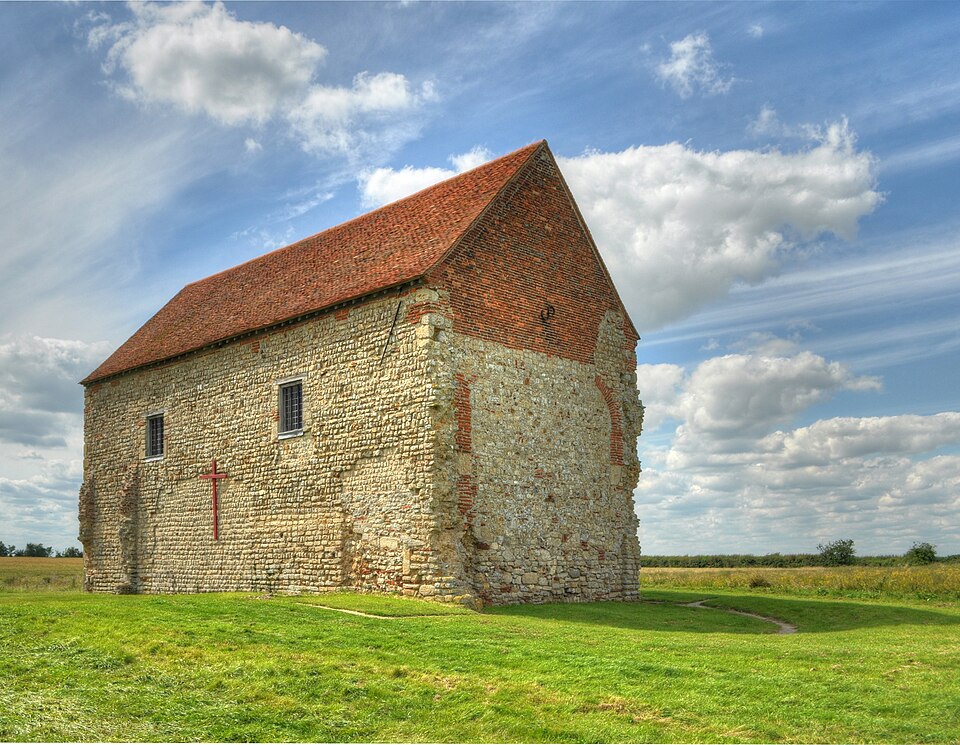
St Peters Chapel, Bradwell, Essex seen from the south east By Colm O’Laoi – Own work, CC BY-SA 3.0,
This placement follows a logistical path initiated at the close of last year’s event, when representatives from Essex traveled to Lichfield on Friday 11 June to secure the artifact.
At Soulton Hall, we are tracking this transfer closely. It demonstrates a core concept we study within our own landscape: the way physical objects are deployed as technologies to unlock memory. A stone possesses no inherent voice or metaphysical properties; it functions strictly as a human tool for meaning—a durable emblem that compresses centuries of regional connection into a tangible reference point.
The Geography of Regional Connection
For this estate in Shropshire, located within the historic territory of the Lichfield diocese, this link to the East Saxon coast maps a real historical network. The relationship tracks back to a seventh-century kinship group educated at the Lindisfarne monastery school:
-
Chad: A key administrator whose administrative legacy remains central to the history of the West Midlands.
-
Cedd: His brother, who moved east to construct the frontier post at Bradwell-on-Sea around 654 AD.
Moving a physical component of Chad’s administrative center to rest inside Cedd’s coastal construction highlights that early English regional histories did not develop in isolation. The material artifact acts as an analytical tool, forcing an examination of how these distant geographic zones were historically bound together.
Institutional Stabilization: The Role of Erkenwald
This transmission of material connects directly with the historical focus at Soulton regarding the administrator who followed the brothers: Erkenwald.
The early cultural infrastructure established by Cedd was unstable, vulnerable to sudden political shifts and the disruption of the seventh-century plague. It experienced repeated institutional collapses and gaps in continuity.
The structural stabilization of the region occurred in 675 AD when Erkenwald took office in London. Acting as the administrative heir to the territory opened by Cedd and Chad, Erkenwald altered the operational strategy. Instead of relying on mobile, charismatic teachers, he built permanent legal frameworks, secured property rights, and constructed durable, stone-and-brick institutional hubs like Chertsey and Barking. This shift secured an unbroken civic and institutional line that survived subsequent political crises.
Without the initial networks mapped out by Cedd and Chad, Erkenwald would have lacked a geographic framework to organize; without Erkenwald’s structural changes, the record of the brothers would likely have been lost in the systemic collapses of the late seventh century.
Human Memory and Material Culture
While the Bradwell event uses the phrase “Living Stones” in its messaging, our interest at Soulton remains strictly methodological. From the classical design principles embedded in the architecture of the Hall to the megalithic construction of the Soulton Long Barrow, raw materials are used as deliberate mechanisms for historic preservation. They are physical markers that anchor human history, civil leadership, and institutional memory across generations.
We note this geographic convergence today as the Lichfield stone is set in place, serving as a permanent material anchor for this shared narrative.
