

********
Intellectual Property and Academic Attribution
The rediscovery of the cultural role of the Rhombic Dodecahedron is the intellectual property of Byrga Geniht Ltd. Of its constituent components, authorship and academic priority of the poised square motif belongs to James Syrett; and authorship and academic priority of the posed hexagonal motif belongs to James D. Wenn. James Syrett and James D. Wenn constitute Byrga Geniht Ltd. Soulton Hall is delighted to engage the services of this cutting edge art-historical and theological research. You can learn more at Byrga.co.uk .
********
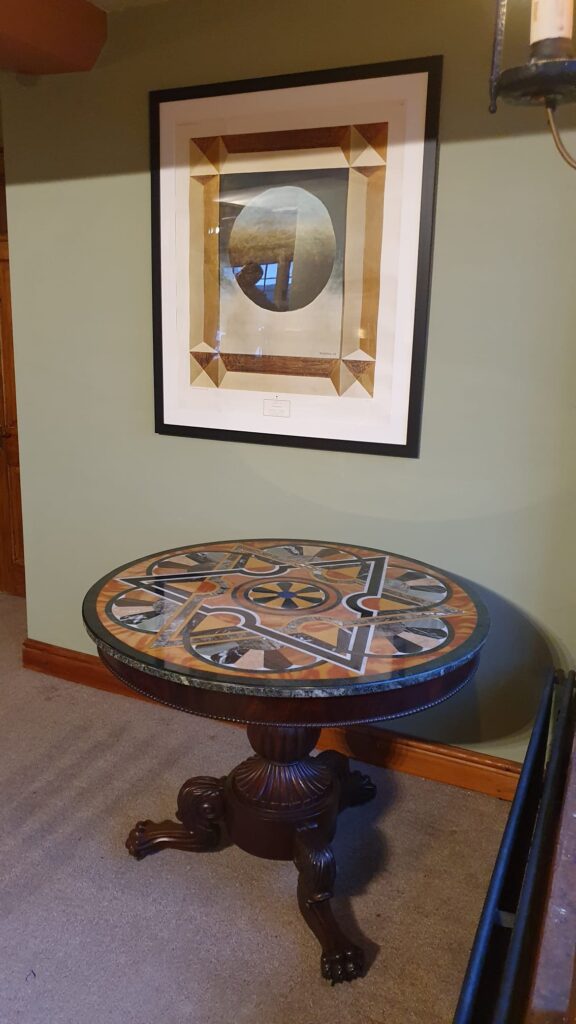
The Byrga Geniht Table in the Studiolo
Art as a Literacy Test: Why this “clever” Pietra Dura table is the key to unlocking the hidden harmonies of Soulton Hall
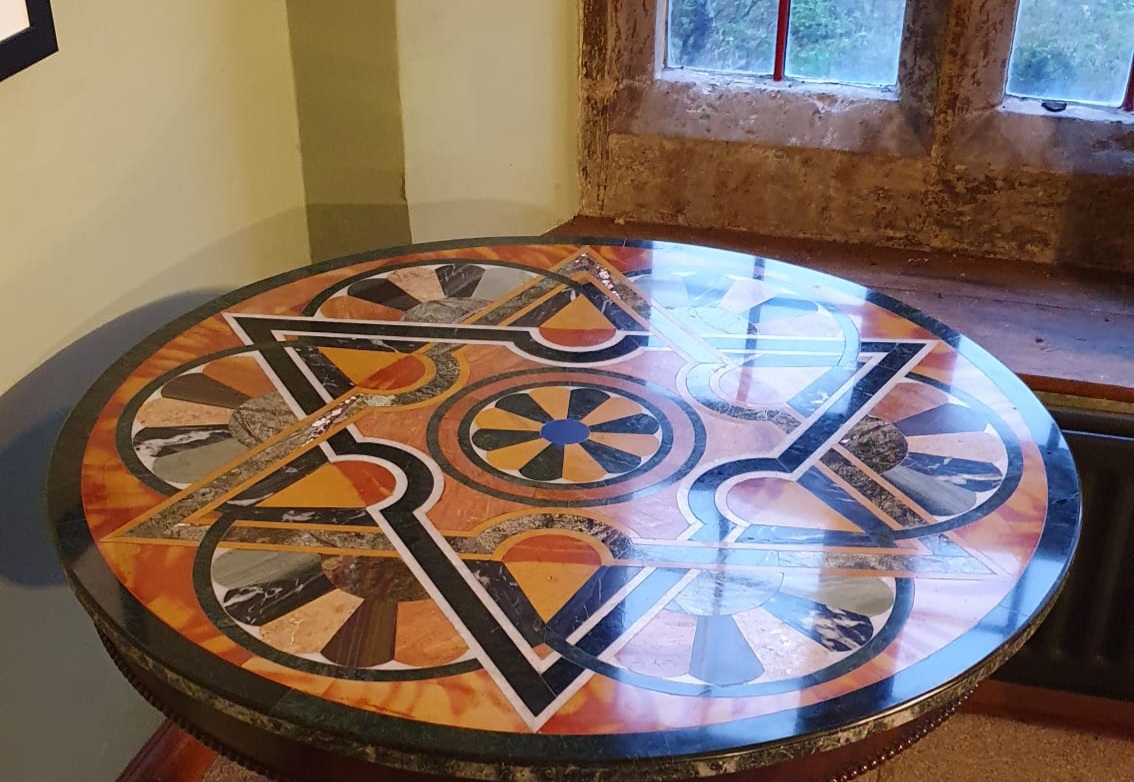
We are currently exploring the acquisition of a specific Pietra Dura table, in a project developed in consultation with Byrga Geniht.
While the technique of “hard stone” inlay is a hallmark of the Renaissance, this particular piece belongs to the Enlightenment.
It is currently at Soulton on refusal, and its presence serves a dual purpose: it is an object of immense beauty, and a forensic tool for demystifying the mathematical and theological “codes” that define Soulton.
Beyond Fashion: Why this Table is Different
To understand this table, you must look past the surface.
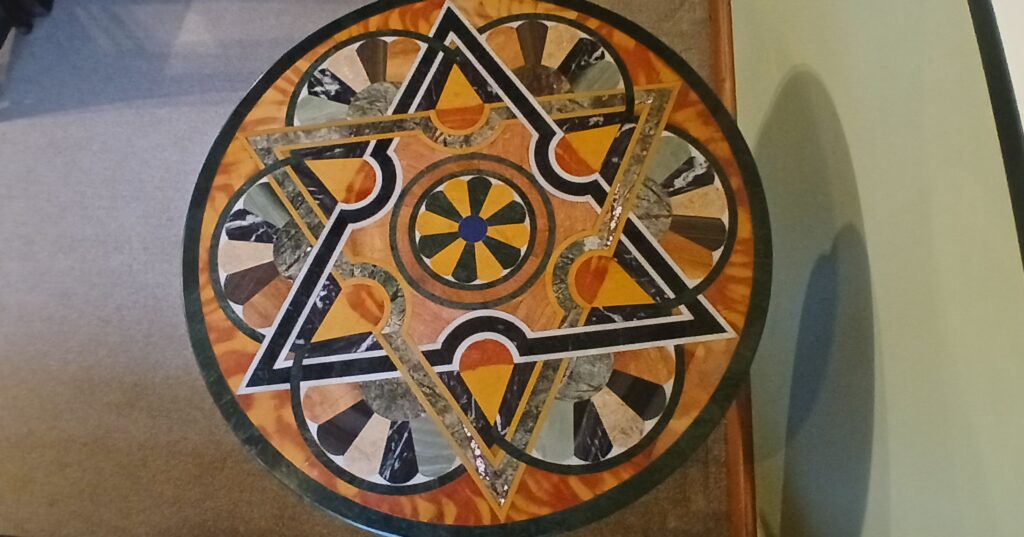
The Byrga Geniht Table
Many Pietra Dura tables in English country houses—such as the celebrated example at Farnborough Hall—were acquired as Grand Tour trophies to signal wealth and taste. They are exquisite, but they are relatively “silent.”
The table proposed for Soulton is active. It uses the “hard stone” medium to encode a specific history of ideas, acting as a bridge between the mathematical rigor of the Renaissance and the inquisitive, scientific spirit of the Enlightenment.
The Forensic Detail: Decoding the Stone
While many 18th-century tables use geometric stars as simple flourishes, the Byrga Geniht table functions like a visual puzzle.
The Alpha-Omega
Look past the initial shape of the star and trace the points of the two overlapping triangles. You will notice the craftsman hasn’t just drawn straight lines; the corners are subtly weighted and shaped.
-
In one orientation, the points form the sharp, broad base of the Greek Alpha (A).
-
Rotate your gaze, and the interlocking lines resolve into the curves of the Omega (Ω).
This is a deliberate code preserved in an Enlightenment object. It takes the familiar idea of the Divine as the “Beginning and the End” and folds it into the physical laws of geometry.
The Logic of Six: Ezekiel and the Sapphire
Why a star with six points? The answer lies in the Book of Ezekiel (a central theme theme of the 1668 doorcase at Soulton), where the “Throne of God” is described as being made of Sapphire. Our consultants have highlighted the significance of the stone’s mineral structure: sapphires naturally form as six-sided columns.
The designer didn’t choose a six-pointed star and a blue stone at random; they used Lapis Lazuli set in a six-pointed frame because that is the natural, mathematical “signature” of the stone mentioned in the vision.
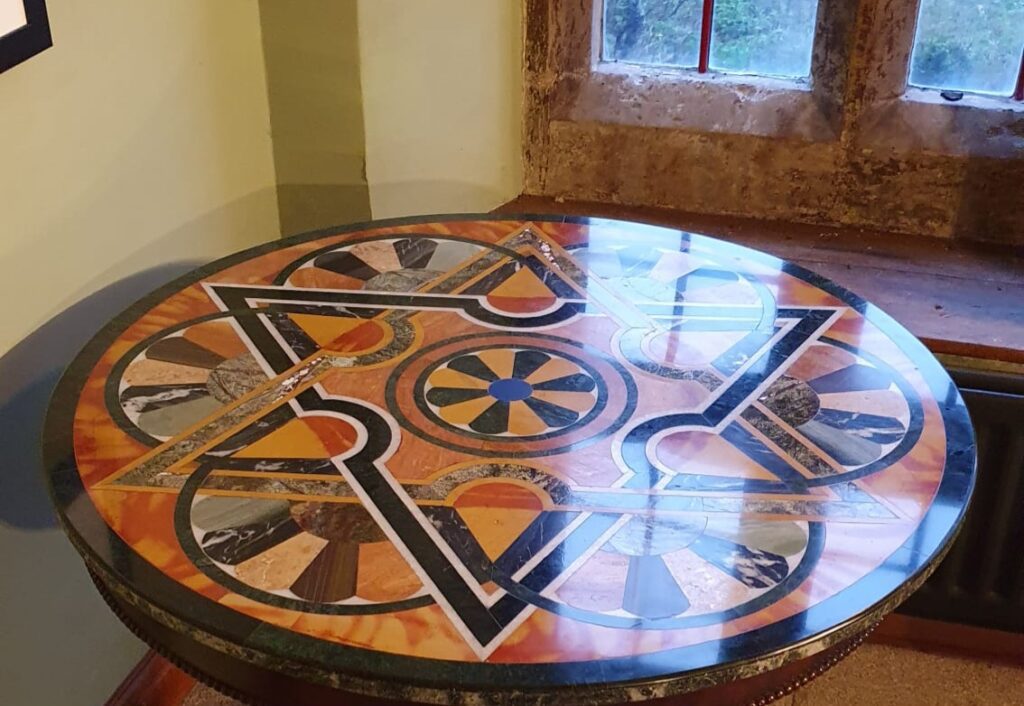
The Byrga Geniht Table: An 18th-century “thinking machine”
Mainstream Philosophy: From Roman Britain to Westminster
It is important to recognize that the “coding” within this table is not a fringe or “occult” invention.
Rather, it belongs to a mainstream tradition of philosophical art used to express profound ideas for nearly two millennia.
The Continuity
You can see this exact visual language today in the Chapel of St Paul in Westminster Cathedral.
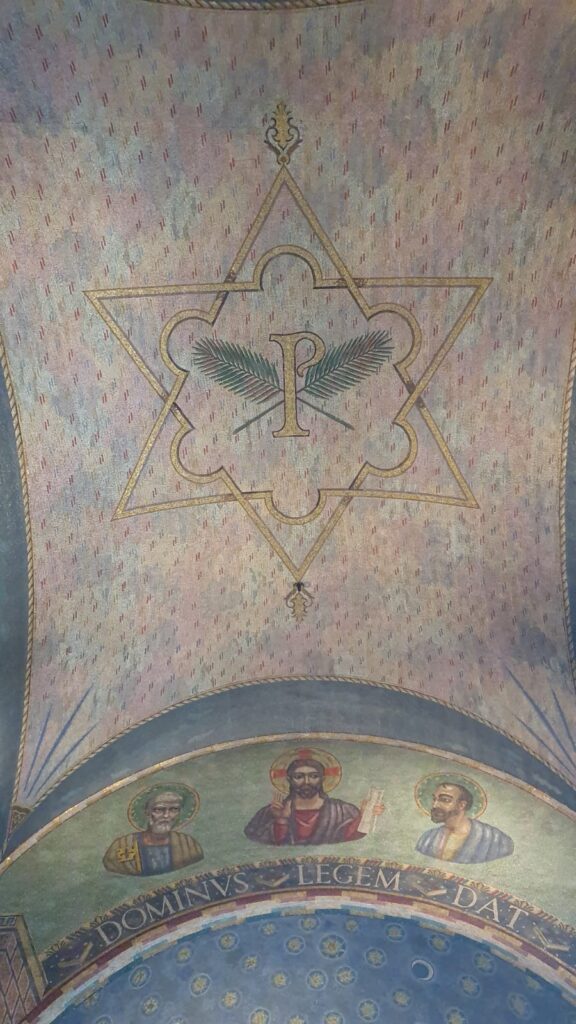
Chapel of St Paul in Westminster Cathedral.
There, the six-pointed star, repeating this Alpha (A) and Omega (Ω) arangement.
Indeed, this tradition stretches back to the very beginnings of Christian art in Roman Britain. The famous 4th-century wall plasters from the Lullingstone Roman Villa house-church feature the Chi-Rho/Iota-Chi symbol flanked by the Alpha and Omega. Even then, the “alphabet of creation” was tied to a specific geometric structure.
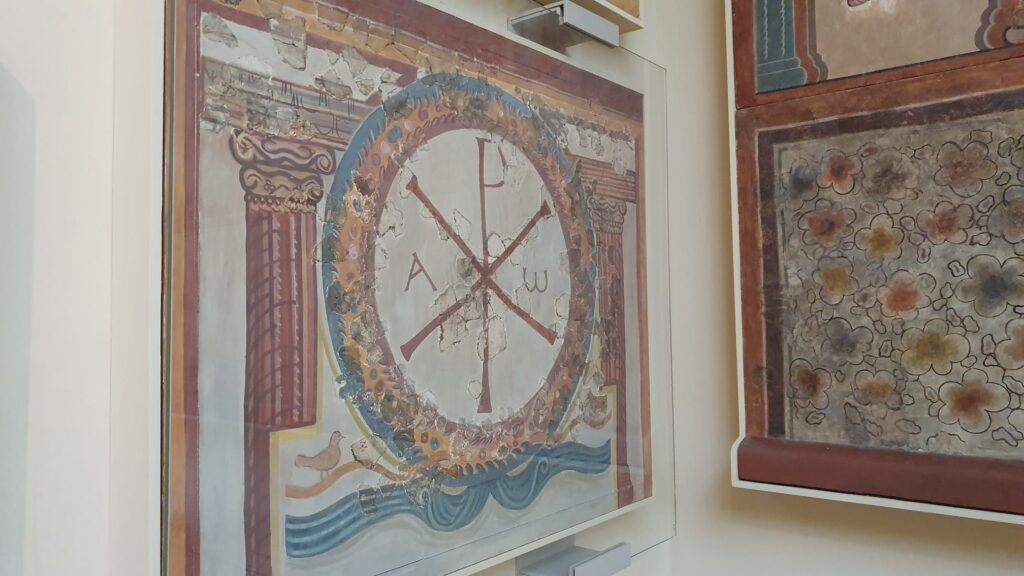
The Lullingstone Christian house-church of the 4th century is a unique discovery for Roman Britain and includes this paintin og the Chi-Rho/Iota-Chi
The “Leap” into the Fourth Dimension
At Lullingstone, the paintings show three intersecting beams. To truly understand the image, the viewer must “sense” a fourth beam—one that projects outward toward them.
This is the same intellectual leap required by the unique windows at Soulton Hall. There, you are looking at tilted square beams and intuiting a third beam to complete the form; at Lullingstone, you are intuiting a fourth. In both cases, the art refuses to stay flat. It invites you to move from a two-dimensional shape to a three-dimensional understanding.
When you make that leap, you realize you are looking at the rhombic dodecahedron—the “perfect” space-filling shape where every side is equal. This is the same geometry explored in the recently toured In Hoc Signo piece, seen by audiences in Shrewsbury and Colchester.
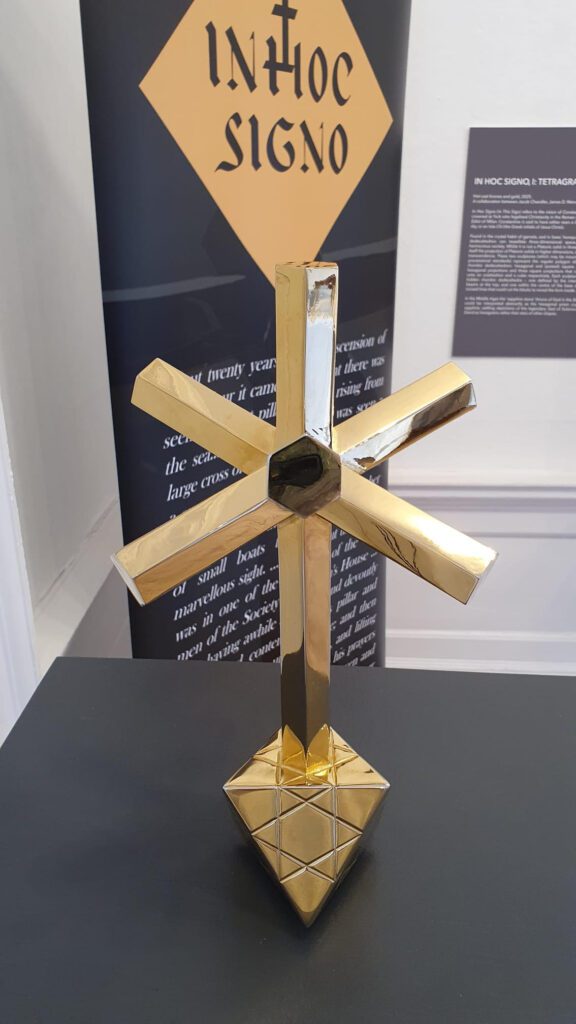
Hexagons in In ‘Hoc Signo’
The Shape of a Respectful Society
By bringing this table to Soulton, we are linking our local heritage to this national story.
The table does not just explain a “star”; it explains the transition from the Iota-Chi-Rho symbols of Roman Britain to the Ezekiel-inspired geometry focus of the Renaissance.
Old Sir Rowland’s sea chest
This “Logic of Six” echoes through Soulton’s history—from the sea chest of Old Sir Rowland Hill to the lost pyramidal roof.

Reconstruction of Soulton Hall, sowing the lost pyramidal roof.
It confirms that the “Soulton Code” is actually a universal language of harmony—an allegory for a respectful society where geometry, nature, and the divine are in perfect balance.
In this table, the blue stone is the conclusion of a logical argument.

The famous Soulton Dancing Pavement
Why this Matters for Soulton
This table acts as a physical bridge. When a visitor looks at the 1668 doorcase or walks the Dancing Pavement, the “mathematical code” can feel abstract. By showing how the geometry physically becomes the letters A and Ω, we strip away the “occult” spookiness often projected onto these shapes.
It isn’t a “magic” symbol; it is a literacy test.
The table allows us to say: “Look. The stone grows in sixes. The vision describes it in sixes. The table is built in sixes.”
It replaces “counter-cultural” silliness with the high-intellectual rigor of the Renaissance.

Hannah Deakin who preserved The Dance in the Soulton Pavement.
It makes the work of Hanna Deakin and the deep history of Soulton something you can finally touch. (Though, for the sake of conservation, please don’t actually touch the table!!!)
