

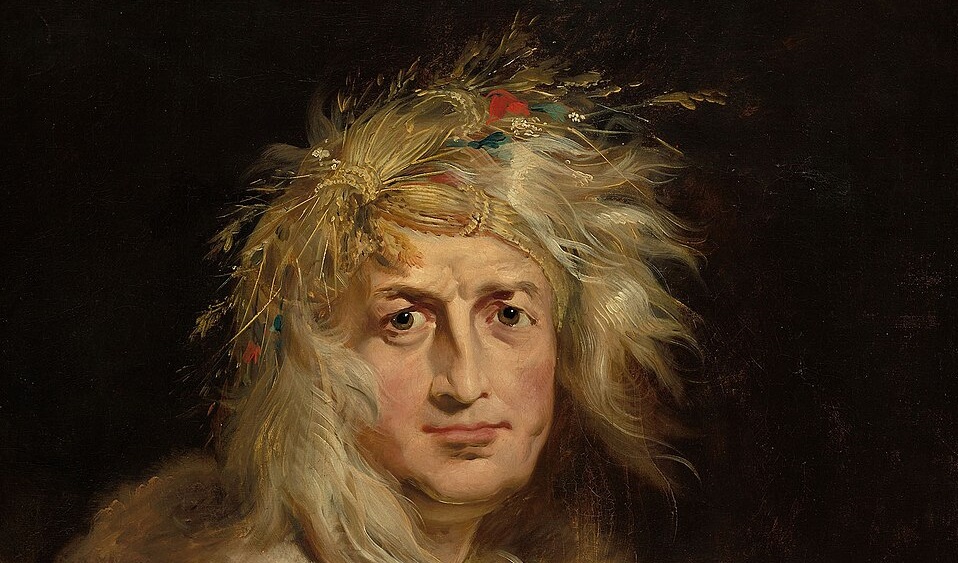
At Soulton, where history and storytelling are ever around us, we always pay close attention to productions that honour and reinterpret Shakespeare’s genius, and there’s something particularly compelling about radio drama. It strips away the visual spectacle and demands a fresh focus on the language and the actor’s voice. This is certainly true of the recent BBC Radio 4 production of King Lear, which has genuinely captured our interest.
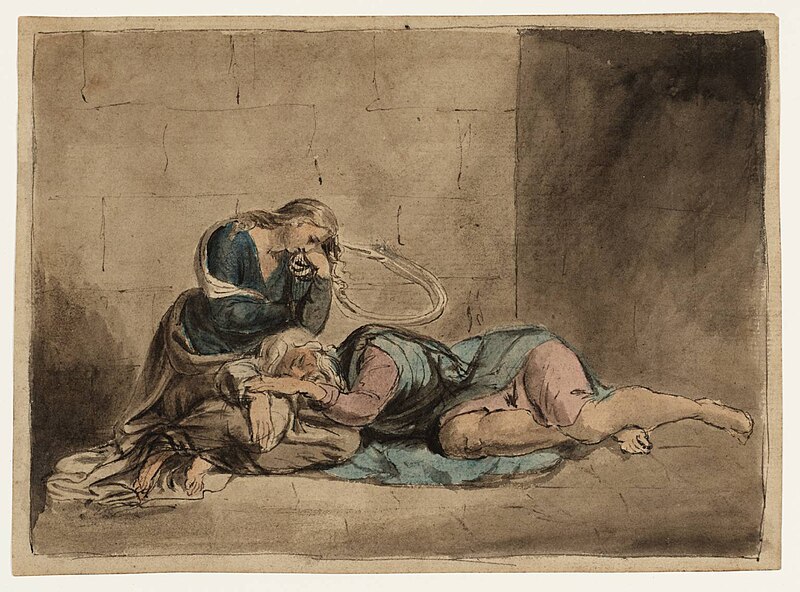
Lear and Cordelia in Prison – William Blake c. 1779
The reason to tune in is Richard Wilson, who, at nearly 89, takes on the role of King Lear for the very first time.
He is, the BBC says, the oldest British actor ever to play the part, lending a singular gravity and insight to Lear’s profound journey that truly deserves to be heard.
King Lear itself is, of course, a play of formidable power. It begins innocently enough with a king’s seemingly simple decision to divide his kingdom amongst his daughters based on their professions of love. Yet, from this point, it swiftly descends into a devastating examination of power, ingratitude, and the harrowing vulnerability that can accompany old age. Lear’s rash disinheritance of Cordelia and the subsequent betrayals by Goneril and Regan lead him, and indeed the audience, into a spiraling world of madness and destitution.
It’s particularly striking how King Lear, a play of such profound bleakness, serves almost as a photographic negative to Shakespeare’s As You Like It.
That play begins in a fractured and unsettling court, where characters are driven out into the Forest of Arden. Yet, in that natural setting, they find renewal, reconciliation, and ultimately, harmony. Here, the talk of love, while often poetic and elaborate, is ultimately sincere and overwhelming, leading to genuine bonds.

As You Like It Poster
King Lear, by contrast, offers a stark reversal.
It begins with the court’s public declarations of affection, but the very notion of love is immediately tainted; for Goneril and Regan, it is disingenuous and tactical, uttered merely to gain advantage. These grave errors made at court—Lear’s misjudgment, the daughters’ deceit—don’t remain contained. Instead, those failings cast a long, dark shadow, bringing chaos, suffering, and profound tragedy out into the very countryside itself, turning what might have been a place of solace into a scene of desolation. This thematic contrast, particularly in the nature of love and its consequences, truly highlights Shakespeare’s incredible range in exploring how human choices ripple through society and the natural world.
One of the most profound, and indeed disturbing, aspects of Lear is the almost universal ruin that unfolds.
So many characters, whether consciously or through grave misjudgment, seem to act in bad faith.
This pervasive absence of sincerity – from the daughters’ hollow declarations of love to the treacherous manipulations of Edmund – ensures that ultimately, nearly everyone involved is swept into suffering leaving a world profoundly altered and scarred.
One cannot help but feel a chilling Mutual resonance with some contemporary narratives. Such echoes suggest that Lear‘s lessons regarding Nicking, lying and abusive self-interest and its corrosive effects, are uncomfortably, relevant today.

The Tiddington Obelisk, near Shakespeare’s birthplace at Stratford
The radio adaptation benefits from a rather excellent cast, who bring these complex characters to life with considerable skill through voice alone. You can truly discern the deceit in Greta Scacchi’s Goneril and Tamsin Greig’s Regan, and feel the steadfast loyalty of Matthew Marsh as Kent and Trevor Fox as the Fool. The parallel tragedy of Gloucester, played by Toby Jones, ensnared by David Tennant’s Edmund, is equally compelling. It’s a remarkable assembly of talent.
With original music from Steven Isserlis and Irène Duval, and the seasoned direction of Clive Brill, this Brill Production for BBC Radio 4 offers an absorbing listening experience.
If you appreciate a finely crafted piece of radio drama that delves deeply into one of Shakespeare’s most profound tragedies, we would certainly encourage you to seek this out. It’s a valuable opportunity to experience King Lear interpreted in a truly memorable fashion.
