

Bach-y-Graig: A Monument to Welsh Identity and the 1567 Bible
Two Houses, Both alike: One Shared Vision of Cultural Preservation
Bach-y-Graig is a place we love, and for good reason. It’s a vital part of Welsh heritage, a monument to the endurance of the nation’s culture and language. Built to honour the year 1567 (for reasons we will come to), it represents a moment of pride in the survival of Welsh culture and a monument to a moment of fragility it had crucially survived. Beyond this, the house’s long-standing connection to Soulton offers a unique opportunity to explore a shared history, one that has been shaped and sometimes hidden over the centuries.
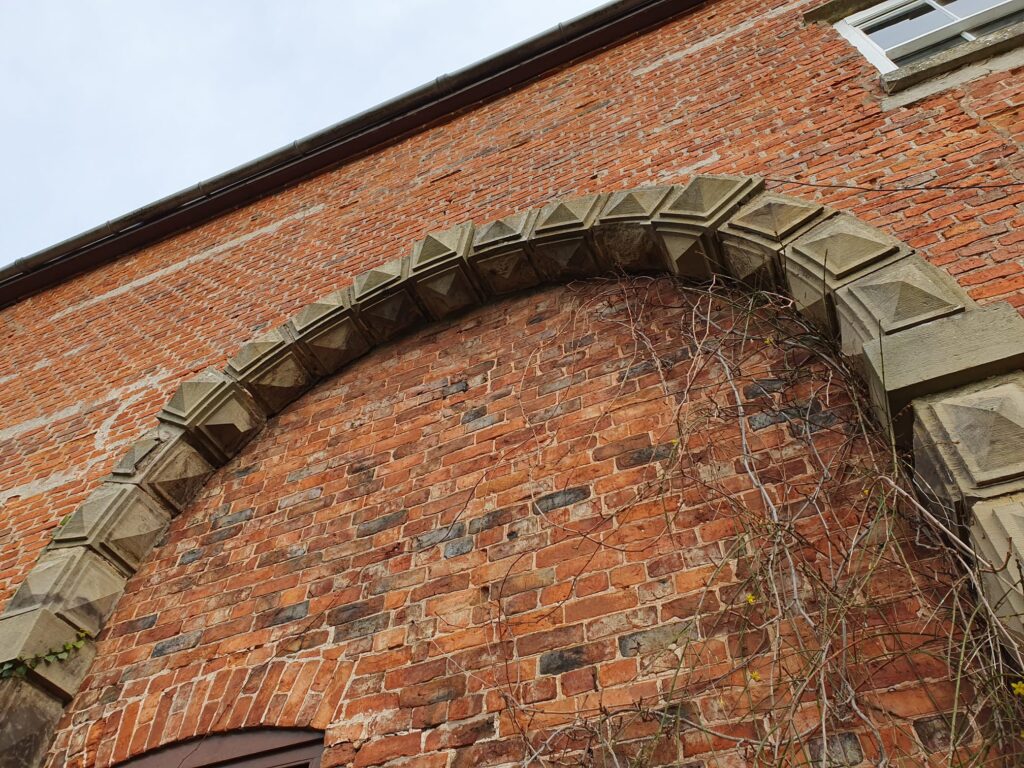
The monumental Renaissance arch at Bach-y-Graig, adorned with rhombic dodecahedrons
With the two buildings sharing fellowship in the life of the mind they represent, and the fellowship of Tudors acting in some danger to protect harmony, they have something to say, even centuries later, about a respectful partnership and deep affection between England and Wales.
********

Portrait of Sir Rowland Hill, Mercer’s Copy
Soulton Hall, a Renaissance masterpiece conceived by Sir Rowland Hill, embodies his Tudor vision. The intricacies of that vision are now being revealed by contemporary scholar James D. Wenn, whose collaboration with the Ashton family has brought the hall’s significance into sharp focus for our time.

This image depicts a scholarly reconstruction of Soulton Hall, highlighting its architectural elements inspired by the ancient theater of Epidaurus. The yellow lines trace these features, revealing the Rowland Hill’s homage to the renowned Greek structure.
The Renaissance influences on the design of Soulton Hall are rooted in Hill’s interests, which included Neoplatonism generally and the fifth Platonic solid in particular, which he associated with the rhombic dodecahedron. Plato linked the dodecahedron to the cosmos itself, believing it represented the very fabric of the universe. This association with the fifth element, the quintessence, gave the dodecahedron a unique and powerful symbolism.
This fascination with Neoplatonic thought within Hill’s circle and followers is also strikingly evident at Bach-y-Graig. Built by a younger associate of Hill (Richard Clough) whom he would have known via the Mercers, Bach-y-Graig features this symbol prominently. The monumental double-height porter’s lodge gate to the base court offers the most compelling example of this fascination with the rhombic dodecahedron.
********
Neoplatonism provided a bridge between classical philosophy and biblical revelation, offering Tudor thinkers a powerful and, importantly, a safe framework. It allowed them to articulate complex theological concepts using a rich philosophical vocabulary, demonstrating that faith and reason could indeed walk hand in hand. This approach also offered a way to discuss potentially controversial theological ideas in an adjacent, less direct manner, increasing the safety of theological work, particularly in the turbulent times leading up to the Reformation. We can even see echoes of this idea in works like Shakespeare’s As You Like It, where the figure of Hymen descends to symbolize harmony and reconciliation.
This leads us to another crucial function of Soulton, the product of Sir Rowland Hill’s intellectual vision, and Bach-y-Graig, a project undertaken by his fellow mercer and associate, Richard Clough: both houses act as memorials to, and active agents in, the implementation of what became the Elizabethan religious settlement within their respective countries via the Geneva Bible and the Bible in Welsh.

Brisck work in a court at Bach-y-Graig – showing crosses which line up to make light effects, repeating a practice observed at Soulton
Both buildings served as vessels, encoding both interpretations of scripture and the wisdom of classical ideas.
Having fielded that part of the two buildings’ identity work (on which more will be said below), we can invite you to think deeper again about Bach-y-Graig specifically, and its profound significance for Wales. The Tudor translation of the Bible into Welsh was essential for the language’s survival. It unlocked scripture for everyone, regardless of social standing, bringing the word of God into the hearts and homes of the Welsh people. This was more than just a religious event; it was a cultural watershed. The Welsh Bible solidified the language’s presence in every aspect of life, from the pulpit to the fireside. It nurtured a deeper spiritual connection while simultaneously reinforcing Welsh identity in the face of encroaching English influence.
*******
Making out this point requires us to look at some timelines and some biographical history, Tudor social networks, and the activities of certain people, which we will now do.
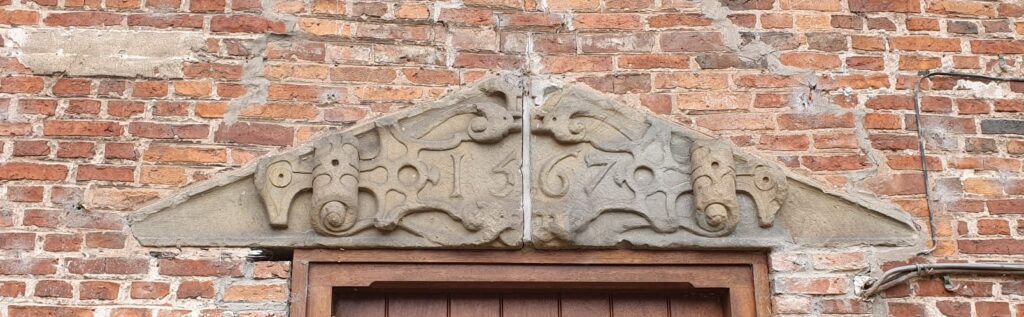
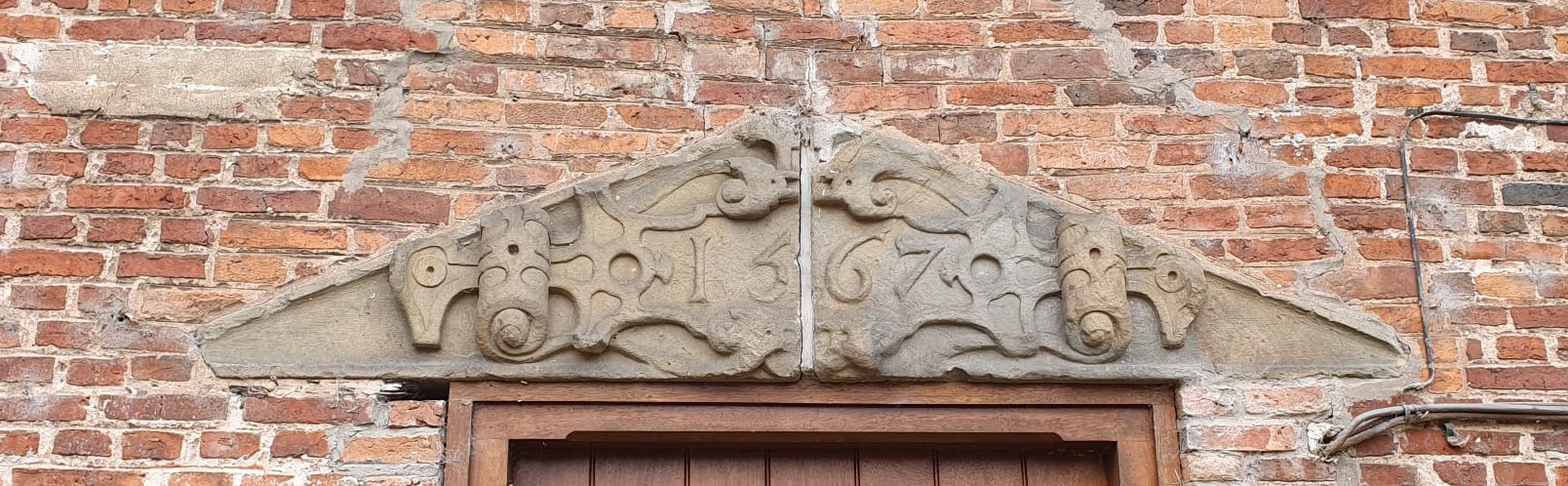
1567 Date Carving at Bach-y-Graig
The year 1567 was prominently memorialised on Bach-y-Graig more than once – what is special about this year?
To understand this, we must examine the timeline of the Welsh Bible.
Just after the 1560 publication of the Geneva Bible, so closely linked to Sir Rowland Hill, Parliament passed, in 1563:
‘An Acte for the translating of the Bible and the Dyvine Service into the Welshe Tongue’ (5 Eliz. 1. c. 28).
This 1563 act, mandating the Welsh bishops and the Bishop of Hereford to complete the translation of the Bible and the Book of Common Prayer by March 1, 1567, is key to understanding the significance of buildings like Bach-y-Graig.
It allows us to see it as more than just a house; it’s a monument, much like Soulton Hall, to the preservation of cultural and religious identity. Soulton served as a headquarters for the precarious work of translating and disseminating the Bible in English, a process carried out within a climate of religious tension and even peril. By contrast, while the Welsh Bible scholars acted with explicit parliamentary approval, the very act of undertaking the translation (approval for which was not guaranteed) was itself a bold move, safeguarding the Welsh language and culture.
In this context, the construction of a ‘Soulton counterpart’ in Wales, at Bach-y-Graig, takes on a new meaning. It becomes a symbol of that cultural safeguarding, a parallel effort to preserve identity, albeit under different circumstances.
With this broader context established, we can now examine the biographical details that reinforce this interpretation, so clearly evident in the architecture itself.
Richard Clough, the builder of Bach-y-Graig, led a fascinating life that uniquely positioned him to memorialize the achievement of the Welsh Bible. Born a glover’s fifth son, he showed early promise as a scholar and was made a chorister at Chester Cathedral.
A powerful patron, who might well have been Sir Rowland Hill, and was in any event was obviously connected to the Mercers’ Company, recognized his potential and brought him to London. There, Clough became associated with Sir Rowland Hill’s circle through the Gresham family (who, interestingly, lacked direct ties to the Shropshire, Wales, and Cheshire region).
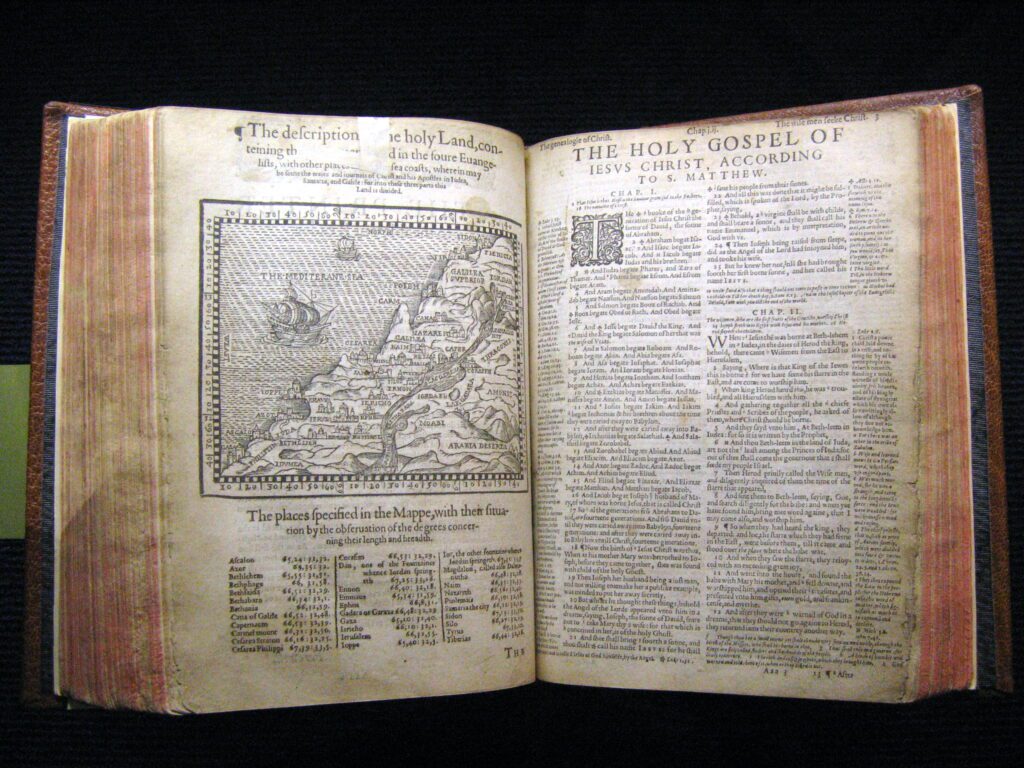
Map of the Holy Land from the Geneva Bible of 1560. Photo via Wikimedia.
At a remarkably opportune time for the conspicuous mapping work exemplified by the Geneva Bible, the young Clough was funded to travel to Jerusalem, where he was knighted as a Knight of the Holy Sepulchre and he became a close associate of Abraham Ortelius, the renowned cartographer, geographer, and cosmographer from Antwerp.
Richard Clough’s proximity to Hill and continental merchant circles placed him in the orbit of Marian exiles between 1553 and 1558.
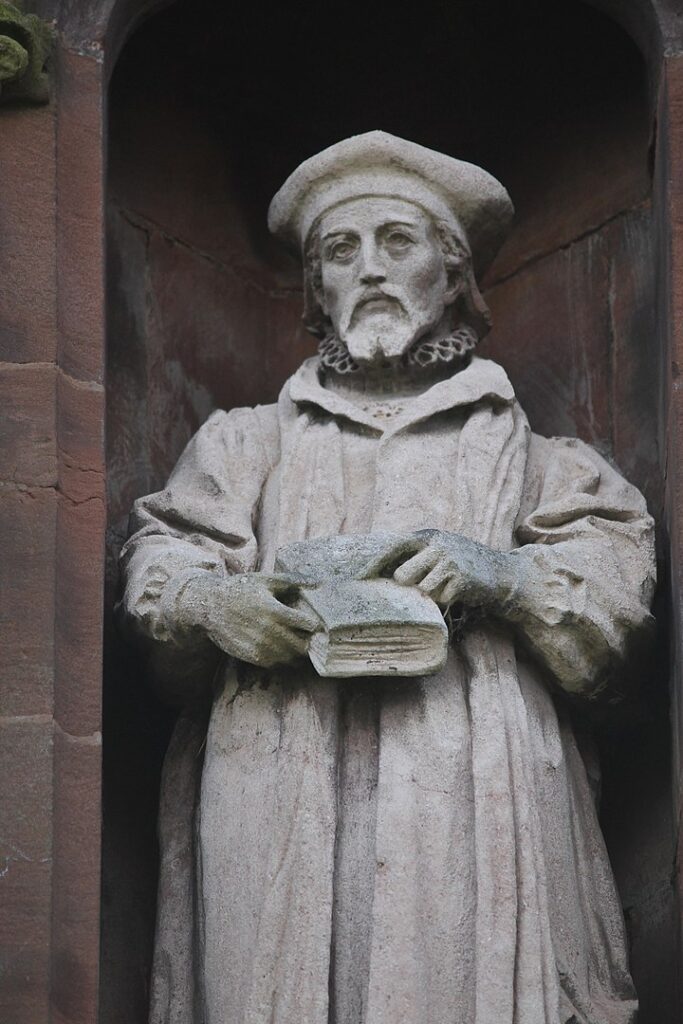
Richard Davies (bishop) on the translators’ Monument, St Asaph, North Wales.
This connection likely brought him into contact with (Bishop) Richard Davies. Davies, a fellow North Welshman, was educated at New Inn Hall, Oxford, and served as vicar in Buckinghamshire before seeking refuge in Geneva during Mary’s reign. He returned to England after Elizabeth’s accession in 1558 and quickly re-established his Welsh connections. Following a commission to the Welsh dioceses, he was consecrated Bishop of St Asaph in January 1560, and then translated to the bishopric of St David’s in early 1561. As a bishop, Davies was a dedicated reformer—industrious, active, and generous, though perhaps not always careful with church property. A member of the Council of Wales and the Marches, he was close friends with Matthew Parker, Archbishop of Canterbury (a friend of Sir Rowland Hill), and was considered a trusted advisor on Welsh affairs by both Parker and Lord Burghley.
Meanwhile, back in Wales, Richard Clough’s second marriage connected him to another circle deeply involved in this work. His wife, Katheryn of Berain (sometimes called “Mam Cymru,” or “Mother of Wales”), was a woman of notable lineage. Known also as Katheryn Tudor, she was the daughter of Tudur ap Robert Vychan and Jane Velville. Her maternal grandfather, Sir Roland de Velville (1474–1535), is believed to have been an illegitimate son of King Henry VII by a Breton woman. This would make her a close blood relative of the reigning Tudors. Katheryn was reportedly a ward of Queen Elizabeth.

Portrait of Katheryn of Berain AKA Katheryn Tudor, on account of being thought said to have been of a a line of King Henry VII of England by a Breton lady
For our purposes, the significance of Katheryn of Berain’s marriage to Richard Clough lies in her previous marriage to John Salusbury, Esquire, son of Sir John Salusbury of Llewenni (died 1578), of the prestigious Salusbury family of Lleweni, Denbighshire. Thomas Henry Salusbury (c. 1409-1471), is a patriarch of this important Welsh dynasty, who enables the links of key figures in Welsh theology are connected by cousinhood: Fouke Salisbury, Dean of St Asaph between 1511 and 1542, and William Salesbury (c. 1520-c. 1584), the leading Welsh scholar of the Renaissance and principal translator of the 1567 Welsh New Testament.

Statue of William Salesbury on the Translators’ Memorial in the churchyard of St Asaph Cathedral
Another link in this chain of connections is Richard Clough’s relationship as a friend and patron of the map publisher Humphrey Llwyd of Denbigh. Llwyd, elected MP for Denbigh Boroughs during Elizabeth’s second Parliament, also resided at Denbigh Castle, with permission from Sir John Salusbury (Katheryn of Berain’s first father-in-law and then Lord of the Manor of Denbigh). This connection brings us back to the enactments for the Welsh Bible and the significance of 1567, a year that would be memorialized.
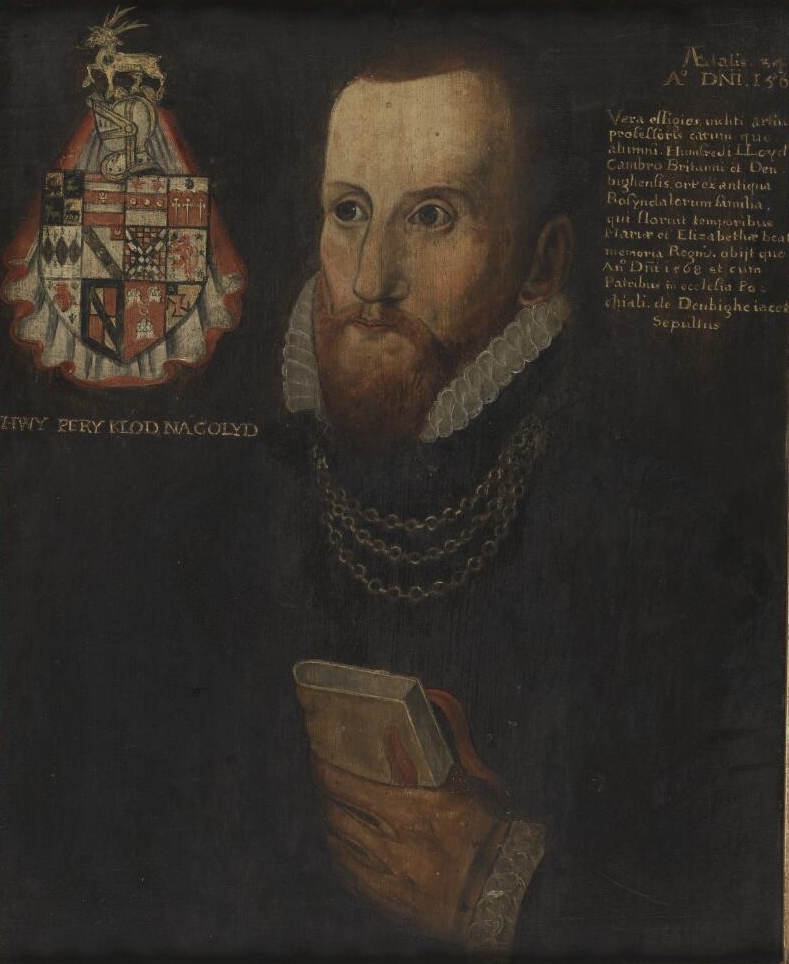
Humphrey Llwyd (also spelled Lhuyd) (1527–1568)
Fittingly, Lord Roberts of Conwy, during a House of Lords debate concerning the Welsh language, stated:
“It was an Act of 1563, promoted by Humphrey Llwyd of Denbighshire in the Commons and Richard Davies, Bishop of St Davids, in the House of Lords that secured William Salesbury’s translation of the New Testament and Davies’s own translation of the Book of Common Prayer for use in Welsh churches by 1567.”
Finally, Richard Clough’s portrait reveals a curious detail: his attire, resembling livery for a gentleman retainer, is striking in its black and white coloring, echoing Sir Rowland Hill’s coat of arms. While further research is needed to confirm the link, it’s plausible that Hill recognized Clough’s talent, bringing him from obscurity in Wales and launching his extraordinary career. This patronage could certainly explain the evident admiration for Soulton Hall reflected in the design and construction of Bach-y-Graig, built so closely in time and style—and clearly by a man with the same fascination for rhombic dodecahedra.
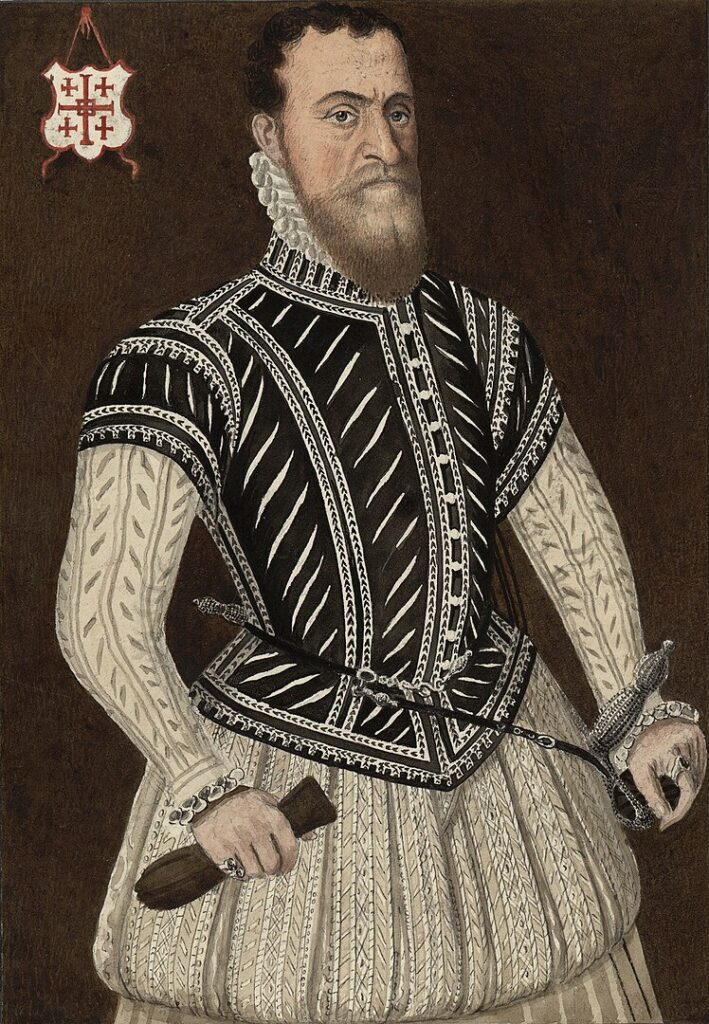
Richard Clough/Rhisiart Clwch
********
In summary, when we consider Richard Clough’s social connections, his intriguing activities (including his possible involvement in secret service), and his conspicuous and repeated links to those working to promote the Welsh Bible and the survival of Welsh culture, and then observe the strikingly close inspiration Bach-y-Graig takes from Soulton Hall, the picture becomes clear.
Bach-y-Graig is was not just a house, it was a a monument—like Soulton another “sermons in stones”, but this time, a monument for Wales.
********
While our focus here has been the Welsh Bible, it’s intriguing to note a related connection to the broader cultural landscape of Elizabethan England and Wales which furnishes a link to Shakespeare.
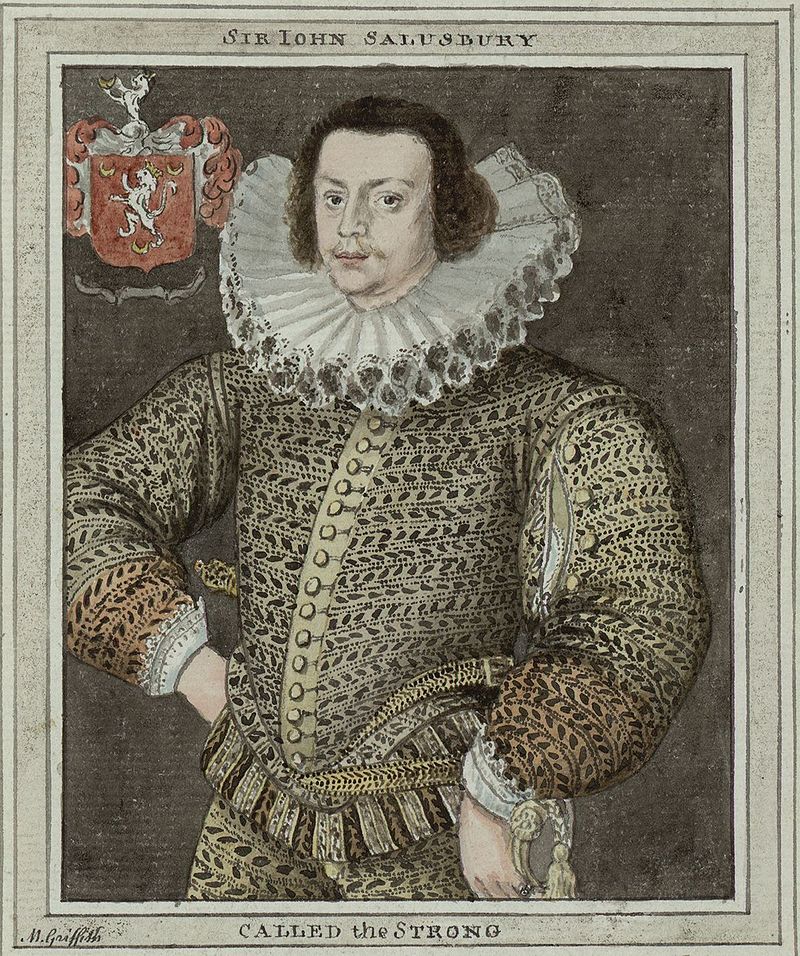
An 18th-century copy of a portrait of Sir John Salusbury from ‘A tour in Wales. by Thomas Pennant (1726-1798) that chronicle the three journeys he made through Wales between 1773 and 1776.
This is furnished by Robert Clough’s step son, and Katheryn of Berain’s son of her fist marriage: Sir John Salusbury Jr. (1567 – 24 July 1612).
The close ties between the Clough and Salusbury families are further underscored by an account from historian Helen Williams-Ellis. When Sir Richard Clough was on his deathbed in Hamburg in 1570, John Salusbury of Rhug and his brother-in-law, Robert Salusbury, traveled to ensure the future of Clough’s Salusbury stepchildren, of whom Sir John Salusbury Jr. was one.
John Salusbury Jr. was the dedicatee of Shakespeare’s poem The Phoenix and the Turtle, which was included in the 1601 collection Love’s Martyr. Several works were dedicated to him. In 1595 Henry Perry dedicated his book of Welsh grammar Egluryn Ffraethineb to Salusbury. Sinetes Passions (1597) a collection of verse by Robert Parry, was also dedicated to Salusbury.
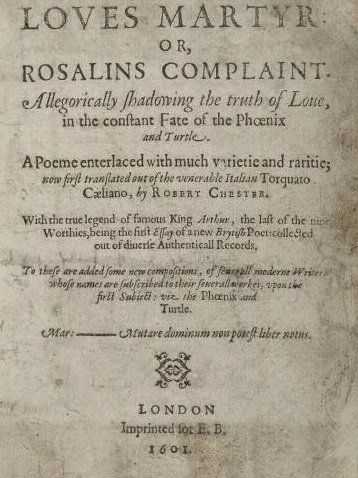
1601 cover of ‘Loues martyr, or, Rosalins complaint’
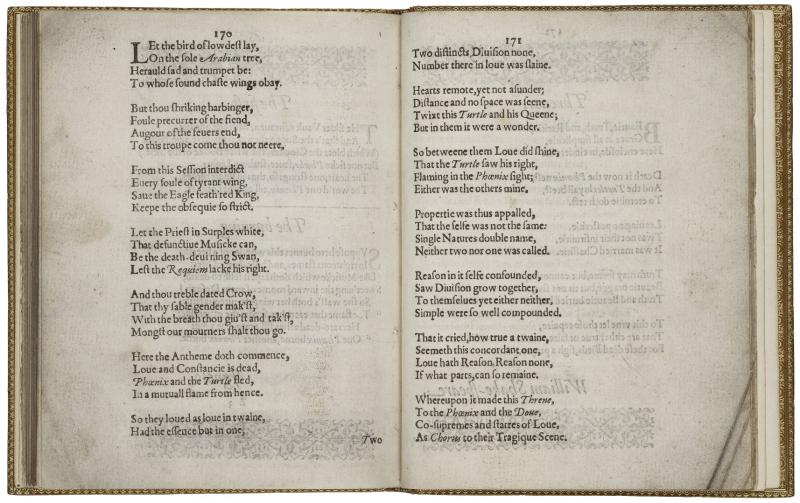
Shakespeare’s poem, now known as “The Phoenix and the Turtle,”
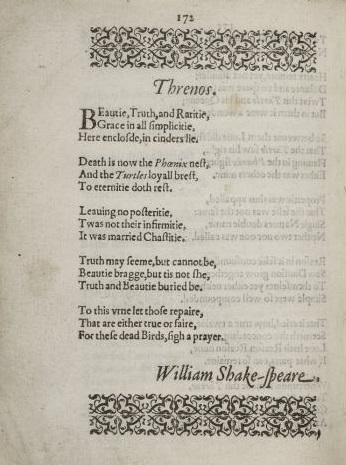
Shakespeare’s name at the closing of the poem, “The Phoenix and the Turtle,”
John Salusbury Jr, was a courtier at Elizabeth I’s court and married Ursula Stanley, the illegitimate daughter of Henry Stanley, 4th Earl of Derby who was a significant patron of Elizabethan theatre, maintaining acting companies both before and after his accession to the earldom in 1572. These companies, became Lord Strange’s Men. This further connect the Salusbury family to the cultural world of the time beyond Wales.

Ben Jonson: portrait by Abraham Blyenberch, c. 1617; oil on canvas painting at the National Portrait Gallery, London
Sir John Salusbury, a staunch Protestant and political player in Elizabethan and Jacobean England, was known for his opposition to both Catholic recusants and the Earl of Essex. He even engaged in a sword fight with his Essex-supporting cousin, Owen, which ultimately benefited his standing. Knighted for his role in suppressing the Essex Rebellion (in which Owen was killed), Salusbury’s political career was marked by conflict, including the “Wrexham riot” during a parliamentary election.
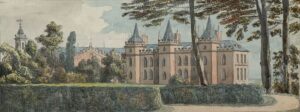
Plas Lleweni (Lleweni Hall), the Salusbury family seat from 1289-1748, near Denbigh, Wales. Note the repeating three-tower design, echoing Bach-y-Graig.
While he briefly served as MP for Denbighshire, his influence at court waned after Elizabeth’s death.

Bach-y-Graig, Tremeirchion
He subsequently focused on pursuits like gardening and herbal medicine at Lleweni Hall, a house whose castilated three-tower design, mirroring Bach-y-Graig, may have been inspired by Sir Rowland Hill’s coat of arms.
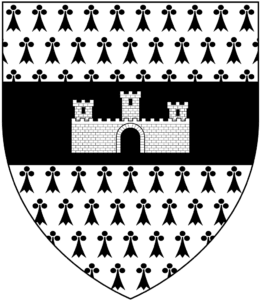
Arms of Sir Rowland Hill
********
The Phoenix and the Turtle,” while ostensibly a poem about transcendent love, offers a possible and interesting political interpretation, especially when considered alongside Robert Chester’s related work.
In this interpretation, the poem’s central allegory, the union of the immortal Phoenix and the mortal Turtle, can be understood as a reflection on the intricate relationship between England and Wales during the Elizabethan era, a time of religious upheaval and shifting political landscapes.
The Phoenix was explicitly associated with Elizabeth I herself, so much so that there is a famous portrait of her wearing jewellery featuring this mythical bird. In this reading, she embodies England’s power and perceived resurgence under her rule. Her unique position and almost mythical aura mirror the way Elizabeth was presented as a divinely sanctioned monarch. The Turtle, conversely, might represent Wales or a significant Welsh figure.
Significantly for this reading, Chester’s main poem which sets up the Shakespeare work incorporates the story of King Arthur and a history of ancient Britain, emphasizing Welsh etymologies for British towns – and culminates with the joint immolation of the Phoenix and Turtledove, giving birth to a new and more beautiful bird from the ashes. The poem’s exploration of a perfect, unified love, where “two distincts” become “division none,” might be seen as an idealized vision of Anglo-Welsh relations.
The “mutual flame” that consumes both birds might symbolize the trauma of the 1500s and desired harmony and integration of the two nations.
However, this very act of merging also hints at potential anxieties surrounding Welsh identity and autonomy. The loss of distinctness inherent in the union could reflect apprehensions about cultural assimilation or the absorption of Wales under English dominance. Consequently, the poem’s message is not simply one of celebration; it also subtly acknowledges the inherent tensions present in such a union.
The religious context of the Reformation adds another dimension to this political reading. Henry VIII’s break from Rome had profound implications for both England and Wales, reshaping their religious landscape and impacting their political relationship. The “mutual flame” could also symbolize the religious changes imposed upon both nations, with the “death” of the old religious order and the “rebirth” from the ashes representing the religious transformation and the aspiration for a new, unified religious identity under the Crown.
Chester’s dedication of his own poem to the Phoenix and Turtledove, presenting them as female and male respectively, further supports the political interpretation. This gendering of the symbolic birds could reflect the power dynamics between England (often personified as female) and Wales (potentially male). Chester’s longer allegorical work, incorporating Arthurian legends and Welsh history, could be seen to reinforce this connection. In this light, “The Phoenix and the Turtle” becomes a possible and interesting allegory for the political and religious realities of its time, offering a nuanced reflection on the complex relationship between England and Wales during a period of significant change.
Further reading
- “SALUSBURY, SALISBURY, SALESBURY family, of Lleweni and Bachygraig” on the Dictionary of Welsh Biography.
- Lord Roberts of Conwy, remarks during debate on the National Assembly for Wales (Legislative Competence) (Welsh Language) Order 2009, House of Lords, Hansard (HL Deb 9 December 2009) vol 715 col [Insert Column Number Here].
