


A remarkable discovery unfolded in London in May 1954, as documented in this press clipping from the Soulton Archive (unfortunately the publication is lost, for the moment).
During the excavation of the bombed chapel of Mercers’ Hall in Cheapside, a beautiful Early Renaissance statue of Christ was unearthed five feet below the floor.
Described as “one of the major archaeological finds made in London during this century,” the statue’s “remarkable beauty” and “complete realism” of the head were immediately noted.
The image conveyed by the brief excerpt is poignant: “The body of Christ lies alone, with none to mourn it, after it has been taken down from the Cross.”

1954 Press Clipping concerning the Mercer’s Christ, in the Soulton Hall Archive
While the initial discovery was significant, further historical context paints an even more compelling picture of the statue’s journey through time.
The key to understanding its burial lies in the turbulent period of the Reformation and the widespread iconoclasm that accompanied it. It is highly probable that this significant religious artwork was deliberately hidden during this era to protect it from destruction.
Adding another layer of intrigue is the physical layout of Mercers’ Hall. The chapel was not a standalone structure but was directly connected to the Great House in London, the residence of Sir Rowland Hill of Soulton.
Sir Rowland Hill was an exceptionally influential figure in Tudor London. His four terms as Master of the Mercers’ Company underscore his deep authority within this powerful livery company. Furthermore, his service as Sheriff of London in 1542/3 and Lord Mayor in 1549/50 places him at the very heart of London’s civic leadership during the height of the Reformation’s iconoclastic fervor.
Given this context, the likelihood that such a significant statue could be buried within the connected complex of Mercers’ Hall and his own Great House without Sir Rowland Hill’s knowledge seems incredibly slim. Indeed, the possibility of his direct involvement in the statue’s concealment becomes a strong and compelling theory.
Perhaps Sir Rowland Hill, or those acting under his authority, recognized the immense artistic and spiritual value of this “figure of Christ of remarkable beauty” (which is only damaged in he slightest way) and made a deliberate decision to safeguard it from the destructive forces of religious reform. Burying it beneath the chapel floor, within the physical proximity and connection of his own property, would have been a clandestine act of preservation, a silent act of defiance against the prevailing religious climate.
The rediscovery of this Renaissance Christ centuries later, amidst the rubble of a chapel damaged in the Second World War, is a powerful testament to the enduring nature of art and faith. This artifact, hailed as a major find in 1954, carries with it a silent narrative of survival, potentially orchestrated by one of the most powerful figures in London during a period of immense religious upheaval.
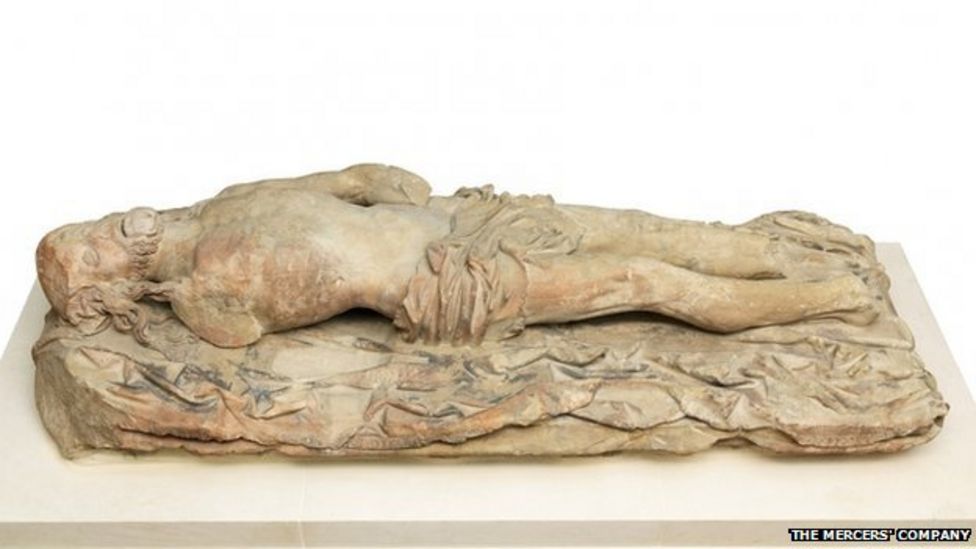
The Statue of the Dead Christ was discovered in 1954 (c) The Mercers Company
The statue’s long concealment speaks volumes, hinting at a deliberate act of protection by Sir Rowland Hill, a Master of the Mercers who may have ensured this beautiful depiction of Christ would one day rise again from its hidden depths.
The text we have from this documents reads as follows:
MAY 27 1954
STATUE OF CHRIST DISCOVERED IN LONDON.-An Early Renaissance figure of Christ of remarkable beauty which has been discovered 5ft. below the floor of the bombed chapel of Mercers’ Hall, in Cheapside, during recent excavation of the site. In an article which appears on page 15 it is described as one of the major archaeological finds made in London during this century.
