

It is Boxing Day—the one day of the year when the UK is quite literally obsessed with boxes.
We’ve just spent the morning tearing them open, the afternoon flattening them down, and the evening trying to figure out how to fit them all into the recycling bin.
But at Soulton Hall, “boxiness” takes on a much more sophisticated meaning.
It is an invitation to think about mathematics and social allegory.
On the surface, the Hall is a sturdy, handsome, red-brick cube—a sentinel standing firm against the Shropshire elements for nearly five centuries. After the loss of its original pyramidal roof, that cubic silhouette became even more pronounced. However, on this day of transitions, when the low winter sun casts shadows that stretch longer than the landscape should allow, that famous Soulton “boxiness” reveals its true nature.
This is not just a house; it is a mathematical cipher designed by one of the 16th century’s greatest minds, Old Sir Rowland Hill.
The Hidden Shape: The Rhombic Dodecahedron
While the Hall looks like a simple box, scholars like James Wenn have discovered that its architecture is a physical manifestation of a far more complex shape: the Rhombic Dodecahedron. This is a 12-faced solid where every face is a perfect diamond (rhombus).
The Allegory of Inclusion: Filling the Space
The most beautiful thing about the Rhombic Dodecahedron isn’t just its symmetry, but its ability to tessellate. In geometry, this means the shape can pack together perfectly to fill three-dimensional space without leaving a single gap.
In the Renaissance, this was more than just a maths trick; it was a social allegory. In an era of religious chaos and social breakdown, Sir Rowland Hill was using geometry to talk about humanity. Just as these shapes fit together perfectly to fill a void, Hill believed in a society where every individual—no matter their background—could “tessellate.”
It is an architecture of inclusion: a reminder that we can all fit together comfortably, supporting one another without gaps or friction, to create a stable and harmonious whole.
The Clue is in the Windows: Look closely at the stone windows.
The mullions (the vertical and horizontal bars) are unique to Soulton and Thomas Tresham’s unfinished Lyveden New Build. Where they meet, they don’t just cross at a right angle; they meet at a distinctive square block.
If you imagine three beams of light traveling through these blocks—up/down, left/right, and forward/backward—their intersection points mathematically describe the vertices of a Rhombic Dodecahedron.

Rotation of a rhombic dodecahedron
In the Renaissance, these geometric forms were “learning technologies.”
They weren’t just for show; they were designed to train the mind to see the underlying harmony of the universe.
Stepping into the Tesseract
If we take this “boxy” fun a step further into modern physics, we encounter the Tesseract (or hypercube).
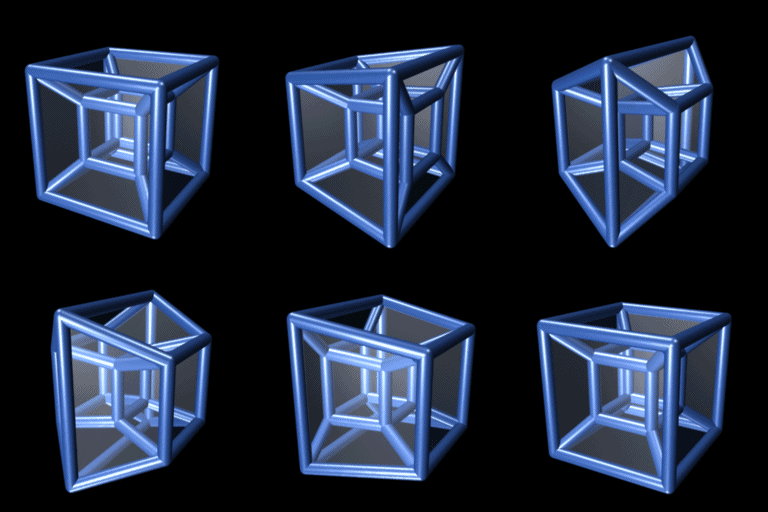
In geometry, a tesseract or 4-cube is a four-dimensional hypercube, analogous to a two-dimensional square and a three-dimensional cube
This is the four-dimensional version of the Hall.
Think of it like this:
-
A Square is 2D.
-
A Cube is 3D.
-
A Tesseract is 4D.
If you “unfolded” a 4D Tesseract into our 3D world, it would look like a cross made of eight cubes.

Hypercube
When you walk through the doors of Soulton, navigating its symmetrical rooms and hidden spaces, you are essentially moving through a 3D “slice” of a higher-dimensional spatial reality.

A two-dimensional shadow cast by the frame of a tesseract.
The Allegory of the Box
In an era of religious chaos and social breakdown, Sir Rowland Hill used geometry as a social allegory. A cube is perfectly stable; it represents truth and equality because every side is equal.
The cubic clarity of Soulton is a reminder that even when the world feels shapeless or divided, there is a “code” of peace and reconciliation underneath it all—the same “Dance of Harmony” found on the Hall’s famous dancing pavement.

The famous Soulton Dancing Pavement
The house was designed to be a place where different sides could meet in a space governed by the immutable, predicatble and therefore fair laws of mathematics.
As you enjoy your Boxing Day walk, look back at the Hall.
Don’t just see a “boxy” building.
See a geometric anchor.
See a cube that suggests a hypercube.
See a home that occupies three dimensions of space, but many dimensions of meaning.
