


A tempestuous sea rages off the coast of Greece, circa 520 BC.
A man, Hippasus of Metapontum, fights for his life.
Cast overboard from a small vessel, he is left to drown in the unforgiving waters.
His crime? Revealing a mathematical secret so dangerous it could shake the foundations of the Pythagorean worldview.
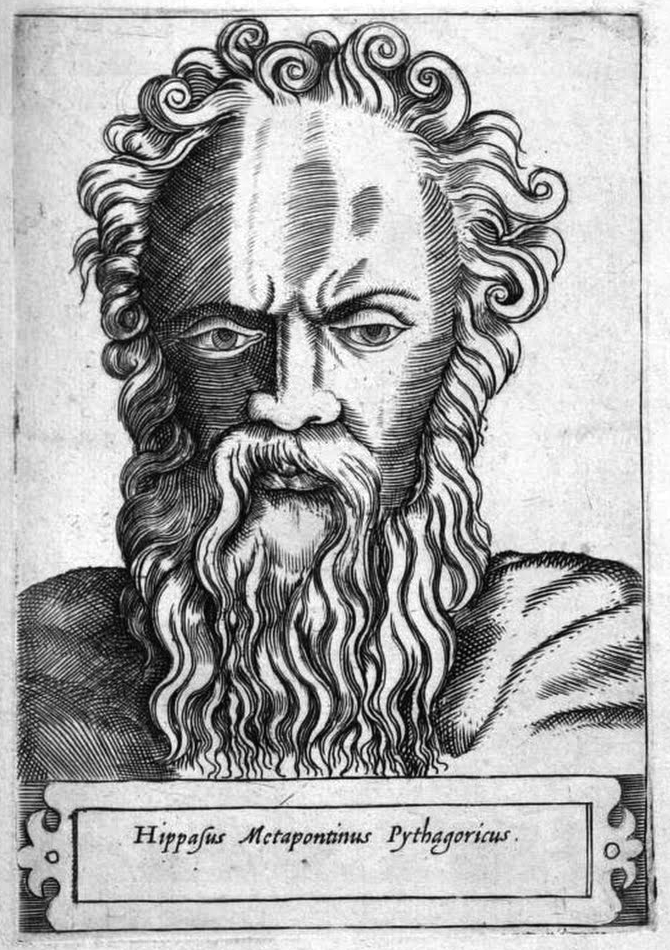
Hippasus, engraving by Girolamo Olgiati, 1580
********
The Pythagorean school, founded by the enigmatic figure Pythagoras of Samos around 569 BC, was a secretive society obsessed with the power of numbers.
Their motto, “All is number,” reflected their belief that the universe was fundamentally mathematical and that whole numbers held divine significance. The inner circle of the school, the mathematikoi, delved deep into the properties of numbers and assigned specific meanings to each.
For example: Odd numbers were masculine, even numbers feminine.
However, lurking beneath the surface of this harmonious numerical world was a dark secret, a number that threatened to unravel the Pythagorean cosmology.
This number, the ratio of the diagonal of a square to its side, or the hypotenuse of a right-angled triangle to one of its shorter sides, defied the Pythagorean belief in the primacy of whole numbers.
It was this very number, the square root of two, that is believed to have led to Hippasus’s tragic fate.
Its irrationality, the fact that it cannot be expressed as a simple fraction, challenged the Pythagorean doctrine and exposed a flaw in their perfect numerical universe. The revelation of this secret, it is said, was met with shock and horror by the Pythagorean brotherhood, leading to Hippasus’s expulsion and, ultimately, his demise.
The Pythagorean theorem, which relates the lengths of the sides of a right-angled triangle, is perhaps the most famous mathematical theorem of all time. It is from this theorem that the irrational nature of the square root of two emerges, a number that continues to fascinate and perplex alike.
********
To understand why √2 is irrational, let’s assume the opposite: that it can be expressed as a fraction a/b, where a and b are integers with no common factors (i.e., the fraction is in its simplest form).
If √2 = a/b, then squaring both sides gives:
2 = a²/b²
Rearranging, we get:
2b² = a²
This equation tells us that a² is an even number (since it’s 2 times something). If a² is even, then a must also be even (the square of an odd number is always odd).
Let’s express a as 2c, where c is another integer. Substituting this into the equation above, we get:
2b² = (2c)² = 4c²
Dividing both sides by 2, we have:
b² = 2c²
Now, we see that b² is also even, which means b must be even as well.
So, both a and b are even numbers, which contradicts our original assumption that a/b was in its simplest form. This contradiction proves that √2 cannot be expressed as a ratio of two integers, making it an irrational number.
The discovery of irrational numbers forced the Pythagoreans to confront the limitations of their rational worldview. It was a profound revelation that challenged their understanding of the universe and the nature of numbers.
********
The irrational number √2, once a source of philosophical and mathematical turmoil for the ancient Pythagoreans, has found practical applications in various fields, including paper sizing.
The A4 paper size, a global standard, is a testament to the elegance of this irrational number. This specific dimension is chosen to maintain a consistent aspect ratio of 1:√2. This means that when an A4 sheet is folded in half, the resulting A5 sheet retains the same proportions. This property ensures that documents can be scaled up or down without distortion, a feature crucial for printing, photocopying, and digital document formats. The 1:√2 ratio optimizes the use of paper, minimizing waste and maximizing efficiency. It’s a fascinating example of how a seemingly abstract mathematical concept can have tangible real-world applications.
********
The square root of 2 (√2) also has a surprising connection to the rhombic dodecahedron, a three-dimensional shape composed of twelve identical rhombuses.
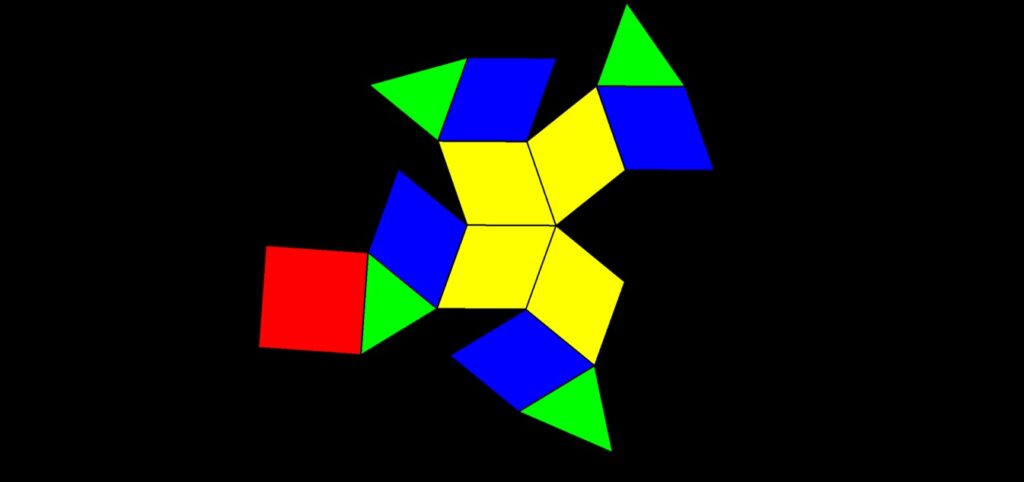
Diminished rhombic dodecahedron net
The rhombic dodecahedron itself appears in various fields, from crystallography to architecture and design: it is very important to Soulton Hall’s concepts.

This image depicts a scholarly reconstruction of Soulton Hall, highlighting its architectural elements inspired by the ancient theater of Epidaurus. The yellow lines trace these features, revealing the Rowland Hill’s homage to the renowned Greek structure.
Its intriguing properties and aesthetic appeal make it a popular subject of study and exploration, for a deeper understanding of which, we refer you to our consultants, Byrga Geniht.
