

Italian Villas and English Manors: Performance Spaces of the Renaissance
Villa Emo Capodilista (c. 1580), designed by Dario Varotari the Elder, and Soulton Hall (c. 1550s), designed by/for Sir Rowland Hill potentially with involvement from Archbishop Parker, are separated by hundreds of miles, but are close in time.
They offer compelling case studies in the intersection of architecture, geometry and theatrical practice during the Renaissance.

This scholarly reconstruction of Soulton Hall as it was in Old Sir Rowland’s time highlights proportions chosen to link to Classical Greece by superimposing yellow lines showing the proportions of the renowned theatre at Epidaurus. This theatre was praised by Pausanias and its geometry was described by Vitruvius in texts Old Sir Rowland would have known well.
Villa Emo Capodilista , an exemplar of Venetian villa design, reveals its performative history very explicitly through inscriptional evidence linked to Luigi Groto’s Adriana, a play that is considered a possible inspiration for Shakespeare’s Romeo and Juliet. These inscriptions, embedded within the villa’s fabric, suggest not only the presence of theatrical activity but also the integration of performance within the villa’s social and cultural function.
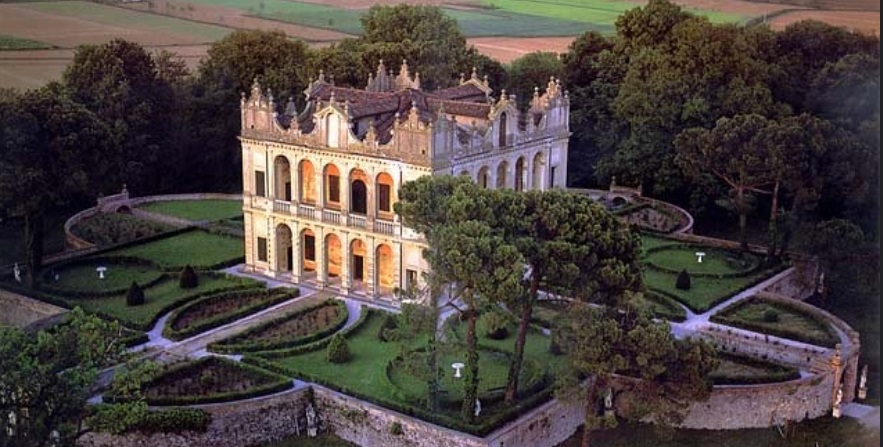
The later Villa Emo Capodilista, Creative Commons.
Soulton Hall, conversely, manifests its theatrical aspirations through its architectural debt to the ancient theatre of Epidaurus.
The “Epidaurus Court,” a deliberate design feature, points to a conscious effort to create a space conducive to dramatic presentation, reflecting a broader European interest in classical models. While Capodilista’s theatrical function is evidenced by the memorialisation of dramatic text, Soulton Hall’s theatricality is embedded within its structure and its direct association with a specific dramatic works (As You Like It and Rosalynde).
Both of these buildings show the influence of Alberti and Vitruvius’s principles (whose writings on classical architecture were highly influential) and the humanist pursuit of classical ideals.
Both, share a common element: the blurring of lines between domestic and performative space.
The villa, in the Italian context, served as a locus for aristocratic entertainment and cultural display. Similarly, Soulton Hall, though English in its context, suggests a comparable function, where the “Epidaurus Court” would have provided a venue for dramatic and other forms of cultural expression. Thus, these two structures, distinct in their regional styles and specific manifestations of theatricality, offer valuable insights into the ways in which Renaissance architecture was conceived not simply as a backdrop to life, but as an active participant in shaping the cultural landscape and experience of dramatic performance.
You can see, across from Soulton in the rolling hills of Derbyshire, at Bolsover Castle, drama unfolded in a way we can closely associate with these other two buildings.
Charles I attended a grand masque of “Love’s Welcome” in 1634 in the time of Sir Charles Cavendish, and before and after then its Fountain Court is understood to have been designed for and used for music, dance, and the spoken word.
The impulse to perform, and the linked desire and need to build ‘Show Houses’ (in the sense of performance, not showing off) is woven into the fabric of Renaissance life, as we can see from these few examples.
Thus, these two structures, along with others like Bolsover Castle, distinct in their regional styles and specific manifestations of theatricality, offer valuable insights into the ways in which Renaissance architecture was conceived not simply as a backdrop to life, but as an active participant in shaping the cultural landscape and experience of dramatic performance.
