Dystopia to Harmony (A Journey):
Jacob Chandler’s As You Like It Installation
Remarks of contributors at the Private View
There is an important art exhibition at Soulton between 14 and 17 November. It includes open public access on the Saturday and Sunday as explained in the link just given.

Jacob Chandler, Artist
The private view on the Friday will include some speeches, the speaking notes of which are reproduced below so they are more widely available.
Remarks from Jacob Chandler, the artist
My Lord Lieutenant, Ladies and Gentlemen: Good evening.
I appreciate you attending this event, which is my first installation and the premier of my latest body of work.
Thanks also go out to the Ashton family who have most kindly given us access to this wonderful location and has inducted me into the fabulous history associated with the Manor, which has been the inspiration for my analysis of Shakespeare’s As You Like it.
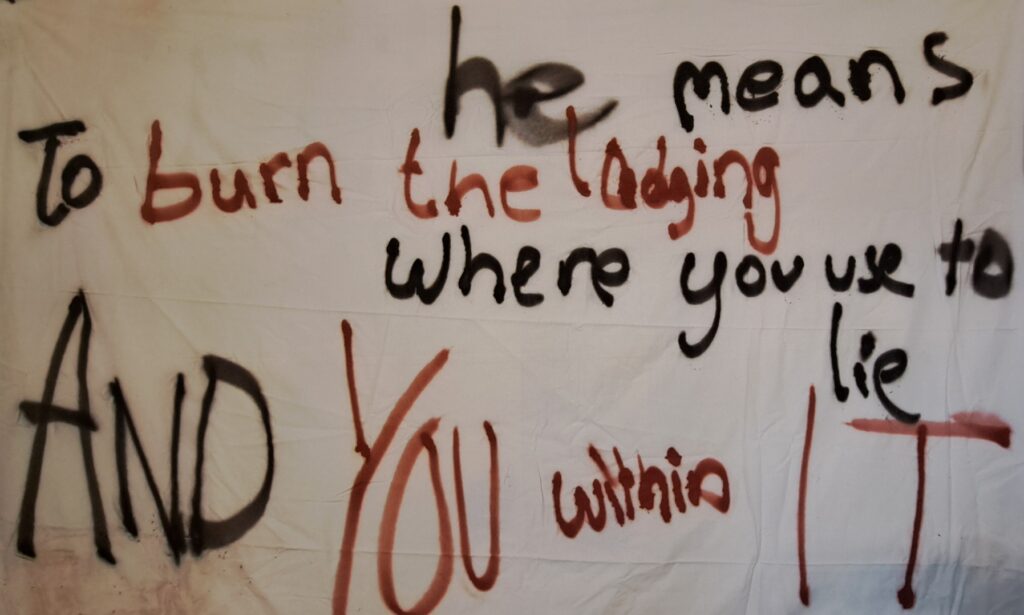
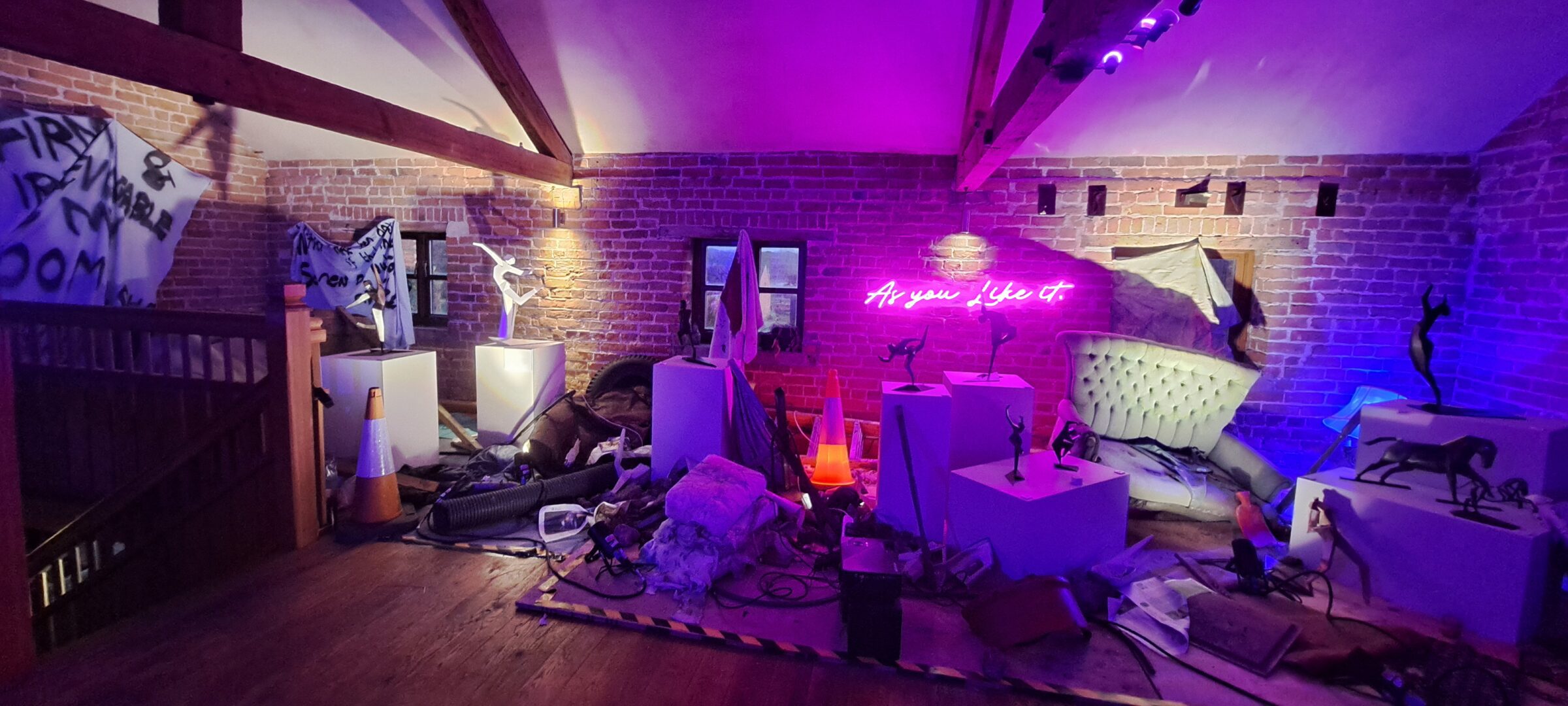
The chaos and dystopia of the usurped court from which the good characters flee is shown in the exhibition, which incorporates a sculpture retrospective.
This installation guides the viewer through the dystopian early acts of As You Like It, where the court is a place of conflict and betrayal, through to The Forest of Arden. This magical place is a transformative space, where love and forgiveness heal the fractures created by the court’s dystopia, bringing the characters to a place of unity and peace.
I placed my sculptures from the “Moments in time” body of work, within this dystopia as these pieces discuss the danger of relying on the inherently fragile human body, to provide self identity. They chronicle my own physical and emotional destruction at the hands of a genetic disease, Ehlers Danlos Syndrome and colitis, which ravaged my health and sense of self. Through sublimation, at this time in my career, I explored the illusion of physical perfection. All the poses captured are caught on the edge of losing balance. This mirrors the court’s precarious condition at the beginning of the play.
My small “Explorations of Flatlands” are placed in this dystopia as glimmers of hope, which is realised, when one sees the transfigured As You Like It characters, in the Harmony of the Forest of Arden.
The Flatlands body of work was inspired by the novel Flatland by Edwin Abbott. This Victorian social satire seems forever poignant and I see it as a metaphor for how hard it is for people who have been polarised, to adjust their thinking and see things from a healthy perspective. Standing back from the relief sculptures allows one to perceive the subject of the composition more clearly but if you look at it from the side it appears as a series of lines, the two views appear to have nothing in common, unless you invest the energy to look at things from both points of view and find the common ground. This is a reworking of Plato’s cave where silhouettes cast from the light of a fire belie the complexity of a human being. I hope to pursue this on a larger scale, where people can physically experience this transition as it seems to be a reflection of society today.
Jacob Chandler’s AS YOU LIKE IT dancers in the Moot Hall, Soulton Hall
The characters in As You Like It start in turmoil; they explore their own identity within the forest of Arden and eventually find themselves and marital happiness.
Rowland Hill, the once owner of Soulton Hall, was Lord Mayor of London, publisher of the Geneva Bible in 1560 and cousin of Shakespeare’s mother Mary Arden. He similarly navigated dangerous unbalanced times, In his case when the country reeled from protestant to catholic and back to protestant. Such was the turmoil of the times that a protestant priest hole was required to protect Queen Elizabeth I’s godfather within the main hall.
Indeed the very room in which we stand was a court room which even presided over a witch trial. (I am happy to say in this place Harmony prevailed).
When Tim Aston commissioned me I was charged with capturing not just the transformation of the characters within the play but to allude to the significant history of the hall. No small task! But I’ll try to explain how I aimed to fulfil this brief.
The visual that most captured my imagination from the play was that of love struck Orlando hanging his poems to Rosalind, in the trees of the forest of Arden. This is where the idea to hang the large prints came from.
The hanging battens symbolically reference the trees and have been constructed from oak, kindly provided by Lord Barnard and sourced from within Shropshire’s ancient forest of Arden.
The plugs at the bottom of the pieces correlate to show which characters wed. The darker more prominent plugs are from an ancient beam sourced from Old Sir Roland’s Soulton hall by kind permission of Tim Ashton. They pay homage to the dance seal of the estate, which features five light sections and three darker ones and Hill’s coded messages evident within The Hall.
The choice of a black and white colour theme was chosen to draw a parallel with the Tudor buildings and particularly with The Globe. I resisted the temptation to print the pieces in a solid uniform black and rather embraced the variance possible when the ink is applied more sparingly. Each print, in this way is unique This hand printing technique is also more reminiscent of the early printing techniques that Shakespeare’s contemporaries and those printing the Geneva Bible would have been familiar with.
My latest iteration on this theme sees the characters represented in the flatlands style. Reinforcing that true harmony can only be achieved when one considers the whole picture. Not allowing polarisation.
I chose a reflective finish, making the viewer and the surroundings part of the piece, illustrating my belief that only when one has respect for oneself and one’s environment can one reach self enlightenment. This is also part of my take, on As You Like It’s message.
This body of work was created as I publicity and personally faced my own disability, the force that had thrown my life into disarray but through it I have now found a new identity, using my arts platform to raise awareness of hidden disabilities and becoming ambassador for EDS UK.
Accepting rather than fighting and denying my disability was difficult but working with Ben Pearson, the bladed athlete, to produce the Commonwealth sculpture on Birmingham New St in 2022 provided me with insights into my own condition. It was my Forest of Arden.”


Remarks for the Ashton family, by Tim Ashton
My Lord Lieutenant and esteemed guests,
It is my distinct pleasure to welcome you all to Soulton Hall, and to this remarkable exhibition celebrating the extraordinary work of Jacob Chandler. This gathering marks a significant moment, not only for Jacob but for the art world as a whole, arriving, as it does at an intersection between scholarship, dance, philosophy, theatre and visual arts, and in a place that is significant to all of those topics.
Jacob is an important artist of his generation, with a growing national reputation, whose work is being institutionally acquired.
In the exhibition Jacob is engaging with important scholarship by James D. Wenn who has worked for my family for some years on part of our story and that of this place.
Silvius, Rosalind, Touchstone and Celia: 4 of the 8 dancers, as rendered by Jacob Chandler
The work that is being shown tonight has met with favourable reviews from Shakespeare’s Globe and the Lord Mayor of London.
Pieces you are about to see have been commissioned by my family, taking Jacob into confidence some years ago, about aspects of the story of Soulton, which have only been publicly acknowledged and shared for a few months. Things that in their moment, in the turbulence of the Tudor period and the centuries that followed, were immensely dangerous and vulnerable, and necessarily secret.
Oliver, Audrey, Orlando and Phoebe. As imagined by Jacob Chandler.
These remarks are not the time for a deep dive into these matters, but I think in this company I may say that for excellent reasons (which I am happy to discuss over a drink), the Old Sir Rowland who is the benign exemplar of virtue in As You Like It, the father of Orland is my forebear, Sir Rowland Hill, the builder of this house, and the publisher of the Geneva Bible, of whom Shakespeare causes Rosalind to say:
“My father loved Sir Rowland as his soul,
And all the world was of my father’s mind:”As Jacob has said, there is a frequently overlooked dynamic in As You Like It which concerns the dystopia of the imperial core of the Dukedom that has been usurped by a wicked Duke, Duke Fredrik, who despise the virtue of Old Sir Rowland (who in our world is a cousin of Shakespeare), who would kill his brother, who has stolen lands and property, who banishes people for being good.
The good characters find themselves in Arden. Arden includes Shropshire as, we all know.
Here in Arden, linked to the estate of Old Sir Rowland, the characters explore pluralism, humour, grace, find love.
But they also had to run away to here for sanctuary because their politics was dangerous and it was a time of emergency.
The source book for Shakespeare’s As You Like It, is the work of Thomas Lodge Jr. His father owned this manor before Old Sir Rowland’s time. The room we are stood in, and the courtyard beyond are on the medieval plan of this manor, so it was on this spot that the culture that birthed the spirit of As You Like It lived and lives.
As we know, there is a divinely commanded dance that concludes As You Like It, asked for by Hymen. It is a circle dance for eight people. it is an ancient dance associated with classical antiquity, and it goes boy, girl, boy, girl: or as Shakespeare has it:
‘Ducdame, ducdame, ducdame’.
The notation for that dance has survived at Soulton in our papers and in the dancing pavement, which you may see tonight on your way to the chapel on the house tours you can join.
The dance essentially draws a mathematical harmony on the floor, teaching would-be Platonic guardians about their duties.
Another message from the dance is to find a place for everyone. Jacob spoke movingly about vulnerability, and the impact of his disability. I join him tonight in sharing my own challenges with dyslexia, noting how various types of difference can work to drive talent from the board that deserves to be heard, and indeed that at types difference fuels creativity and hyperfunction that is socially useful to the wider community.
This interest in mathematics and harmony, together with the vulnerability of harmony, has been a longstanding part of the artistic work.
The Flatlands, work you are also to have set before you today pre-dates Jacob’s work at Soulton but is interestingly linked thematically to Soulton and the As You Like It work.
In flatlands, there are characters who live as squares and circles on a two dimensional flat page, and can move up and down, and left an right — but backwards and forwards, for they lack knowledge of this spatial dimension. It takes a friend living in three dimensional space to pull them into a higher learning perspective of this extra space.
The definitive modern representation of the As You Like It Dancers, Jacob Chandler works shown in the Moot Hall, Soulton Hall
This is a journey Jacob is helping us to see can be made: like the figures in Plato’s cave who are scared of the brighter world then they have known, we need sometimes to unlock these extra dimensions. Old Sir Rowland Hill was able to because he published books that show knowledge of four dimensional space (which we now use in quantum physics) and he built it into this house, which references the mathematics of the rhombic dodecahedron: the form I am holding. For reasons I must send you to the website for this is intricately woven in to the codes of this house.
Marginalia in by Hannah Deakin in the 1830s Soulton Day Book; in the 1840s this was book used to design the Soulton Dancing Pavement.
But I will bring your attention to part of the harmony it has with the dance: if you make this shape only a frame, and not a solid, and make it four dimensional, the shadow of its frame will give you the dance.
Having said this about harmony, I remind you that this exhibition is immersive, and that to fully relish harmony, we must know dystopia, which you will have to walk through before you can see the dancers of harmony in the moot hall, which has the timbers of the boyhood of the writer of the source book holding the roof up.
Dystopian quotations from AS YOU LIKE IT
Therefore, please (if you are able) step outside where there will be some pyrotechnics and strobe effects before you are allowed to experience the harmony that Jacob has found for us in the dance in the Moot Hall above.
My Lord Lieutenant and esteemed guests, thank you.