


St. James Garlickhythe and St. Martin Ludgate, two iconic London churches, were recently visited and explored.
Both these historic sites share an intriguing connection to the renowned architect Sir Christopher Wren, whose influence is evident in their designs. Notably, Wren’s architectural legacy engages with Soulton, and possibly St Marys Church Ingestre near to us highlighting the broad reach of his work.
St James Garlickhythe
St James Garlickhythe, nicknamed “Wren’s lantern” due to its abundance of windows, is a Church of England parish church located in the Vintry ward of the City of London.
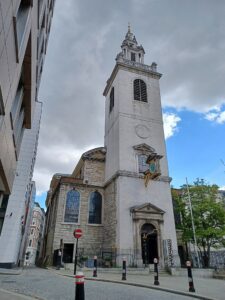
St James Garlickhythe,
It holds the distinction of being the official church of the Intelligence Corps. The church, dedicated to the disciple St James the Great, is a stop on a pilgrims’ route leading to the cathedral of Santiago de Compostela. Visitors can have their credencial, or pilgrim passport, stamped with a scallop shell at the London church. The name “Garlickhythe” derives from the nearby landing place, or “hythe,” where garlic was sold in medieval times The earliest recorded reference to the church dates back to the 12th century. It has been known by various names, including St James in the Vintry, St James Comyns, St James-by-the-Thames, and St James super Ripam.
The church’s association with wine merchants stems from the ships carrying garlic from France, which also transported wine. Located in the Vintry ward, the church was rebuilt in 1326 by the Sheriff of London and vintner Richard de Rothing. The Joiners’ Company, tracing its origins to a religious guild founded in St James in 1375, also has a long-standing connection with the church.
In the 15th century, St James became a collegiate church, served by seven chantry priests. Its significance in the Middle Ages is evidenced by the burial of six Lord Mayors within its walls. Following the dissolution of the monasteries under Henry VIII, St James became a parish church.
During the Commonwealth period, the parishioners provided a pension for the rector, who was ousted in 1647 for using the banned Book of Common Prayer.
The Great Fire of London in 1666 destroyed the ancient church. Rebuilding, to designs by Christopher Wren, commenced a decade later, as recorded on the Victorian vestry boards in the church porch. The body of the church was completed, but the tower lacked a steeple. Construction on the tower began 33 years later and was finished in 1717 by Nicholas Hawksmoor.
St. Martin Ludgate
St. Martin Ludgate, also known as St. Martin within Ludgate, is a historic Anglican church situated on Ludgate Hill in the City of London. While its origins trace back to medieval times, the present structure, designed by the renowned architect Sir Christopher Wren, dates from the 17th century.
Legend connects the church with King Cadwallo, though modern historians dispute this association. The earliest written reference to the church is from 1174. The church has undergone several reconstructions and renovations, including a major rebuilding after the Great Fire of London in 1666.
St. Martin Ludgate is renowned for its distinctive architectural features, including a lead-clad dome topped by a lantern and a sharp obelisk steeple. This striking design, particularly the contrast between the steeple and the dome of St. Paul’s Cathedral, is believed to be intentional.

St Martin, Ludgate
