


Ancient Connections: The Global Reach of the Anglo-Saxons
We recently had the privilege of immersing ourselves in the captivating world of the Silk Roads exhibition at the British Museum. This extraordinary exhibition offers a glimpse into a time when civilizations intertwined and cultures flourished.
One particularly fascinating aspect of the exhibition was the exploration of the Sutton Hoo ship burial. This remarkable archaeological find, located in Suffolk, England, holds significant relevance to Soulton due to our ongoing collaboration with James Wenn and the Anglo-Saxon interests of Sir Rowland Hill, which are evident in the architecture of Soulton Hall.

James Wenn with a garnet stone (copyright National Trust & Phil Morley)
The intricate metalwork and precious objects discovered at Sutton Hoo not only show the wealth and power of the Anglo-Saxon elite but also offer insights into their deeper cultural and spiritual beliefs.
The pioneering work we’ve been supporting with Byrga Geniht Ltd aims to unlock the symbolic meanings embedded within these objects, revealing a rich tapestry of interconnected ideas and traditions.
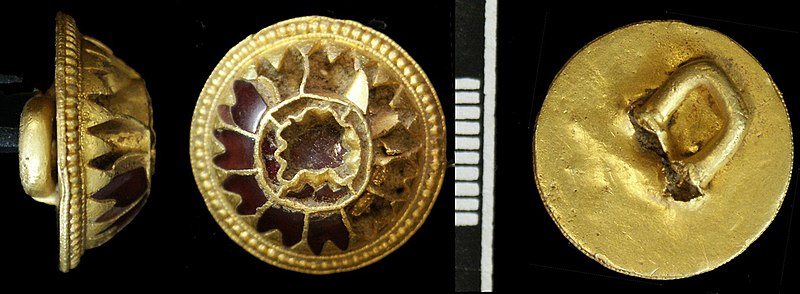
Gold scabbard boss of Sutton Hoo (FindID 399208). Creative Commons, credit The Portable Antiquities Scheme (PAS). The PAS is a voluntary programme run by the United Kingdom government to record the increasing numbers of small finds of archaeological interest found by members of the public. The scheme started in 1997 and now covers most of England and Wales. Finds are published at https://finds.org.uk
The Silk Roads exhibition celebrates not only the material culture of the past but also the enduring human spirit. It reminds us of the interconnectedness of our world and the importance of cultural exchange.
If you have the opportunity to visit the British Museum and experience the Silk Roads exhibition, we wholeheartedly recommend it. It is a truly unforgettable experience that will leave you inspired and amazed.
The Silk Roads were more than just routes for spices and silk. New research on the treasures found at Sutton Hoo reveals a fascinating connection to distant lands. Intricate metalwork adorned with garnets, sourced from as far away as Sri Lanka and the Czech Republic, highlights the extensive trade networks and cultural exchange that existed during the early medieval period. The Sutton Hoo site, once thought to be a mere local burial ground, now stands as a testament to the global interconnectedness of the past, both in terms of ideas and material objects.
Related lectures
The following are related lectures.
referrerpolicy=”strict-origin-when-cross-origin” allowfullscreen>
Further reading
The following 2023 articles by James D. Wenn:
- Secrets in the Stones: Decoding Anglo-Saxon Art – Introduction
- Secrets in the Stones: Decoding Anglo-Saxon Art. Part 1 – From Egypt to East Anglia: design in the Sutton Hoo scabbard bosses
- Secrets in the Stones: Decoding Anglo-Saxon Art. Part 2 – Follow the Lozenges
- Secrets in the Stones: Decoding Anglo-Saxon Art. Part 3 – Early Anglo-Saxon Temple Discovered
- Secrets in the Stones: Decoding Anglo-Saxon Art. Part 4 – The Garnet Code
Other materials:
- ‘Sri Lanka to Suffolk: Sutton Hoo and the Silk Roads’, (2024) by Sue Brunning, Curator, European Early Medieval & Sutton Hoo Collections
