


The Great Hill and Wren, Boyle, Pepys, and the Court: A Circle of Influence in Restoration England
Richard Hill (1655-1727), known as ‘the Great Hill,’ was a prominent English statesman, diplomat, and later, a clergyman.

The Reverend and Right Honourable Richard Hill. British (English) School
He was baptised in Hodnet in 1655 he was born during the English Republic (also known as the Commonwealth of England) a time when the Hill family, as Royalists, were in some necessary obscurity, and monumentalised in the Hawkstone landscape:
in the ruin of Red Castle… Rowland Hill the Royalist found it convenient to hide, for his own safety and the good of the Commonwealth
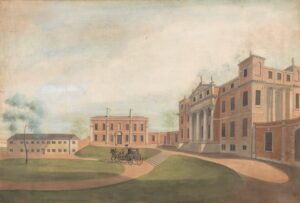
Painting of Hawkstone Hall in a cleaner phase of building, a post restoration building
It is not wholly clear what the house at Hawkstone was at this time and the house at Soulton was still the senior Hill house at this time, making it possible he was born at Soulton.
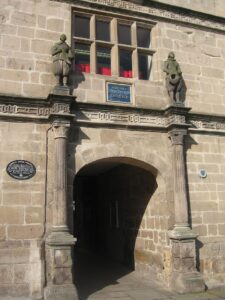
The entrance to the Old Shrewsbury School buildings – an instutution renewing the Saxon traditions of education, which Sir Rowland Hill helped to set up
The Great Hill was at Shrewsbury School and St. John’s College, Cambridge.
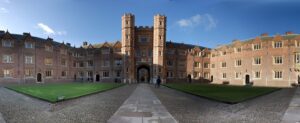
St John’s College Cambridge – a crucible of the Reformation in England
He was well networked with the important smart set of the Royal Society, and Court and the Restoration.
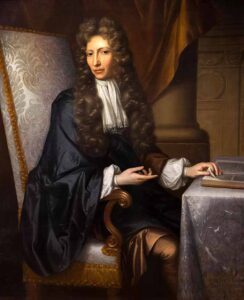
Robert Boyle
He tutored the sons of Richard Boyle (the brother of Robert Boyle), 1st Earl of Burlington, and subsequently the children of Laurence Hyde, 1st Earl of Rochester. The Hill arms are seen next to those of the Boyle Family at All Souls College, Oxford.
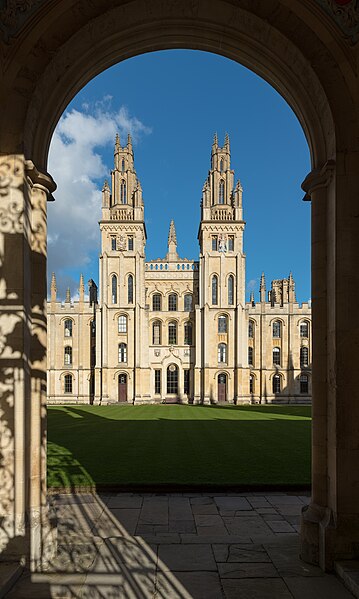
All Souls College Oxford – Hawksmore Quadrangle looking onto the SRC, within a building with two tower-like projections. In the top of the image are the Hill and Boyle arms.
Through Hyde, he cultivated a relationship with Richard Jones, 1st Earl of Ranelagh, the Paymaster of the Forces. This connection ultimately led to Hill’s appointment as Deputy Paymaster to William III’s army in Flanders during the War of the Grand Alliance (1688-96).
As a prominent courtier during a period when the King was heavily involved in continental affairs and foreign office work, Richard Hill found himself juggling his duties as a statesman with the leadership and management of his family’s extensive Shropshire estates.
While his vision for the architectural improvements to his family estates undoubtedly existed, the practicalities of overseeing such projects from afar presented significant challenges. This limited his ability to personally select the architects, as was the case for other statesmen. This likely led to the involvement the Clerk of Works Office on his projects.
Hill’s rise to prominence began under William III, where he served as Deputy Paymaster of the Forces in Flanders during the War of the Grand Alliance (1688-96). This appointment, secured through his connections with influential figures like the Earl of Rochester and the Earl of Ranelagh, proved to be a springboard for his subsequent success.
Throughout the late 17th and early 18th centuries, Hill amassed considerable wealth through a combination of lucrative government positions and astute financial dealings.
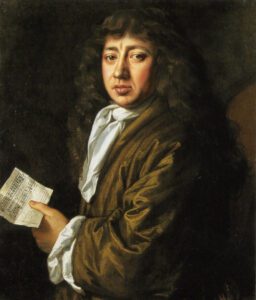
Portrait by John Hayls, 1666
In 1699, he served as ambassador to the court of The Hague. Upon his return to England, Hill assumed the role of Commissioner of the Admiralty (1702-08). Prior to this, he had served as a Lord of the Treasury (1699-1702), a position that would have undoubtedly involved frequent interactions with figures like Samuel Pepys, who held a prominent position within the Admiralty. Hill also served as Counsellor to Prince George of Denmark, the Prince Consort of Queen Anne. William III is famously quoted as declaring that he had “never employed two ministers of greater vigilance, capacity and virtue than yourself, my Lord, and the Reverend Mr Hill” (according to a 1720 dedication to John Robinson, Bishop of London, who had been Lord Privy Seal).
He then looked to serve in the Church, entering holy orders in the Church of England. He refused a bishopric in the hopes of taking that of Ely, and became a fellow of Eton College in 1714.
