

Finding Freedom in Arden: As You Like It as a Symbol of Resistance
As You Like It and Fighting Fascism
In 1948, in Rome, in a Europe newly liberated from fascism, an extraordinary Shakespearean performance took place:
one of the strangest performances of Shakespeare that the present age has seen
– Mario Praz, “Italy: Surrealistic ‘Rosalinda’” Shakespeare Survey 3 (1953) 118
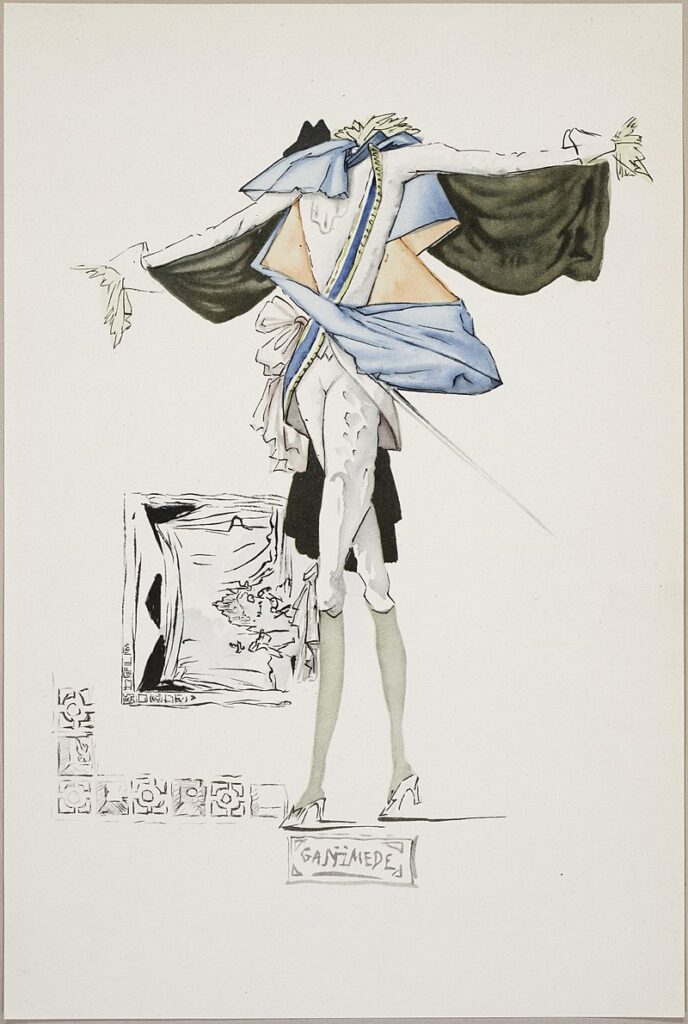
Salvador Dalí costume design for As You Like I – CC BY-SA 2.0
The production, called ‘Rosalinda’, was directed by and directed by Luchino Visconti for Rome’s Teatro Elisa.
The designing of both the sets was done by Salvador Dalí.
Franco Zeffirelli was the art director for the production.
The production was apparently extraordinary:
In Dali’s hands surrealism takes possession of Shakespeare’s pastoral amid a rich riot of colour and wild imagination. In a note addressed to the public the artist declares that As You Like It appeals to him particularly because it is a work “typically anti-existentialist”… Here is the Augustan age, modified by Renaissance pastoralism, interpreted by a modernist, surrealistic painter
– Mario Praz, “Italy: Surrealistic ‘Rosalinda’” Shakespeare Survey 3 (1953) 118.
A colection of these images is shown in the cottate in the As You Like It wood at Soulton.
********
As You Like It and the Fight Against Tyranny
It is worth looking at the context of these works and this production in some detail.
In 1948, Europe was only just liberated from fascism. As You Like It, despite being a play about love set in the Forest of Arden, serves as a powerful allegory for resistance against tyranny. The usurped dukedom, where the good characters are forced to flee or endure the oppressive regime, mirrors the experiences of those who opposed fascist rule.
Orlando’s narrow escape from death, narrowly avoiding being burned alive in his bed thanks to the loyalty of his servant Adam, and his defiance of the usurping Duke symbolize the courage and resilience of those who resisted fascism. The exiled Duke Senior, a good leader, has found refuge in an abandoned cave, joined by other good leaders whose lands have been confiscated. This represents the underground resistance movements that operated in Nazi-occupied Europe.
Rosalind’s banishment for her virtue highlights the persecution of those who dared to challenge the fascist regime. As You Like It offers a message of hope and resilience, reminding us of the importance of standing up for what is right, even in the face of adversity.
Now let us consider the biographies of the company:
- Luchino Visconti, a member of a prominent Milanese noble family, joined the Italian Communist Party during World War II, viewing it as the most effective opposition to Italian Fascism. He despised Mussolini’s tyranny and accused the bourgeoisie of treason. Visconti actively supported the Italian resistance, risking his own life. His villa in Rome became a safe haven for oppositional artists and Allied prisoners of war.
- Zeffirelli, a partisan with the Italian Resistance, later joined British soldiers of the 1st Battalion Scots Guards as an interpreter. Post-war, he shifted his focus from architectural studies to theater, inspired by Laurence Olivier’s performance in Henry V.
- Salvador Dalí, residing in London at the Spanish Civil War’s outbreak, was deeply saddened by his friend Federico García Lorca’s execution by Nationalist forces. During World War II, the Dalís escaped from France to Portugal and then sailed to New York in 1940.
Given their experiences during and after World War II, it’s not surprising that Visconti, Zeffirelli, and Dalí found resonance in As You Like It. The play’s themes of exile, resistance, and the restoration of harmony likely spoke to them deeply.
Their personal journeys mirrored the challenges faced by the characters in the play, making As You Like It a particularly meaningful choice for their production.
Staging As You Like It in Rome in 1948 was a powerful political act. The play’s themes of resistance, exile, and the restoration of harmony resonated with a European audience still recovering from the devastation of World War II and the horrors of fascism. By choosing to stage a Shakespearean play with a surrealist interpretation, Visconti and Dalí aimed to create a thought-provoking and visually stunning production that would capture the public’s imagination and spark important conversations.
The surrealism and attention-seeking nature of the production were integral to its success and its ability to convey a powerful message of hope and resilience.
********
Given the condition of 1948 Spain (Salvador Dalí’s home country), where Franco’s authoritarian regime was still in power, the striking red and yellow backdrop used in the As You Like It production carried a curious visual resonance with the Spanish flag. This could be interpreted as a subtle yet powerful political statement, inviting the audience to see parallels between the oppressive regime of Franco and the usurping Duke Frederick’s court.

Dalvador dali’s back cloth for a 1948 peformance of AS YOU LIKE IT
The company created a production that resonated deeply with audiences on both a personal and political level. The use of the red and yellow backdrop may have served as a subtle reminder of the struggles and sacrifices endured by the Spanish people under Franco’s dictatorship. It could also have offered a message of hope and resilience, echoing the theme of a newly liberated Rome that was still smoldering from its own usurpation.
********
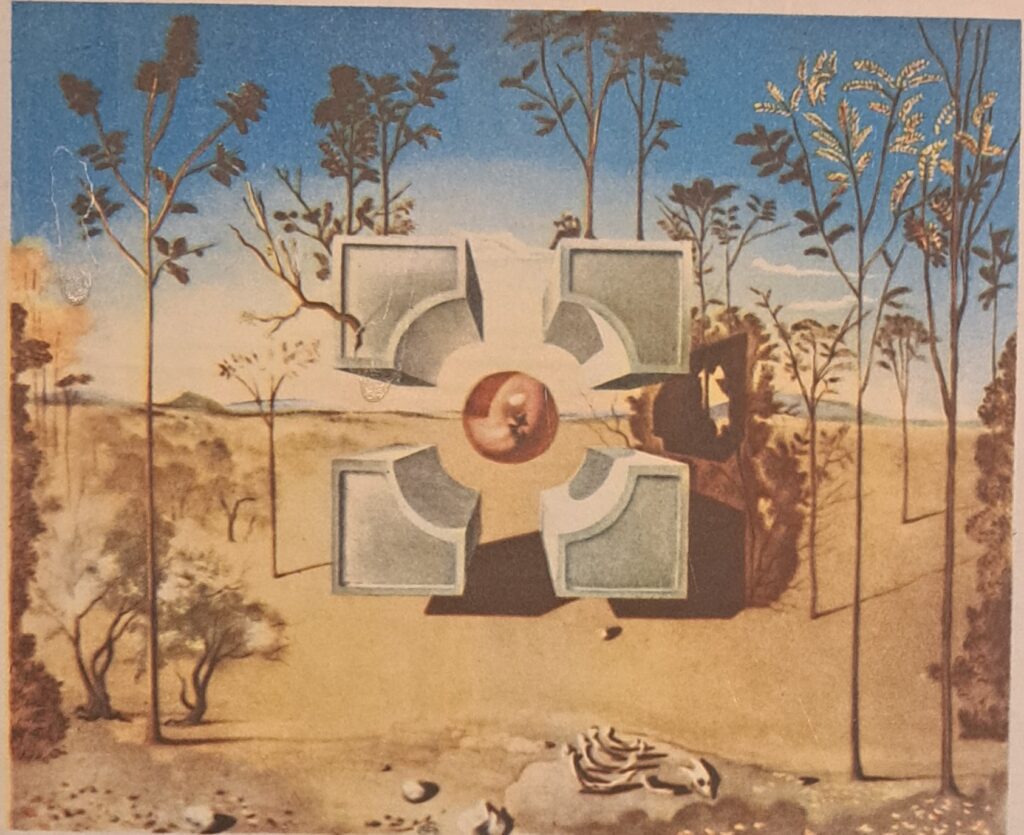
Backcloth, AS YOU LIKE IT, 1948 performance
Another curious aspect of the backcloths lies in the Forest of Arden cloth.
Dalí, like other surrealists, was influenced by the Renaissance masters from a young age. He was also known for his fascination with geometry, in particular the Tesseract (a four-dimensional cube), as seen in his work Crucifixion (Corpus Hypercubus).
In the work for this play, Dalí’s was clearly influenced gardens at Bomarzo, which feature a giant sculpture of one of Hannibal’s war elephants and an octagonal Temple of Eternity.
The prominent pomegranate, forming the center of a quincux with stones in the corners (one casting a damaged shadow), is a remarkable choice.
The association of pomegranates with the Eleusinian Mysteries in Greek mythology is well-established.
Demeter, the goddess of agriculture and the harvest, is inextricably linked to the pomegranate. Her daughter, Persephone, was abducted to the underworld by Hades, the god of the dead, and tricked into eating pomegranate seeds, binding her to the underworld. This act caused Demeter to grieve and neglect her duties, resulting in the barrenness of winter. When Persephone returned, the earth bloomed again, signifying the coming of spring.
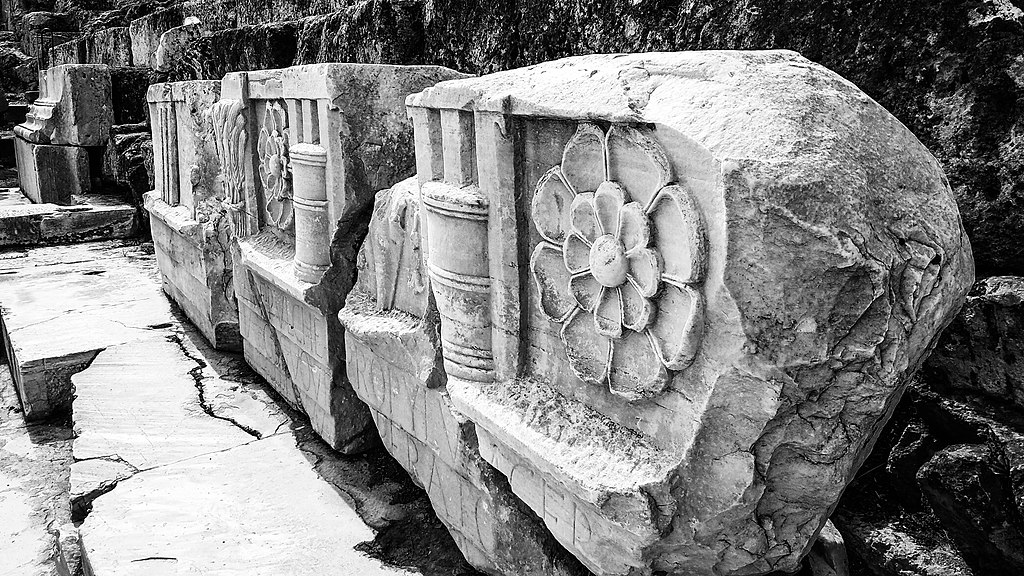
Surviving carvings from the Telesterion at Eleusis
The visualization of the Forest of Arden as a metaphorical Eleusis in the play implies a deliberate connection between the place where harmony is sought in the classical world and the world of the play. This juxtaposition of settings suggests a conscious attempt to evoke the Eleusinian Mysteries and their symbolic significance.
Arden’s Eleusinian Connection is older than As You Like It
The association of As You Like It‘s setting with Eleusis is not new, becuse Soulton is assocaited with Eleusis and in turn with As You Like It.
Even before Thomas Lodge Jr (whoes family, as it goes, owned Soulton prior to the mid 1550s) wrote Rosalynde (1590) for Shakespeare to copy for the play, Old Sir Rowland Hill, the inspiration for the Old Sir Rowland in the play, had Eleusinian carvings placed on his estate at Soulton.

Old Sir Rowland Hill’s Chair of Estate.

The dance and barley chevrons seen on the top of the Sir Rowland Hill chair.

A cannister riser on the Chair of Estate of Sir Rowland Hill
He did the same on his staircase.

Eleusinian Enigma on the Rowland Hill Staircase: Look closely at the eight balusters on this upper gallery. Each features a design reminiscent of Eleusinian canisters, hinting at Sir Rowland Hill’s fascination with the ancient mysteries.
….And.. he also mirrored the Eleusinian telesterion’s footprint when he built Soulton Hall on a 55-yard-by-55-yard precinct.

This image depicts a scholarly reconstruction of Soulton Hall, highlighting its architectural elements inspired by the ancient theater of Epidaurus. The yellow lines trace these features, revealing the Rowland Hill’s homage to the renowned Greek structure.
