


Shakespeare’s As You Like It is a delightful comedy filled with witty banter, romantic entanglements, and a touch of melancholy. However, amidst this festive atmosphere, one character stands out for his incessant whining and world-weary cynicism: Jaques.
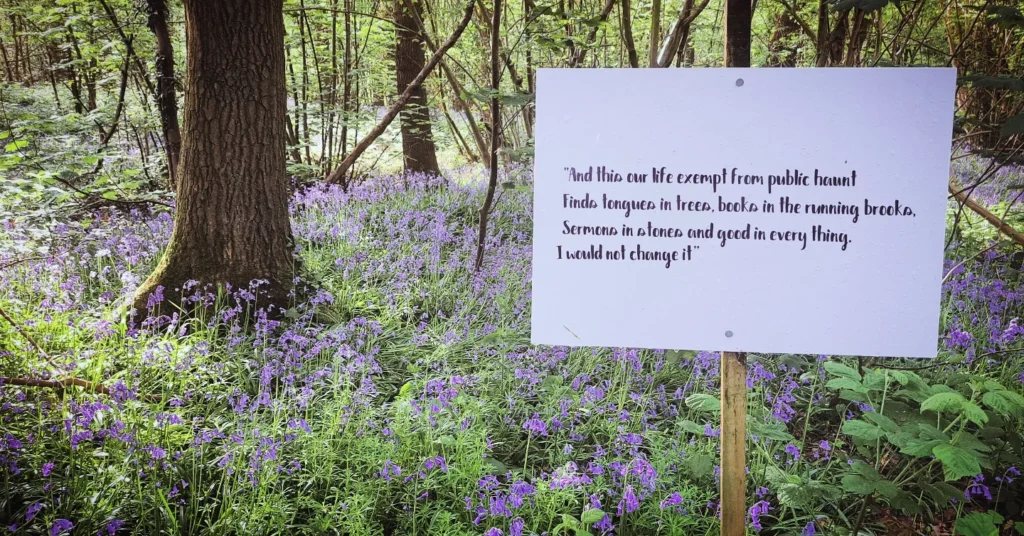
Shakespeare Quote on a sign in the AS YOU LIKE IT wood at Soulton: And this our life exempt from public haunt
Finds tongues in trees, books in the running brooks,
Sermons in stones and good in every thing.
I would not change it.
Jaques, often described as a “melancholy Jaques,” is a character who seems to take pleasure in finding fault with the world around him. His famous “All the world’s a stage” soliloquy, while undeniably poetic, is delivered with a distinct tone of world-weariness. Jaques paints a bleak picture of human existence, reducing life to a series of predictable stages, each more depressing than the last:
Speech: “All the world’s a stage”
By William Shakespeare
(from ‘As You Like It’, spoken by Jaques)All the world’s a stage,
And all the men and women merely players;
They have their exits and their entrances;
And one man in his time plays many parts,
His acts being seven ages. At first the infant,
Mewling and puking in the nurse’s arms;
And then the whining school-boy, with his satchel
And shining morning face, creeping like snail
Unwillingly to school. And then the lover,
Sighing like furnace, with a woeful ballad
Made to his mistress’ eyebrow. Then a soldier,
Full of strange oaths, and bearded like the pard,
Jealous in honour, sudden and quick in quarrel,
Seeking the bubble reputation
Even in the cannon’s mouth. And then the justice,
In fair round belly with good capon lin’d,
With eyes severe and beard of formal cut,
Full of wise saws and modern instances;
And so he plays his part. The sixth age shifts
Into the lean and slipper’d pantaloon,
With spectacles on nose and pouch on side;
His youthful hose, well sav’d, a world too wide
For his shrunk shank; and his big manly voice,
Turning again toward childish treble, pipes
And whistles in his sound. Last scene of all,
That ends this strange eventful history,
Is second childishness and mere oblivion;
Sans teeth, sans eyes, sans taste, sans everything.
While Jaques may be a fascinating character to analyze, his constant complaining can be grating to the modern reader. His pessimistic outlook and lack of empathy make him a difficult character to connect with. It’s as if he’s a perpetual party pooper, always ready to rain on everyone’s parade.

Soulton Wood, inspiration for Thomas Lodge’s Rosalynde and for Shakespeare’s AS YOU LIKE IT
Perhaps Shakespeare intended Jaques to serve as a foil to the more optimistic characters in the play. By highlighting the darker side of human nature, Jaques adds depth and complexity to As You Like It. However, it’s hard to shake the feeling that Jaques is simply a bit of a downer.
So, the next time you encounter Jaques and his “All the world’s a stage” speech, remember that while it’s a powerful piece of literature, it’s also a reminder that not everyone can appreciate the beauty of life and love:
JAQUES
By my troth, I was seeking for a fool when I found
you.
ORLANDO
He is drowned in the brook: look but in, and you
shall see him.
JAQUES
There I shall see mine own figure.
ORLANDO
Which I take to be either a fool or a cipher.
JAQUES
I’ll tarry no longer with you: farewell, good
Signior Love.
ORLANDO
I am glad of your departure: adieu, good Monsieur
Melancholy.
Some people, like Jaques, prefer to focus on the negative.
He is a warning, really. And it is telling he runs away from harmony when it is found at the ned of the play.
